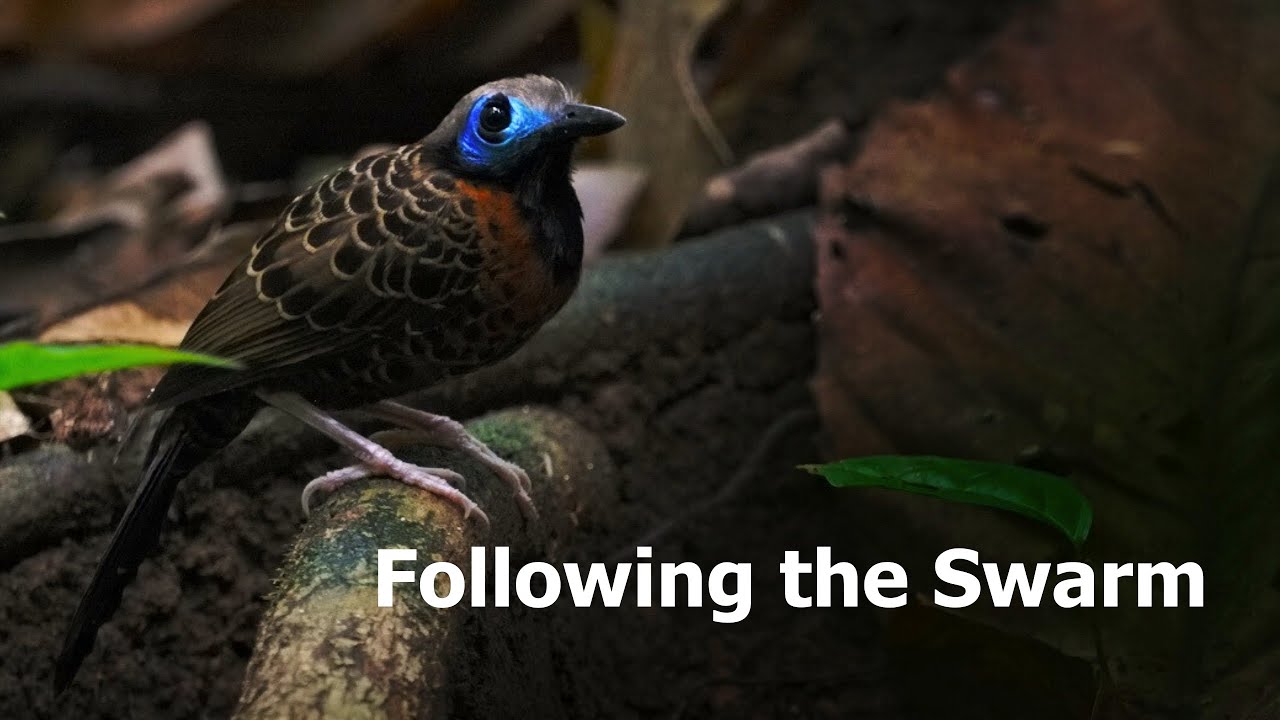
Following the Swarm
Keywords
Summary
212 words
Critical Evaluation
Value of the Information & Strength of the Argument
The video provides valuable qualitative insights into a specialized ecological interaction: the army ant-following bird community in Neotropical forests. It effectively conveys the complexity of resource partitioning among birds at swarms, supported by direct field observations and researcher commentary. The argument that army ants act as keystone species is well-illustrated through the sheer number of dependent species and the cascading effects if ants disappear. The researchers’ explanations of their methods (point counts, behavioral observations) add credibility and show how data are collected. However, the video does not present quantitative results or statistical analyses, so the strength of the evidence remains largely descriptive. The argument for conservation is implicit: by understanding these interactions, we can better protect biodiversity. The narrative is coherent and builds a case for the importance of ants in maintaining tropical forest diversity, but it relies on expert testimony rather than experimental manipulation or long-term data trends.
Scientific Rigor, Source Quality, Title Accuracy
The video is produced by the Smithsonian Tropical Research Institute, a reputable scientific organization, and features researchers from the University of Wyoming. The project is funded by the National Science Foundation, which adds to its credibility. The methods described are standard and appropriate for the research questions. However, the video does not cite specific peer-reviewed papers or provide on-screen references, so viewers cannot easily verify the claims. The title ‘Following the Swarm’ is perfectly aligned with the content, as the entire video revolves around following army ant swarms to study bird behavior. No comments were provided for analysis.
262 words
Title / Content Match
The title 'Following the Swarm' accurately reflects the content, which focuses on researchers following army ant swarms to study ant-following birds. It is concise and fitting.
Quality & Reliability
8/10
The content is produced by a recognized scientific institution (Smithsonian Tropical Research Institute) and features researchers from the University of Wyoming, with funding from the National Science Foundation. The methods described (point counts, behavioral observations) are standard field ornithology techniques. The claims about ant-following bird diversity (over 450 species, 12% of Neotropical birds) are consistent with published literature. However, the video is a documentary short and does not provide detailed data, citations, or peer-reviewed references on screen, which limits the depth of verifiability.
Key Moments
Markers derived by PSI from the transcript: the creator did not define chapters.
- Introduction to the tropical moist forest and the army ant swarm.
- Description of the swarm's behavior and the carpet of ants.
- First mention of ant-following birds and their reliance on swarms.
- Explanation of keystone species concept and the 12% of Neotropical bird species foraging at swarms.
- Researcher describes studying species roles and resource partitioning at swarms.
- Field methods: point counts and behavioral observations.
- Observation of dominance interactions, e.g., ocellated antbird displacing bicolored antbird.
- Challenges and rewards of fieldwork in the tropics.
- Educational opportunities for technicians and undergraduates.
- Conclusion on interconnectedness and conservation implications.
Cited Sources
- Tarwater Lab — Lab website for Dr. Corey Tarwater, co-leader of the Army-ant-followers Project.
- Kelley Lab — Lab website for Dr. Patrick Kelley, co-leader of the Army-ant-followers Project.
- Army-ant-followers Project — Project page detailing the research on army ant-following birds in Panama.
Concurring Sources
- Army ant — General information on army ants and their ecological role, consistent with the video's description.
- Ant-following — Describes the behavior of birds following army ants, matching the video's focus.
- Keystone species — Explains the concept of keystone species, which the video applies to army ants.
Contribution & Novelties
The video offers a behind-the-scenes look at ongoing research on army ant-following birds in Panama, highlighting the complexity of species interactions at swarms. It brings together field observations and researcher perspectives to illustrate the ecological importance of army ants as keystone species. While the core concepts are well-established in ecology, the video’s value lies in its accessible presentation of current research and its emphasis on the interconnectedness of tropical ecosystems.
Pour aller plus loin :
- Army ant — Wikipedia article on army ants, their behavior, and ecological impact.
- Ant-following — Wikipedia article on ant-following behavior in birds.
- Keystone species — Wikipedia article explaining the concept of keystone species.
- Eciton burchellii — The species of army ant central to this study; see Eciton burchellii for details.
125 words
Radar Profile
The radar profile shows a strong emphasis on reliability and quality of information, reflecting the credible institutional backing and expert involvement. The quantity of information and technical level are moderate, as the video is a short documentary aimed at a general audience rather than a detailed scientific report. Overall, the profile indicates a trustworthy and informative piece with a balanced depth.