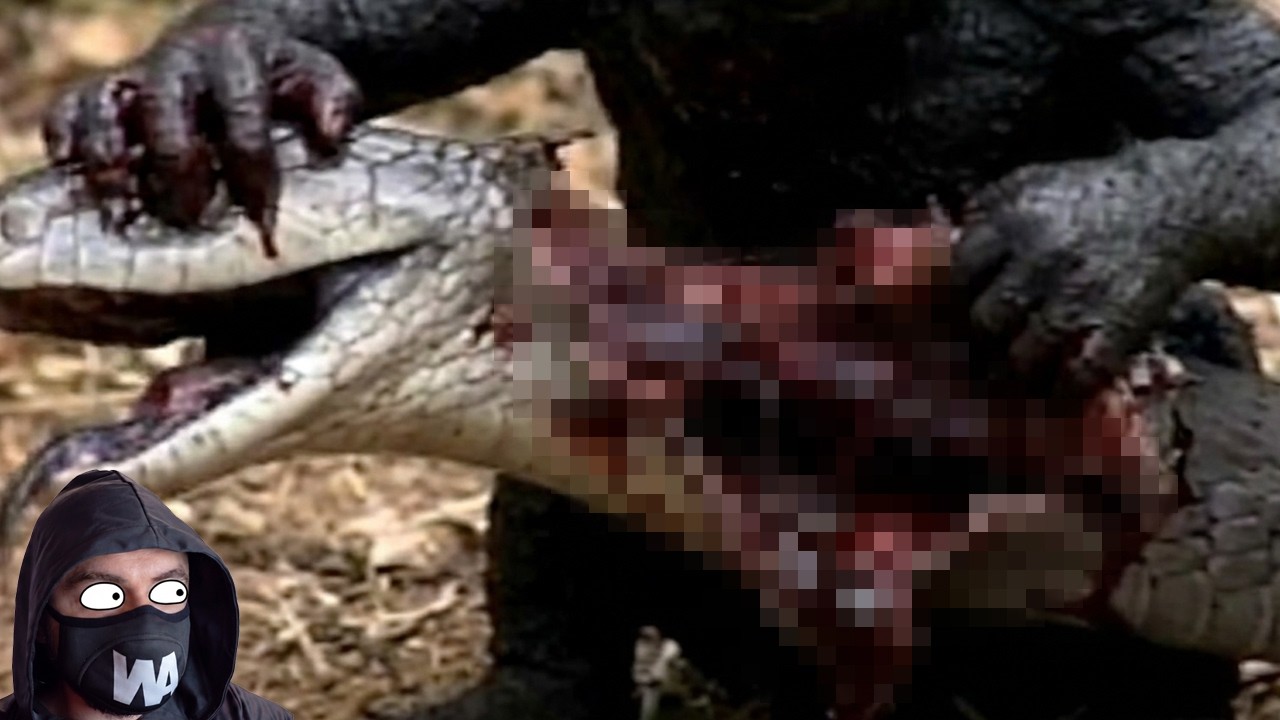
It's Starting to Kill Black Mambas and Ignore Their Venom
Title history
- It's Starting to Kill Black Mambas and Ignore Their Venom — observed on 20261101-0101 UTC (YouTube)
Keywords
Summary
143 words
Critical Evaluation
Value of the Information & Strength of the Argument
The video offers valuable information about snake eagle predation and venom safety, presenting a clear logical chain from mystery to solution. The argumentation is solid: each potential predator is considered and dismissed based on evidence, and the final conclusion is well-supported by the described behaviors and anatomical adaptations. The historical example of Martinique adds depth, illustrating the difference between individual predation and population control. The narration is engaging and accessible, making complex biological concepts understandable without oversimplification.
Scientific Rigor, Source Quality, Title Accuracy
The scientific rigor is moderate: the video relies on established facts but does not cite specific studies or provide verifiable sources. It mentions a Texas incident and medical reports without names, which reduces traceability. The title accurately captures the main theme but overstates the idea of ‘ignoring’ venom, as the eagle’s adaptations are clearly explained. Public comments are generally positive, with viewers praising the informative content and humorous delivery. Many appreciate the investigative approach and the surprise reveal. Concerns about the thumbnail were mentioned but did not dominate the overall sentiment.
183 words
Title / Content Match
The title accurately reflects the video's core content: a predator that kills black mambas and appears to 'ignore' their venom due to specialized adaptations. The wording is slightly sensational but not misleading.
Quality & Reliability
7/10
The video presents a compelling and plausible narrative based on known facts about brown snake eagle hunting behavior and venom neutralization. It references specific incidents (Texas 2018, Martinique) but lacks direct citations or peer-reviewed sources, limiting its scientific rigor. The reasoning is logical and consistent with biological knowledge.
Key Moments
Markers derived by PSI from the transcript: the creator did not define chapters.
- Introduction to the mystery of decapitated black mambas in Zimbabwe.
- Evaluation of potential predators: wild dogs, mongooses, and honey badgers.
- Discovery that the predator is likely a bird, based on remains found in nests.
- Reveal of the brown snake eagle and its hunting technique.
- Explanation of why head removal is necessary, including dead snake bite cases.
- Historical Martinique secretary bird experiment and conclusion about population control.
Cited Sources
- Texas rattlesnake decapitation incident (2018) — Referenced as an example of a severed snake head biting a person.
- Martinique lancehead introduction attempt — Historical attempt to introduce secretary birds to control snakes.
Contribution & Novelties
The video provides a clear, engaging synthesis of known scientific facts about brown snake eagle hunting behavior, particularly its adaptation to venomous snakes. It does not present new research but rather an accessible explanation of why these birds decapitate snakes, linking behavior to venom safety. The historical comparison with Martinique adds a novel perspective on the limits of biological control.
Pour aller plus loin :
- Brown snake eagle — Detailed species information and hunting behavior.
- Black mamba — Overview of the species, distribution, and venom.
- Snake venom — Composition and effects, supporting the video’s explanation of venom breakdown in the gut.
101 words
Radar Profile
The radar profile shows a well-rounded video: high quantity of information, good quality, and moderate technical depth, making it suitable for a general audience while still offering detailed insights. Reliability is moderate, reflecting the lack of direct citations.
💬 positive