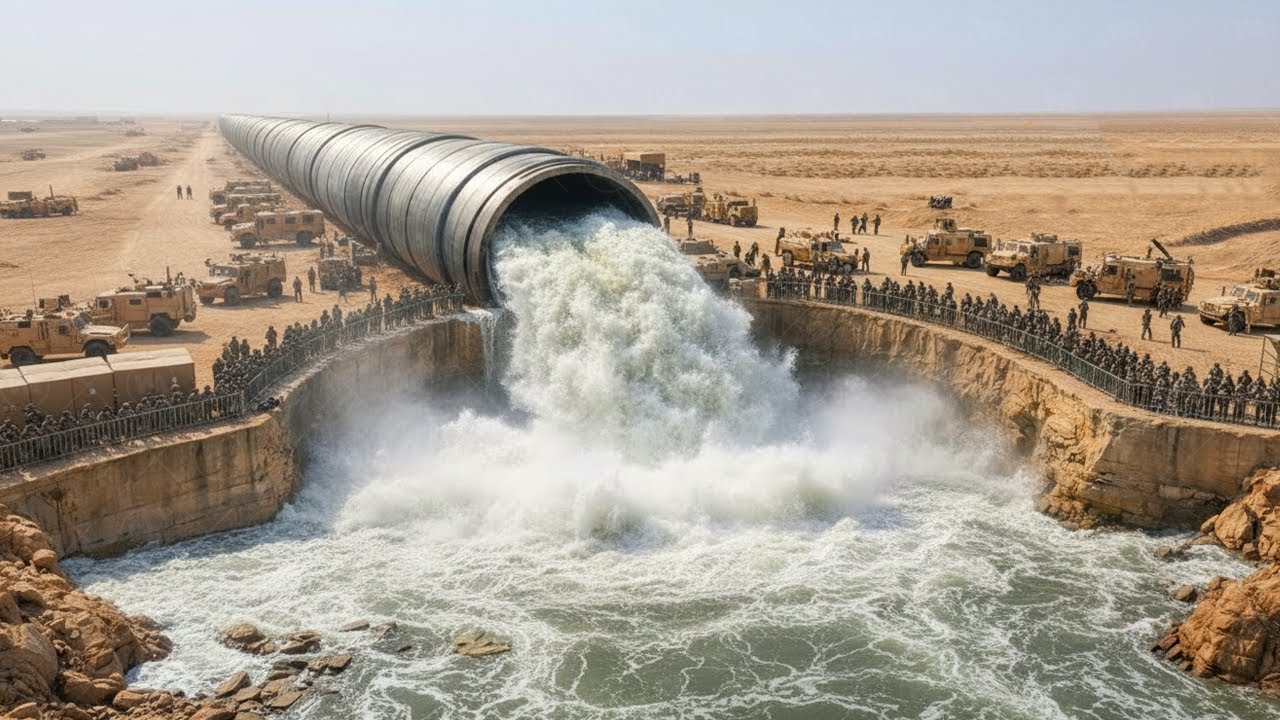
How the U.S. Pumps Billion Tons of Seawater From Mexico Through Giant Pipelines Into Dry Arizona
Title history
- How the U.S. Pumps Billion Tons of Seawater From Mexico Through Giant Pipelines Into Dry Arizona — observed on 20261101-0149 UTC (YouTube)
Keywords
Summary
155 words
Critical Evaluation
Value of the Information & Strength of the Argument
The video presents a balanced view of the proposed desalination project, acknowledging both its potential benefits and its serious drawbacks. It uses concrete data (volumes, costs, distances) and names of companies and officials to support the narrative. The argumentation is structured logically, moving from problem to solution to complications. However, it relies heavily on dramatization and may oversimplify complex geopolitical and contractual nuances. The value lies in raising awareness about Arizona’s water crisis and the trade-offs of large-scale engineering solutions, but it does not offer original research or unique insights beyond what is publicly available.
Scientific Rigor, Source Quality, Title Accuracy
The video does not cite specific sources directly, but it references known entities like IDE Technologies, the Central Arizona Project, and the vaquita. Its reliability is moderate: it incorporates factual figures and quotes, but viewers flagged errors such as footage from California being labeled as Arizona. The title is engaging but slightly sensational, and the content adequately matches the title. Overall, the video is informative but not peer-reviewed, and some claims lack verification.
183 words
Title / Content Match
The title accurately reflects the video's focus on the proposed pipeline and desalination project, though it slightly exaggerates the current reality (the project is still under consideration).
Quality & Reliability
7/10
The video provides a detailed overview of a proposed desalination project, citing specific figures, company names, and environmental concerns. However, some inaccuracies were noted by viewers, such as mislabeled satellite imagery, and the video lacks direct citations to primary sources.
Key Moments
Markers derived by PSI from the transcript: the creator did not define chapters.
- Introduction to Arizona's water crisis and the proposal to import seawater from Mexico.
- Explanation of Arizona's two main water sources (groundwater and Colorado River) and their depletion.
- Details of the desalination plant plan, including IDE Technologies and projected water volumes.
- Discussion of the pipeline route and the need to integrate with the Central Arizona Project.
- Environmental concerns, particularly the impact on the vaquita porpoise in the Gulf of California.
- Indigenous Tohono O'odham concerns and the impact on protected desert lands and saguaro cacti.
- Financial challenges: the cost is nearly 10 times current water prices, with potential 100-year contracts.
- Alternatives: agricultural efficiency, rainwater harvesting, and reducing outdoor water use.
- Political and regulatory hurdles, including Mexican approval and current status as of November 2025.
- Conclusion: Arizona is likely to pursue mega-projects despite challenges, following its history of ambitious infrastructure.
Cited Sources
- IDE Technologies - Wikipedia — Mentioned as the Israeli company that would build and operate the desalination plant.
- Central Arizona Project - Wikipedia — The existing canal system into which the desalinated water would be integrated.
- Vaquita - Wikipedia — The endangered porpoise species that could be threatened by increased brine discharge.
- Puerto Peñasco - Wikipedia — The Mexican city where the plant is proposed to be built.
Contribution & Novelties
The video synthesizes publicly available information about a specific proposed desalination project, bringing together technical, environmental, and political aspects into a cohesive narrative. It adds value by highlighting the paradox of exporting water from a water-scarce Mexican city and the unresolved contractual risks. The content is not groundbreaking but serves as an accessible comprehensive overview.
Pour aller plus loin :
- Desalination - Wikipedia — Learn about the general technology and its global applications.
- Water scarcity in the United States - Wikipedia — Broader context of water shortages in the American West.
- Tohono O’odham - Wikipedia — Explore the history and culture of the indigenous community affected by the proposed pipeline.
110 words
Radar Profile
The radar profile shows high scores in information quantity and moderate scores in quality and technical depth, with reliability slightly lower. This indicates a video that provides ample data and context but may not be fully precise or technically rigorous, aligning with the viewer-reported inaccuracies and lack of primary source citations.
💬 Négative. Sur les 30 commentaires analysés, la plupart expriment des doutes sur le projet de dessalement, soulignant des préoccupations environnementales, des erreurs dans la vidéo (images satellite de la Californie) et l'absence de restrictions sur les usages de l'eau.