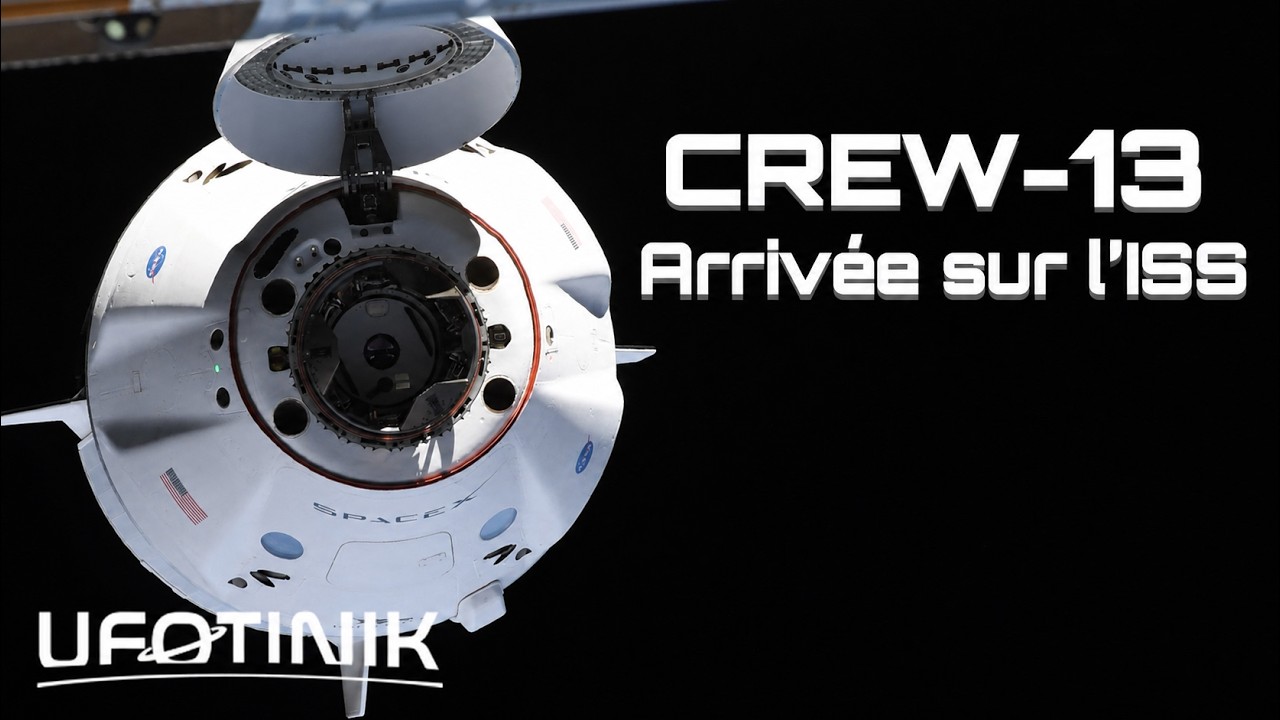
🔴 EN DIRECT SPACEX CREW-13 ARRIVE SUR LA STATION SPATIALE INTERNATIONALE (VOL HABITÉ - Amarrage) FR
🔴 LIVE SPACEX CREW-13 ARRIVES AT THE INTERNATIONAL SPACE STATION (CREWED FLIGHT - Docking)
Keywords
Summary
168 words
Critical Evaluation
Value of the Information & Strength of the Argument
The video’s value lies in its real-time, detailed explanation of a complex space operation, making technical concepts accessible to a broad audience. The host demonstrates solid knowledge of orbital mechanics, spacecraft systems, and safety protocols, and supports his points with concrete examples and numbers (e.g., speeds, distances, zone radii). The argumentation is logical and well-structured, walking viewers through each phase of the approach and explaining the rationale behind different rules. The inclusion of crew backgrounds and experiment specifics adds depth and credibility to the presentation.
Scientific Rigor, Source Quality, Title Accuracy
The host frequently references NASA and SpaceX as the primary sources of information, and the live feed comes from NASA TV. However, he does not cite specific reports or official documents, relying instead on his own expertise and publicly known mission details. The title matches the content accurately, as the video is indeed a live broadcast of the docking event. While the presentation is rigorous in its technical accuracy, it lacks formal citations, which slightly reduces its scholarly reliability. Nevertheless, the information appears consistent with publicly available facts about SpaceX missions.
191 words
Title / Content Match
The title accurately reflects the content, which focuses on the arrival and docking of SpaceX Crew-13 at the ISS. The live coverage matches the title's promise.
Quality & Reliability
7/10
The video provides detailed and technically accurate information about the Crew-13 mission, docking procedures, and safety zones. The host appears well-informed and uses proper terminology. No obvious factual errors were detected, though some speculative statements about future missions are present.
Key Moments
Markers derived by PSI from the transcript: the creator did not define chapters.
- Introduction of the mission and announcement of the arrival of Crew-13 at the ISS.
- Detailed biographies of the four crew members, including their backgrounds and prior space experience.
- Discussion of the Crew Dragon capsule Grace, its prior flight history, and the launch delay due to a fuel valve issue.
- Overview of scientific experiments being conducted on the ISS, including research on cardiovascular diseases, Parkinson's disease, and plant growth.
- Explanation of orbital mechanics, approach phases, waypoints, and safety zones (approach ellipsoid and keep-out sphere).
- Final approach procedures, including the role of the automated system, potential abort scenarios, and the expected timeline for docking.
Cited Sources
- Sponsor link (exclusive advantages) — Link to become a sponsor of the channel, mentioned during the live.
- Launch calendar from UFOTINIK — Upcoming space launch schedule mentioned in the video description.
- Mission patches store — Link to purchase mission patches, referenced as a way to support the channel.
Contribution & Novelties
The original contribution of this video is its live, detailed, and accessible breakdown of a real-time space docking event, providing insights that are typically not covered in mainstream media. It bridges the gap between official NASA broadcasts and the general public by adding context about crew, spacecraft, and safety protocols. The host’s experience in space reporting adds credibility and pedagogical value.
Pour aller plus loin :
- NASA Official Website — Official NASA source for space missions, providing verified information on ISS operations and crewed flights.
- SpaceX Crew Dragon Wikipedia — Comprehensive overview of the Crew Dragon spacecraft, including technical details and mission history.
- International Space Station Wikipedia — Detailed information about the ISS, its orbit, and its research facilities.
119 words
Radar Profile
The radar chart shows a high score in information quantity and technical level, with moderate scores in quality and reliability. The content is rich in details and technical accuracy, but the reliance on live commentary without explicit external citations reduces the overall reliability score. The balance suggests a well-informed presentation that could benefit from more formal referencing.