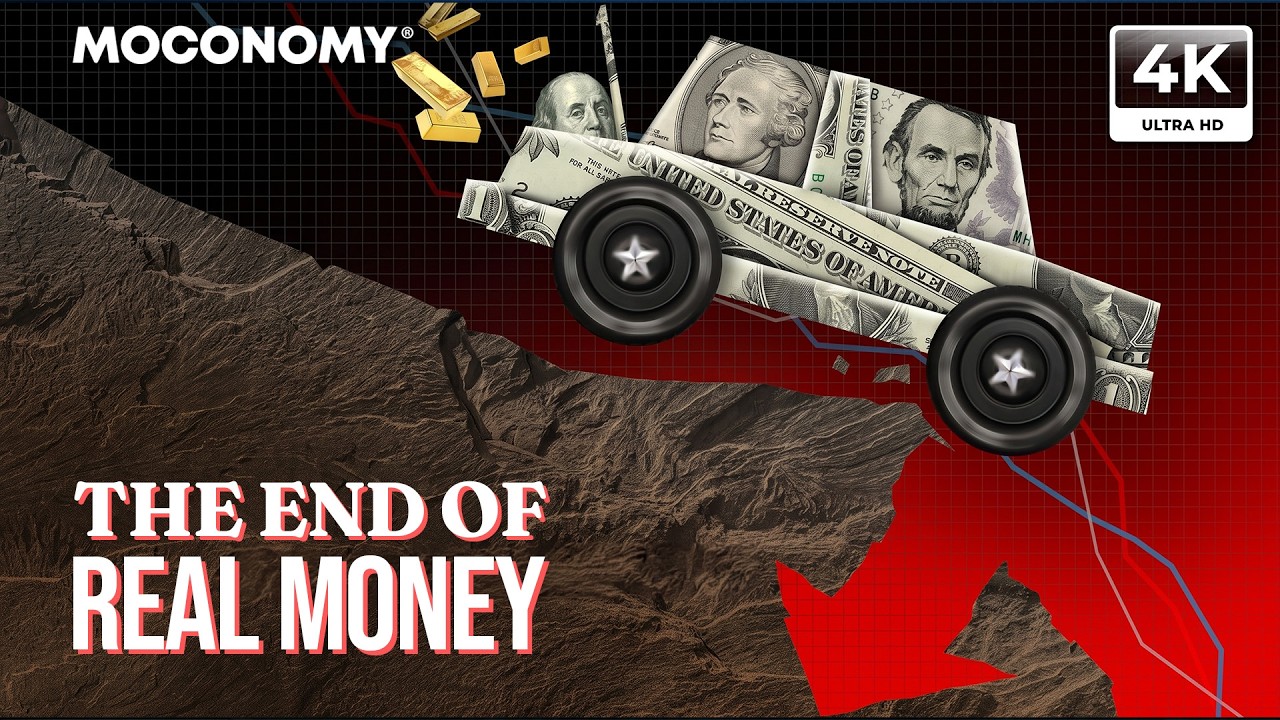
End of the Road | How Money Became Worthless | What Comes Next? | 4K
Keywords
Summary
118 words
Critical Evaluation
Value of the Information & Strength of the Argument
The documentary provides a coherent narrative that connects historical events to current economic issues, which can be engaging for a general audience. However, its argumentation is largely based on assertions from a select group of gold-standard advocates, lacking rigorous evidence or acknowledgment of mainstream economic research. The ‘Ponzi scheme’ analogy is presented as fact without exploring contrary views, and the proposed solution (gold) is promoted with obvious conflict of interest, as some interviewees are gold dealers. The value lies in raising questions about monetary policy, but its one-sided approach undermines its persuasiveness.
Scientific Rigor, Source Quality, Title Accuracy
The documentary cites no specific academic sources or data; it relies on anecdotes and expert opinions from individuals with known biases. Historical facts like the 1971 Nixon shock are accurate, but interpretations are selective. The title is attention-grabbing and matches the content’s apocalyptic tone, though the ‘4K’ suffix is irrelevant. No sources are listed in the description beyond promotional links, and the film’s copyright statement suggests legal licensing, not scholarly accuracy. The adéquation between title and content is strong, but the rigor is insufficient due to the lack of balanced sourcing.
198 words
Title / Content Match
The title accurately reflects the content: a documentary on why money becomes worthless and the impending financial collapse. It is somewhat sensational but matches the thesis.
Quality & Reliability
5/10
The video presents a one-sided critique of fiat money, blending historical facts with strong opinions. It relies on interviews with known gold proponents and lacks balance. While some historical events are accurate, the central 'Ponzi scheme' analogy is oversimplified and contested by mainstream economists.
Key Moments
Markers derived by PSI from the transcript: the creator did not define chapters.
- Nixon's speech announcing the suspension of gold convertibility
- Explanation of the Bretton Woods system and its reliance on gold
- Definition of a Ponzi scheme and comparison to the Federal Reserve system
- Discussion on inflation statistics manipulation and its impact on purchasing power
- Warning that the global economy has maxed out on debt and faces unavoidable collapse
Dissenting Sources
- Fiat money — Mainstream economic theory generally supports fiat money as a stable medium when managed by central banks, contrasting with the film's claim that it is inherently destined for collapse.
- Criticism of the Federal Reserve — While critical, this article provides a balanced view of the Fed's role and includes counterarguments to the 'Ponzi scheme' characterization.
Contribution & Novelties
The documentary offers a compelling, accessible narrative that synthesizes historical monetary events with a critical perspective often absent from mainstream media. It popularizes the idea that fiat money inherently leads to financial instability, but its novelty is limited as these arguments have been made by goldbugs for decades. The film’s strength lies in its storytelling, not in new research.
Pour aller plus loin :
- Gold standard — Provides historical context and economic implications.
- Nixon shock — Details the 1971 events and their consequences.
- Fiat money — Explains the concept and its modern critiques.
- Modern Monetary Theory — Offers a contrasting view on government debt and money creation.
107 words
Radar Profile
The profile shows moderate information quantity but low reliability and technical level, indicating a broad but superficial and biased treatment. The low global reliability score drags down the overall credibility, making it suitable only for introductory and opinionated angles.