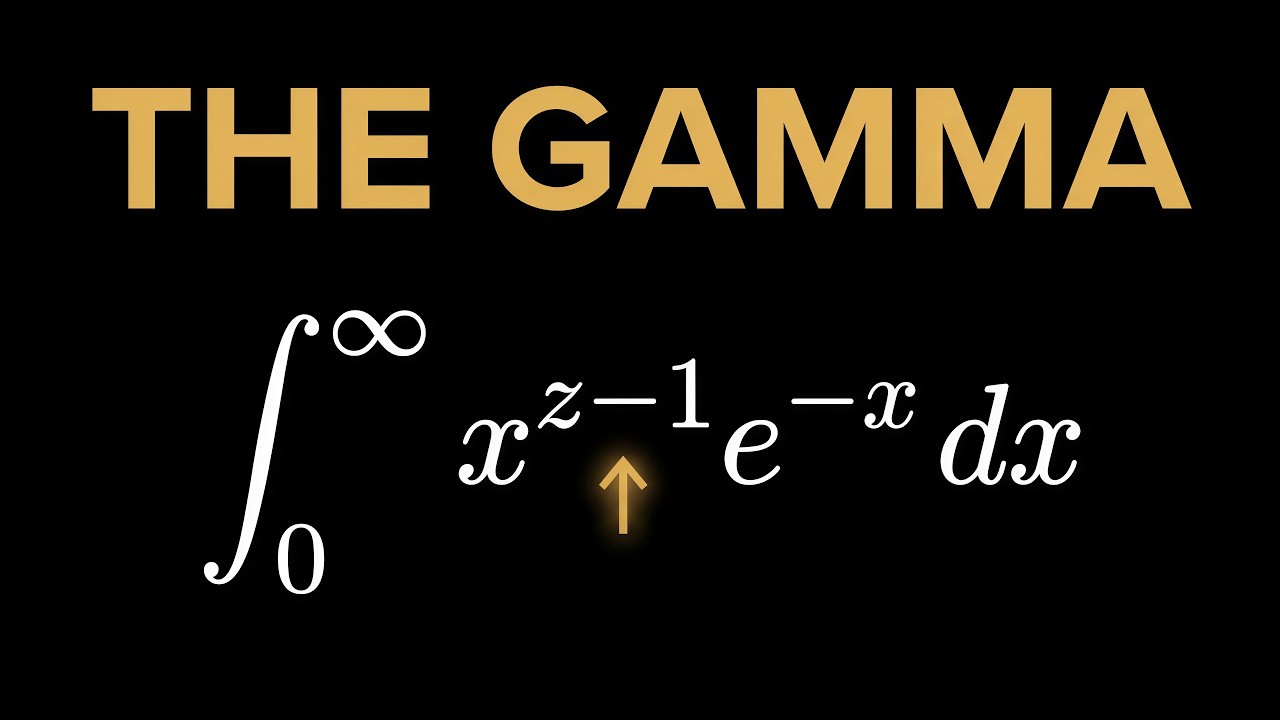
We Have To Talk About the Gamma Function
Keywords
Summary
195 words
Critical Evaluation
Value of the Information & Strength of the Argument
The video provides substantial value by addressing a common gap in explanations of the Gamma function: why Euler’s integral is the ‘correct’ extension. It clearly explains the existence of infinitely many rival curves and introduces the Bohr-Mollerup theorem as the resolution. The argumentation is solid, building from the recurrence relation, deriving the integral representation, and then using the theorem to establish uniqueness. The logical flow is strong, and the use of visualizations aids understanding. The video also connects the Gamma function to other areas of mathematics, such as the zeta function and sphere volumes, demonstrating its broader significance.
Scientific Rigor, Source Quality, Title Accuracy
The video demonstrates high scientific rigor. It references authoritative sources, including the NIST Digital Library of Mathematical Functions and Euler’s original work, and it correctly states the Bohr-Mollerup theorem. The mathematical derivations are accurate and clearly presented. The title accurately reflects the content, which is a thorough discussion of the Gamma function. The video does not overstate claims and appropriately notes the historical context (Euler’s work vs. the later theorem).
183 words
Title / Content Match
The title accurately reflects the content, which discusses the Gamma function, its uniqueness, and its implications.
Quality & Reliability
9/10
The video provides a rigorous mathematical explanation of the Gamma function, including the derivation of its recurrence relation, the evaluation of Gamma(1/2) via the Gaussian integral, and the statement of the Bohr-Mollerup theorem. It cites authoritative sources (NIST DLMF, Euler's original work) and demonstrates a clear understanding of the subject. The content is accurate and well-structured, with no apparent errors or misleading claims.
Chapters
Cited Sources
- Euler's original work on the Gamma function (English translation) — Referenced as the original work by Euler (1729/1738) defining the Gamma function.
- NIST DLMF: Euler's integral and analytic continuation of Gamma — Official reference for the integral definition and analytic continuation of the Gamma function.
- NIST DLMF: Factorial relation and special values of Gamma — Official reference for the factorial relation and special values, including Gamma(1/2).
- NIST DLMF: Functional relations and the Bohr-Mollerup theorem — Official reference for the Bohr-Mollerup theorem and functional relations.
- NIST DLMF: Integral representations connecting Gamma and the Riemann zeta function — Official reference for the connection between Gamma and the Riemann zeta function.
Concurring Sources
- NIST DLMF: Euler's integral and analytic continuation of Gamma — Supports the integral definition and analytic continuation of the Gamma function.
- NIST DLMF: Factorial relation and special values of Gamma — Supports the factorial relation and the value Gamma(1/2) = sqrt(pi).
- NIST DLMF: Functional relations and the Bohr-Mollerup theorem — Supports the statement of the Bohr-Mollerup theorem.
External References
Contribution & Novelties
The video’s original contribution lies in its explicit treatment of the uniqueness problem for the Gamma function. It clearly demonstrates that the recurrence relation alone does not uniquely define an extension of the factorial, and it introduces the Bohr-Mollerup theorem as the essential missing condition. This goes beyond typical popular explanations that simply present Euler’s integral without justifying its uniqueness. The video also effectively explains the appearance of pi in the half-factorial by tracing it through the Gaussian integral, and it highlights the broader significance of Gamma in other areas of mathematics.
Pour aller plus loin :
- Bohr-Mollerup theorem — Provides a detailed statement and proof of the theorem, which is central to the video’s argument.
- Gamma function — Offers a comprehensive overview of the Gamma function, including its properties, history, and applications.
- Gaussian integral — Explains the integral used to evaluate Gamma(1/2) and its connection to pi.
- Riemann zeta function — Discusses the zeta function and its analytic continuation, which relies on the Gamma function.
166 words
Radar Profile
The radar profile shows high scores across all dimensions, with particularly strong performance in information quality and reliability. The video is technically solid, well-sourced, and provides a substantial amount of information, making it an excellent educational resource.