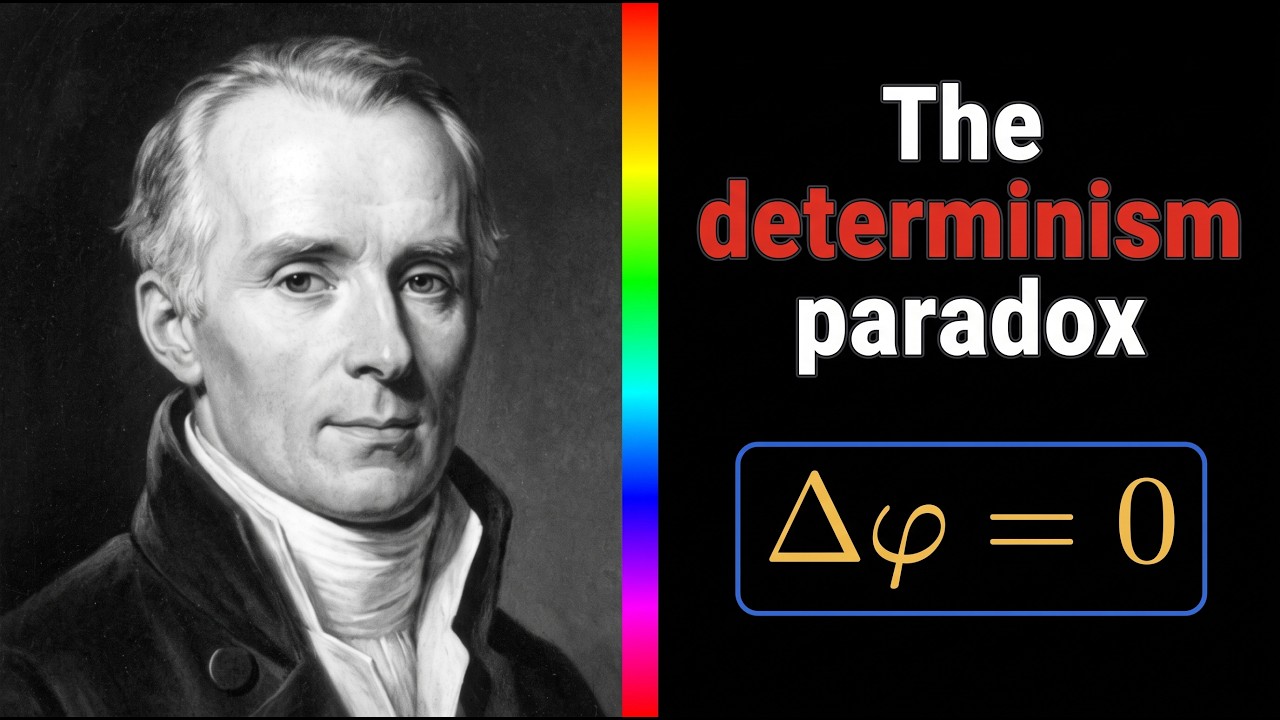
You Will Never Look At Laplace The Same Way Again
Keywords
Summary
99 words
Critical Evaluation
Value of the Information & Strength of the Argument
The value of this video lies in its pedagogical approach: it transforms a mechanical symbol (the Laplacian) into an intuitive geometric concept (deviation from local average) while embedding it in a compelling historical narrative. The argumentation is solid and self-contained, starting from Taylor’s expansion and culminating in the mean-value property and the maximum principle. The logical chain is unbroken, and each step is motivated with clear examples and verification. The video also critically addresses the limitations of Laplace’s claims, acknowledging the chaotic nature of the three-body problem, which strengthens the overall argumentative integrity.
Scientific Rigor, Source Quality, Title Accuracy
The video demonstrates high scientific rigor by tracing the historical development of the Laplacian from Laplace’s 1785 memoir to Poisson and Earnshaw, and by citing reputable sources such as the Encyclopedia of Mathematics, NASA/JPL data, and Scott Tremaine’s work on solar system stability. The derivations are mathematically correct, and the transcript, despite minor transcription errors in names, presents accurate physics and mathematics. The title accurately reflects the video’s aim to provide a fresh understanding of Laplace’s equation; it is not hyperbolic and aligns well with the content. The sources listed in the description are credible and directly support the claims made, including original works by Laplace and modern references on chaos.
219 words
Title / Content Match
The title promises a new perspective on Laplace's equation, and the video delivers by explaining the Laplacian as a measure of deviation from the local average, connecting it to celestial mechanics and harmonic functions.
Quality & Reliability
9/10
The video presents accurate mathematical derivations and historical context, with references to original works and reliable sources. The explanation is rigorous and well-structured, with only minor transcription errors in the transcript.
Chapters
Cited Sources
- Free ebook: See The Math — Promotional offer for a free ebook related to the video's topic.
- Encyclopedia of Mathematics: Harmonic function — Reference for the definition and properties of harmonic functions, central to the video.
- Laplace, Théorie des attractions des sphéroïdes et de la figure des planètes (1785) — Original work by Laplace where the Laplacian is used.
- Dictionary of Scientific Biography: Laplace (PDF) — Biographical source on Laplace.
- Laplace, A Philosophical Essay on Probabilities (translation) — Source for Laplace's philosophical essay.
- NASA/JPL, Planetary Physical Parameters — Data on planetary parameters.
- Scott Tremaine, Is the Solar System Stable? — Reference on solar system stability and chaos.
Contribution & Novelties
The original contribution of this video is its didactic synthesis of the Laplacian as a measure of deviation from the local average, accompanied by a rigorous derivation that connects the mathematical formalism to physical intuition. It bridges historical context with modern chaos theory, offering a fresh perspective on a classical topic. The animation and step-by-step explanations enhance accessibility without compromising depth.
Pour aller plus loin :
- Laplace’s equation on Wikipedia — Provides a comprehensive overview and additional contexts.
- Mean-value property for harmonic functions — Directly relevant to the core derivation in the video.
- Maximum principle — Essential for understanding why empty space cannot contain a local extremum.
- Earnshaw’s theorem — Explains the impossibility of stable static configurations, linked to the video’s discussion.
- Three-body problem — Contextualizes the historical background and the limits of prediction.
134 words
Radar Profile
The radar profile shows uniformly high scores across all dimensions, with particular strength in information quantity and technical depth. Reliability is slightly lower, consistent with minor transcription errors and the absence of external verification in the transcript, but overall the video stands as a highly reliable educational resource.