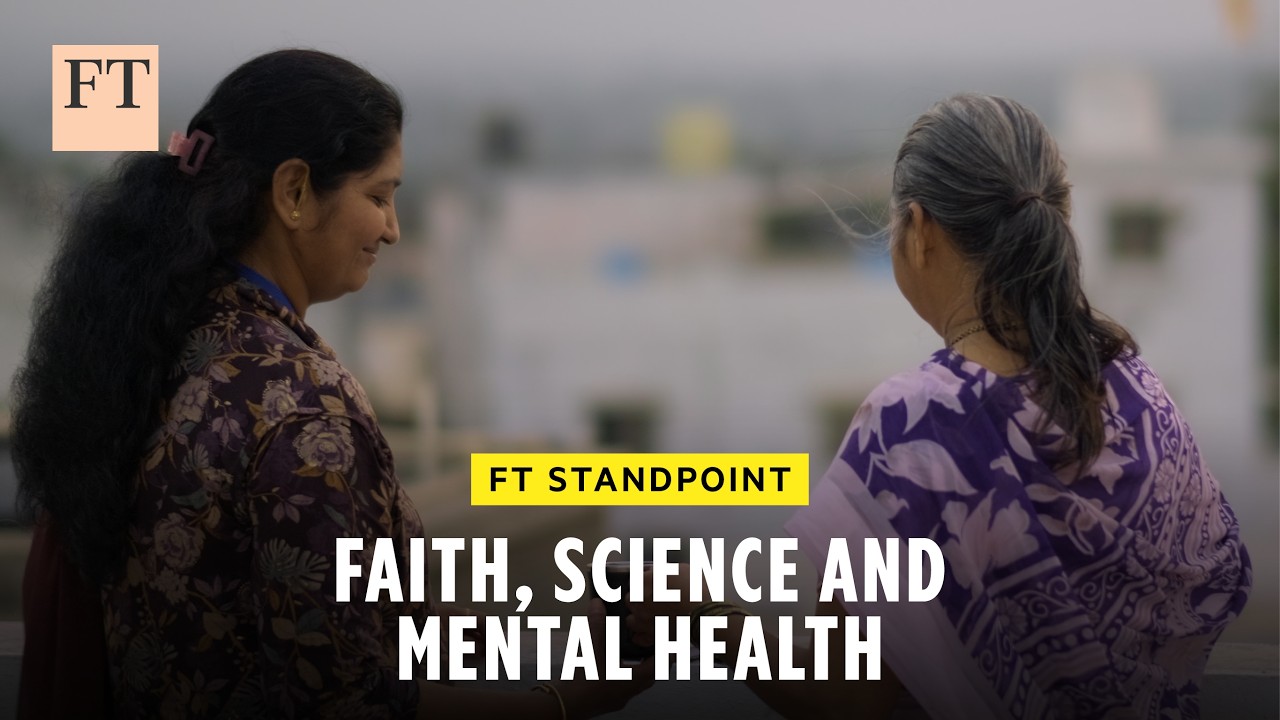
How India is reshaping mental healthcare | FT Standpoint
Keywords
Summary
188 words
Critical Evaluation
Value of the Information & Strength of the Argument
The documentary provides tangible value by giving voice to individuals often marginalized in mental health discourse, and by documenting real-world initiatives that blend traditional faith practices with modern medicine. Its strength lies in the authenticity of first-hand accounts: a patient describing his past violent behavior and subsequent recovery, a widow explaining how training as a community health worker helped her understand her husband’s depression, and a faith healer cooperating with clinicians. The argumentation is persuasive through these concrete examples, though it does not offer quantitative evidence or comparative analysis of outcomes. The narrative builds a case for integrating community-based care with existing cultural structures, arguing that this approach can reduce stigma and improve access. However, it occasionally romanticizes the role of faith, and the lack of expert interviews from a clinical perspective (beyond a few mentions) leaves some questions about efficacy and safety unanswered.
Scientific Rigor, Source Quality, Title Accuracy
The film is journalistically rigorous, given that it is produced by the Financial Times and involves collaboration with a local filmmaker and One World Media. The quality of sources is primarily testimonial, but these are presented with clear context and without sensationalism. The description provides links to FT subscription offers and podcasts, but no direct references to academic studies or reports are included. The title ‘How India is reshaping mental healthcare’ is apt, as it highlights grassroots innovations and systemic changes rather than a top-down approach. The documentary does not claim to be a scientific study, but rather a journalistic exploration. The absence of verifiable data or citations weakens its use as a scientific reference, yet it serves as a valuable qualitative account of an underreported issue.
286 words
Title / Content Match
The title accurately reflects the documentary's focus on innovative mental health solutions in India, particularly the integration of faith healers and medical treatment, as well as community-level interventions.
Quality & Reliability
8/10
The documentary is produced by a reputable international news outlet (FT) and features direct interviews with patients, community health workers, and a local filmmaker. It combines personal narratives with expert commentary, though it lacks detailed statistics or peer-reviewed references.
Key Moments
Markers derived by PSI from the transcript: the creator did not define chapters.
- Introduction to the mental health crisis in India and reliance on faith healers.
- Presentation of the Dawa-Dua clinic where medicine and spiritual counsel are offered side by side.
- A patient recounts his violent past and how treatment with medication and support led to recovery.
- Community health workers conduct home visits, screening for mental health symptoms and providing counseling.
- The Mansarang art therapy group performs songs and plays to combat stigma and foster community connection.
Cited Sources
- FT Schools free access — Student offer for Financial Times content, mentioned in the video description.
- FT subscription trial — Advertisement for FT trial subscription, included in the description.
- FT Podcasts — Link to Financial Times podcasts, provided in the description.
Contribution & Novelties
The documentary contributes a unique on-the-ground perspective on mental health care in India, highlighting innovative collaborations between medical professionals and faith healers. It introduces viewers to specific grassroots initiatives like the Dawa-Dua clinic and the Mansarang art therapy group, which are rarely covered in mainstream media. Its originality lies in showcasing the lived experiences of patients and community workers, offering an alternative to purely clinical or statistical accounts. The film underscores the potential of community health workers to bridge the mental health treatment gap, a model that could inform policy beyond India.
Pour aller plus loin :
- Mental health in India — Overview of mental health challenges and care systems in India.
- Community health worker — Explanation of this health delivery role, relevant to the programs shown.
- Mental health - World Health Organization — Global context on mental health policies and resources.
142 words
Radar Profile
The radar profile shows high scores in information quantity, quality, and global reliability, reflecting a well-researched documentary from a credible outlet. However, the technical level is lower, consistent with its non-specialist audience orientation. This suggests a strong humanistic and journalistic approach rather than a scientific or technical deep dive.