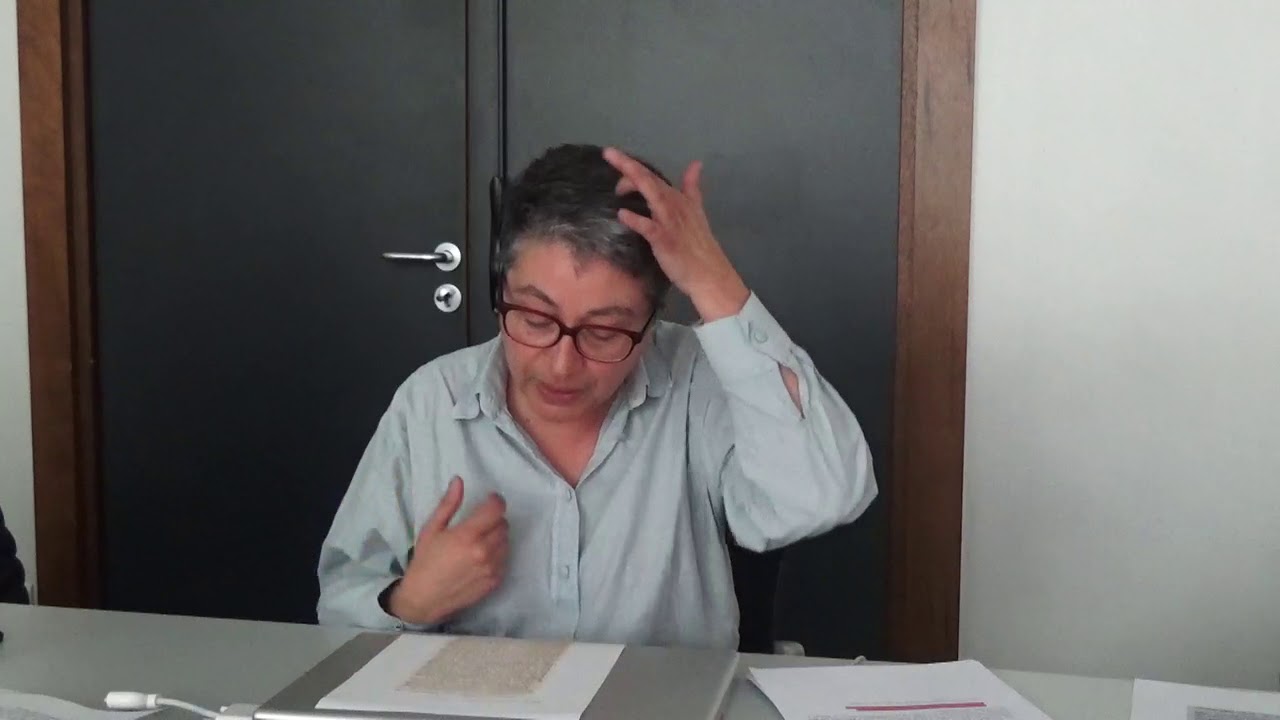
Intervention de Martine FURNO à l'école thématique de Neolatin - session 2017
Intervention of Martine FURNO at the thematic school of Neolatin - session 2017
Keywords
Summary
195 words
Critical Evaluation
Value of the Information & Strength of the Argument
The value of the information is high, as it offers a detailed, text-based analysis of primary sources. Furno uses specific excerpts and explains them in context, which strengthens the credibility of her claims. The argumentation is solid: she supports her interpretations with linguistic and historical evidence, and she carefully distinguishes between assumptions and well-founded inferences. She also addresses potential counterpoints, such as the actual likelihood of the immersive environment described by Cordier, showing intellectual honesty. The talk is well-structured, moving from a specific text to broader discussions of pedagogical materials and grammatical theory, all while maintaining a clear focus on how Latin was actually learned and used.
Scientific Rigor, Source Quality, Title Accuracy
The scientific rigor is evident in the careful examination of primary sources, including references to Cordier’s Colloquia and Linacre’s grammar, among others. Furno cites specific editions and textual details, and she contextualizes them within the broader history of education. The sources are appropriate for the topic and are used critically. The title of the video, ‘Intervention de Martine FURNO à l’école thématique de Neolatin - session 2017’, accurately reflects the content: a scholarly talk delivered at a academic event. No misleading claims are made, and the content matches the title’s promise of an intervention on Neo-Latin themes.
219 words
Title / Content Match
The title accurately describes the content: a lecture on Neo-Latin teaching at a thematic school. The title is clear and matches the talk.
Quality & Reliability
8/10
The talk is based on careful philological analysis of historical texts, with specific examples and citations. The speaker is a university professor, indicating expertise. However, the video is a recorded lecture without peer review, so it is reliable but not formally published.
Key Moments
Markers derived by PSI from the transcript: the creator did not define chapters.
- Introduction to the talk and the topic of Latin teaching methods in the 16th century.
- Presentation of Mathurin Cordier's immersion method and the Colloquia text.
- Detailed reading and analysis of the dialogue between two children, highlighting social and linguistic segregation.
- Discussion of grammars and dictionaries, focusing on Thomas Linacre's grammar and its structure.
- Examination of specific grammatical constructions, such as the ablative of agent, and the evolution of terminology.
Cited Sources
- Mathurin Cordier's Colloquia — Discussed as an example of immersion texts for teaching Latin to children.
- Thomas Linacre's Grammar — Analyzed as a bilingual grammar (English-Latin) and its adaptation for French use.
Contribution & Novelties
The talk provides a nuanced analysis of 16th-century Latin teaching, demonstrating that immersion and formal grammar were not mutually exclusive but coexisted, with social and gender dynamics influencing language choice. It argues that innovation in Latin pedagogy often occurred at the semantic and lexical levels rather than in syntax, which remained conservative. This perspective challenges simplistic views of Renaissance teaching as either purely oral or purely grammatical.
Pour aller plus loin :
- Mathurin Cordier — Biographical and pedagogical context of the scholar mentioned in the talk.
- Thomas Linacre — Overview of the humanist and his grammar, which is a key source analyzed.
- Neo-Latin — General context on the use of Latin in the early modern period, relevant to the talk’s theme.
121 words
Radar Profile
The radar profile shows high scores in quantity and quality of information, with a slightly lower but still solid score for technical level, reflecting the specialized nature of the topic. Overall reliability is strong, indicating a trustworthy expert presentation.