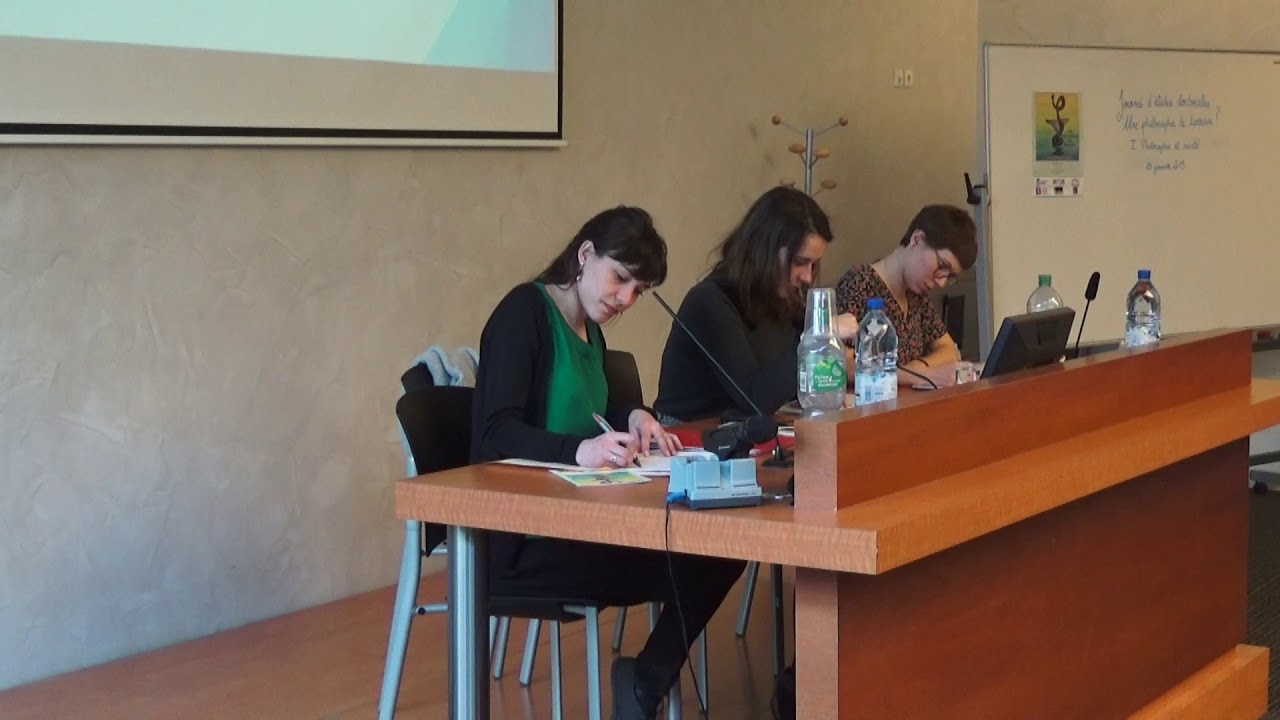
Journée d'études "Une philosophie de terrain?" - Intervention de Anastasia Markoff Legrand
Study Day "A Field Philosophy?" - Presentation by Anastasia Markoff Legrand
Keywords
Summary
167 words
Critical Evaluation
Value of the Information & Strength of the Argument
The value of this presentation lies in its clear articulation of a methodological alternative to both classical applied ethics and purely empirical social sciences. The speaker argues convincingly that the complex method, with its emphasis on systemic thinking and the integration of interdisciplinary insights, addresses a real gap in ethical reflection on end-of-life care. The argumentation is solid: she demonstrates how the method’s principles—rejection of reductionism, attention to contextual complexity, strategic methodology, and reflexive implication—are translated into concrete research choices. The link between the philosophical framework and the practical investigation is well established, showing that this is not an abstract reflection but a tool for conducting fieldwork. However, the argument could be strengthened by more explicit discussion of potential limitations or alternative interpretations of the method, and by offering more comparative analysis with other social science approaches.
Scientific Rigor, Source Quality, Title Accuracy
The presentation demonstrates good scientific rigor in its reliance on explicit methodological references, citing works by Edgar Morin, Yves de Langavant (or Diane de Langavant, as transcribed), Daniel Callahan, and methodologies like Kaufmann’s comprehensive interview and Blanchet & Gotman’s qualitative methods. The sources are relevant and appropriately integrated. The title of the video accurately reflects the content: it is indeed an intervention within a study day on field philosophy, and the content precisely matches this. The speaker’s academic background in a master’s ‘Culture et Santé’ program adds credibility to the practical aspects of the study, though her status as a master’s student limits the authority of the findings. Overall, the rigor is commendable for this context, but more systematic validation of sources and results would enhance reliability.
279 words
Title / Content Match
The title accurately reflects the content: a lecture on field philosophy and the application of the complex method.
Quality & Reliability
7/10
Presentation is well-structured and grounded in philosophical literature, but it is a master's student's project, so depth of validation is limited.
Key Moments
Markers derived by PSI from the transcript: the creator did not define chapters.
- Introduction: presentation of the complex method and its relevance to field philosophy.
- Explanation of the complex method and its distinction from reductionist applied ethics.
- Discussion of the principles of the method: strategic vs. programmatic, researcher implication, reflexivity.
- Overview of the qualitative study on the Claeys-Léonetti law and end-of-life care, including research objectives and hypotheses.
- Construction of the interview method: choice of semi-structured interviews, development of the guide, and selection of locations.
- Reflections on researcher posture, the use of a research journal, and lessons learned from the fieldwork.
Cited Sources
- La méthode complexe by Diane de Langavant — Referenced as the primary methodological framework for the presentation.
- Edgar Morin, La Méthode — Mentioned as an inspiration for the concept of complexity and the systemic approach.
- Daniel Callahan's communitarian approach — Cited as an influence for the communitarian perspective in bioethics.
- Qualitative research methods by Blanchet and Gotman — Mentioned as a source for qualitative interview methodology.
- Kaufmann, L'entretien compréhensif — Referenced for the comprehensive interview approach.
Contribution & Novelties
The original contribution of this presentation lies in its demonstration of how the complex method can be operationalized in a concrete qualitative study on end-of-life, offering a middle path between abstract applied ethics and purely descriptive social science. It emphasizes the need for a strategic, adaptive methodology that respects the complexity of practices, and highlights the role of researcher reflexivity and interdisciplinary articulation. This approach offers a promising template for future philosophical fieldwork.
Pour aller plus loin :
- Loi Claeys-Léonetti — The French law on patients’ rights and end-of-life, central to the study.
- La Méthode (Morin) — Edgar Morin’s foundational work on complexity, which inspired the complex method.
- Éthique appliquée — Overview of applied ethics, the approach the complex method seeks to refine.
123 words
Radar Profile
The radar profile shows relatively balanced scores, with a slight emphasis on information quantity and quality over technical level and reliability. This reflects a conceptually rich presentation but one that remains accessible and based on a modest empirical scope.