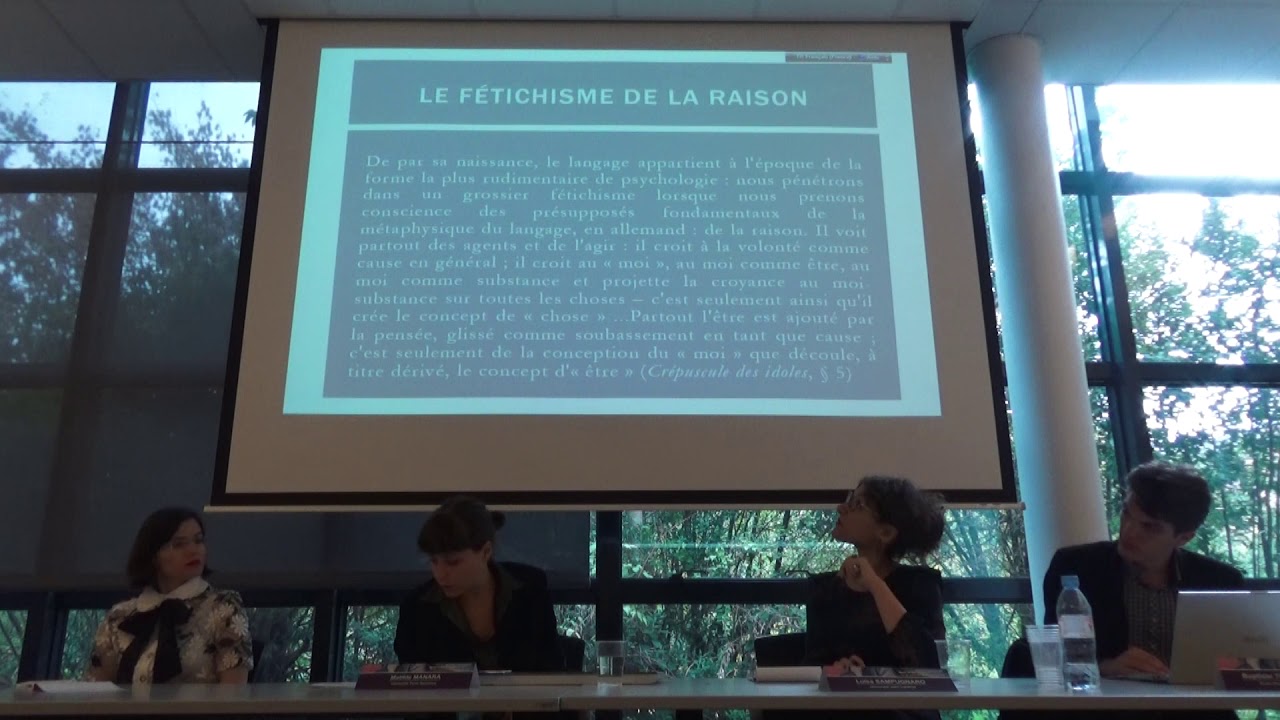
« Moderne / Modernisme. Qu’est-ce que la modernité en art ? » - Mathilde Manara
Modern / Modernism. What is modernity in art? - Mathilde Manara
Keywords
Summary
183 words
Critical Evaluation
Value of the Information & Strength of the Argument
The talk provides a valuable and coherent argument about modernist lyric poetry as a self-reflective genre. Manara builds a strong case for the significance of the essay and figures like Wallace Stevens in mediating between philosophical skepticism and literary expression. Her argument is well-supported with references to Cavell, Emerson, and Stevens’s own texts, though she does not systematically explain her sources. The intellectual quality is high, but the presentation is dense and assumes a specialized audience.
Scientific Rigor, Source Quality, Title Accuracy
The scientific rigor is sound, as the speaker is an academic and the presentation is part of a colloquium organized by Labex COMOD, a recognized research group. However, the video provides no explicit list of references or footnotes; sources are alluded to but not formally cited. The title is appropriate for the broad topic of modernity in art, and the specific intervention on lyric poetry is well-aligned with that theme.
161 words
Title / Content Match
The title 'Modern / Modernism' accurately reflects the broader colloquium theme, while the specific intervention focuses on lyric poetry, which is a major aspect of modernist aesthetics.
Quality & Reliability
8/10
The talk is a well-structured academic presentation by a specialist in modernist poetry, grounded in existing scholarship (e.g., references to Cavell, Emerson, Stevens, and others). The argument is coherent and shows a deep understanding of the topic, though it does not provide footnotes or a formal bibliography beyond the colloquium program.
Key Moments
Markers derived by PSI from the transcript: the creator did not define chapters.
- Introduction and aim of the talk: questioning the self-reflexive character of modernist lyric poetry.
- Discussion of the historical shift from prescriptive to essentialist genres, up to Romanticism.
- Definition of modernism as a self-reflexive conflict, citing Stanley Cavell.
- The role of the essay as a compromise formation between philosophy and literature.
- Introduction of Wallace Stevens as a key modernist poet.
- Analysis of Stevens's view of imagination and reality, with reference to his poems.
- Conclusion on the enduring relevance of the poetic imagination in modernity.
Cited Sources
- Colloquium program: Moderne / Modernisme — The talk is part of a two-day colloquium organized by Labex Comod, focusing on the concept of modernity in art.
Contribution & Novelties
The talk offers a fresh perspective by arguing that modernist lyric poetry, particularly through Wallace Stevens, does not simply break with tradition but engages in a dialogue with it, using self-reflexivity as a means of renewal. Manara’s emphasis on the essay genre as a bridge between philosophical skepticism and poetic expression is particularly insightful.
Pour aller plus loin :
- Modernism — General overview of the modernist movement in arts and literature.
- Wallace Stevens — The poet central to the talk; further exploration of his works and thought.
- Lyric poetry — Historical background on the genre and its evolution.
- Stanley Cavell — Philosopher whose definition of modernism is cited in the talk.
111 words
Radar Profile
The radar profile is balanced, with high scores in information quantity, quality, and technical level, but slightly lower in global reliability due to the absence of formal citations. This suggests a well-informed and intellectually rigorous presentation that would benefit from more explicit sourcing.