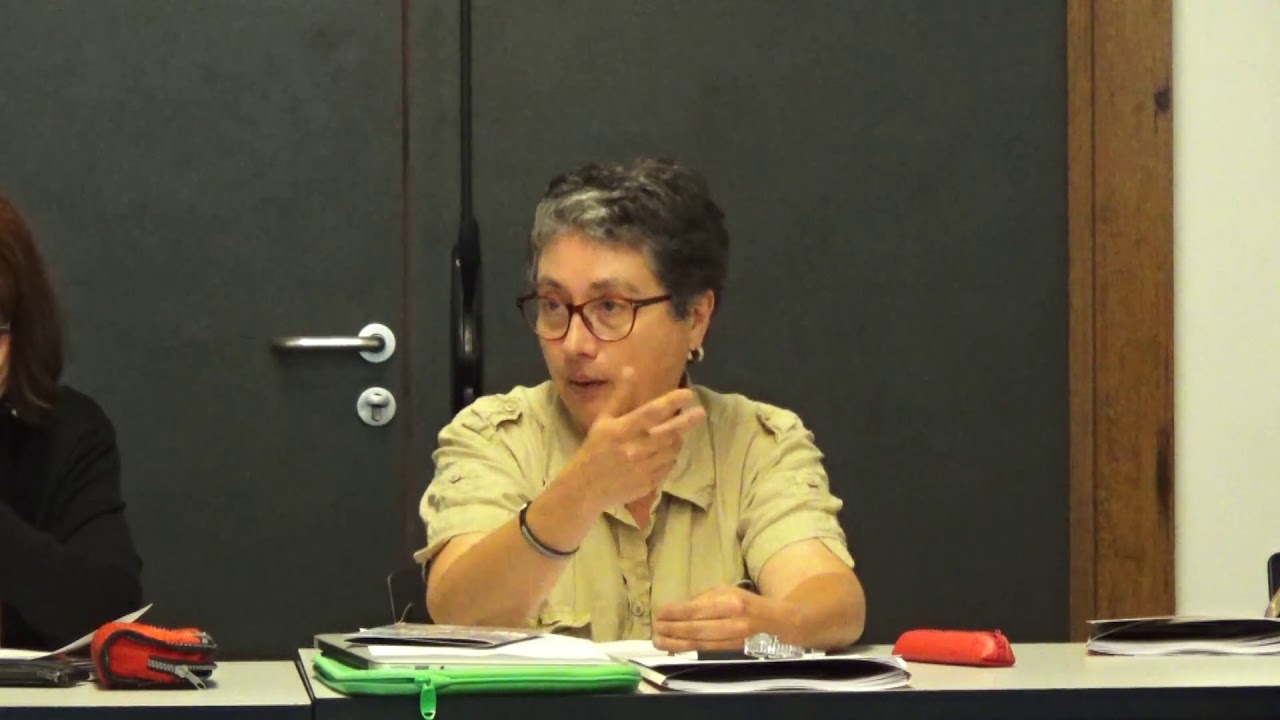
NeolatinLyon 2018 : Martine Furno - Spécificités du latin des XVIe et XVIIe siècles
NeolatinLyon 2018: Martine Furno - Specificities of the Latin of the 16th and 17th centuries
Keywords
Summary
164 words
Critical Evaluation
Value of the Information & Strength of the Argument
The value of this presentation lies in its detailed reconstruction of Renaissance Latin pedagogy using primary source materials. Furno provides a nuanced argument that the teaching of Latin was highly standardized and practical, centered on conversation and early writing, contrary to modern perceptions. She supports her claims with references to historical figures such as Erasmus and the Estienne dynasty, as well as concrete examples from textbooks and dialogues. The argumentation is coherent and demonstrates deep familiarity with the subject, making a strong case for the importance of oral practice and the role of dictionaries as reservoirs for composition. However, the presentation is synthetic and omits detailed contextual data, leaving some claims somewhat general.
Scientific Rigor, Source Quality, Title Accuracy
The talk is grounded in well-known primary sources of the period, including Erasmus’s colloquia, the pedagogical works of Charles Estienne, and the dictionaries of Robert Estienne. Furno accurately references these and uses them to illustrate pedagogical practices. The title precisely matches the content. The source base is excellent, though the presentation format does not allow for explicit footnote-style citations. The adequacy between title and content is high: all discussed aspects pertain to the specificities of Latin in the target centuries.
208 words
Title / Content Match
The title accurately reflects the content: the presentation systematically discusses the characteristics, learning methods, and practical uses of Latin in the 16th and 17th centuries.
Quality & Reliability
7/10
The talk is delivered by an academic expert in Renaissance Latin and is based on well-known historical texts and pedagogical sources. However, it is a presentation without formal citation apparatus, and some claims rely on historical reconstructions. The score reflects the solid academic grounding but the lack of checkable sources in the video itself.
Key Moments
Markers derived by PSI from the transcript: the creator did not define chapters.
- Introduction to the talk: she will address learning methods and dictionaries of Latin in the 16th-17th centuries.
- Discussion on the uniformity of teaching across Europe, with example of Jesuit colleges and the role of oral practice.
- Examples of childhood learning from memoirs, including that of Montaigne and the house of Estienne.
- Analysis of grammatical teaching: use of syntactic questions (e.g., nominative/objective) and the concept of 'case'.
- Presentation of bilingual dictionaries used in classrooms and their structure (thematic vs. alphabetical).
- Discussion on the pedagogical use of dictionaries for writing and the resistance to alphabetical ordering.
- Conclusion: summary of the practical and pragmatic nature of Latin teaching in the period.
Cited Sources
- Erasmus's Colloquia (Colloquia familiaria) — Mentioned as a reference for Latin dialogues and pronunciation discussions.
- Charles Estienne's works on Latin — Cited for examples of pedagogical dialogues and the defense of Latin pronunciation.
- Robert Estienne's dictionaries (e.g., Thesaurus) — Discussed as major Latin dictionaries, with editions used in schools.
- Montaigne's Essays (recollections of learning Latin) — Used to illustrate immersive learning methods in childhood.
Concurring Sources
- Erasmus's Colloquia — Support the idea of conversational Latin learning.
- Jesuit education — Confirms the widespread use of standardized Latin curricula in Jesuit colleges.
Dissenting Sources
- No direct discordant sources — The talk does not explicitly mention opposing viewpoints; however, her interpretation of the primary sources is one among several in the field.
Contribution & Novelties
This presentation provides a comprehensive overview of the practical realities of teaching and learning Latin in early modern Europe, based on a range of pedagogical sources. Its originality lies in the synthesis of these materials to show the uniformity of methods and the emphasis on oral practice and immediate composition, which contrasts with later deductive grammar-focused approaches. The detailed analysis of how case functions were taught (via question-answer routines) and how dictionaries were used as reservoirs for writing adds a practical dimension often missing in historical overviews.
Pour aller plus loin :
- Neo-Latin — Provides context on the development of Latin in the early modern period.
- Erasmus — His educational works and influence on Latin teaching are directly relevant.
- Education in the Renaissance — Offers background on school systems and curricula of the period.
- Robert Estienne — Information on one of the key publishers of Latin dictionaries and texts.
149 words
Radar Profile
The radar profile shows high scores in information quantity and technical level, reflecting a dense, specialized academic presentation. The slightly lower score in 'fiabilite_globale' indicates that while the speaker is expert, the lack of formal citations in the video limits immediate verification. Overall, the talk is a solid, if synthetic, overview.