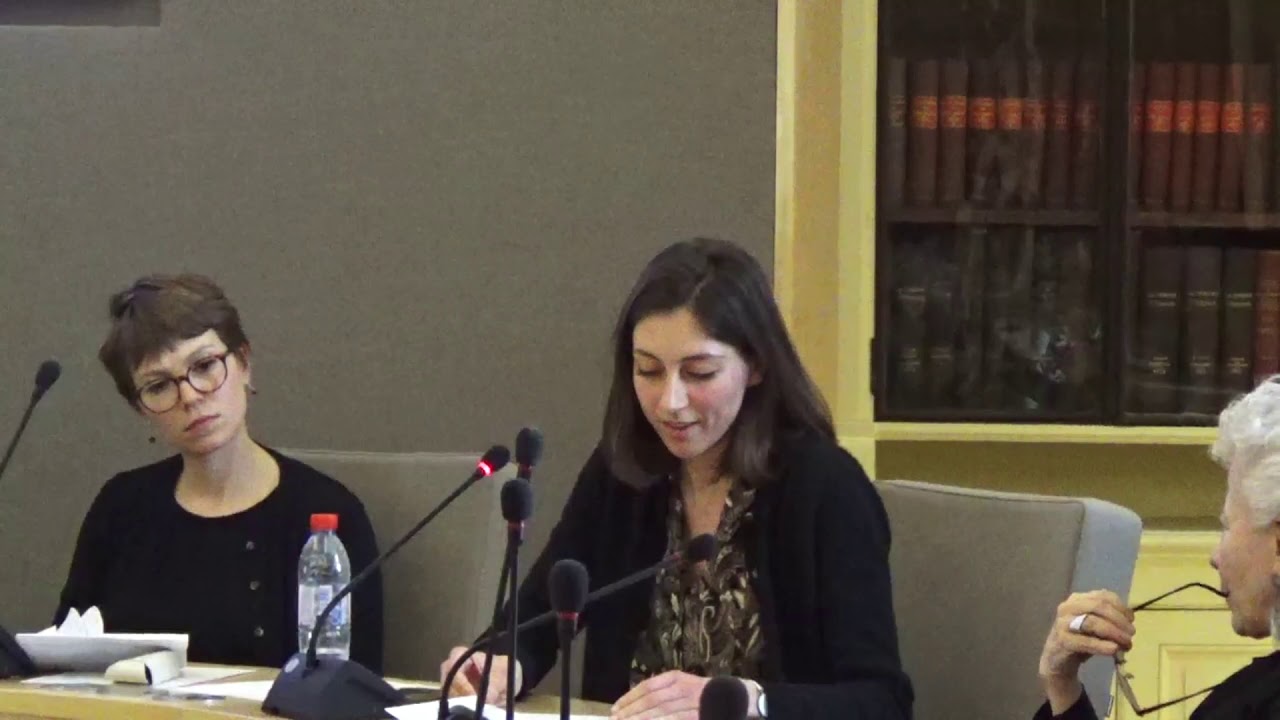
Journée de formation doctorale "Philosophie et écologie" : conclusion
Doctoral training day "Philosophy and ecology": conclusion
Keywords
Summary
161 words
Critical Evaluation
Value of the Information & Strength of the Argument
The value of the information is limited to a personal summary of the discussions, with no new evidence or in-depth analysis. The argumentation is largely descriptive and relies on the authority of the participants’ interventions. While the speaker effectively outlines the main themes and points of divergence, she does not provide a critical distance or a structured framework to weigh the positions. The lack of concrete examples or references weakens the persuasive power. Yet, as a synthesis of workshops, it offers a useful overview for those interested in the methodological debates within ‘philosophy of terrain’, particularly regarding the relation between philosophy and engagement.
Scientific Rigor, Source Quality, Title Accuracy
The video does not cite any explicit written sources; it only mentions names of participants and a few thinkers (e.g., Christiane Vollaire, Julien Henry) without referencing specific works. The title is entirely appropriate. The scientific rigour is poor, as the content is largely anecdotal and no traceability of claims is provided. The conversation touches on epistemological issues but without bibliographic support or verifiable references. Therefore, the overall reliability is low, especially given the poor quality of the transcript and the informal nature of the talk.
203 words
Title / Content Match
The title accurately reflects the content, which is indeed a concluding talk for a doctoral training session on philosophy and ecology.
Quality & Reliability
5/10
The video is a spoken synthesis by a doctoral student at a rather informal level, based on her personal recollection of the discussions. The transcript shows numerous automatic transcription errors, and no verifiable sources are cited. Nonetheless, it provides a coherent summary of the main topics addressed during a two-day doctoral workshop, with some named contributions.
Key Moments
Markers derived by PSI from the transcript: the creator did not define chapters.
- Introduction of two main points: the workshop contained beautiful terrains and the role of the philosopher of terrain.
- Summary of the first session: discussions on methods for approaching terrain, including description, explanation and problematisation.
- Mention of disagreements on whether a normative method is needed and the question of whether descriptive concepts can be separated from prescriptive ones.
- Discussion on the place of emotions and aesthetic dimensions in fieldwork, citing Christiane Vollaire.
- Second day's theme: the role of the philosopher in society, with examples of solicitations from civil society.
- Two formulations of the engagement question: is it possible to do engaged philosophy or is it necessarily engaged?
- Proposal to redefine the philosopher as someone who conducts research with terrain actors, not just as an expert.
- Announcement of future collaborative projects and invitation for suggestions, with thanks to participants and organisers.
Cited Sources
- Christiane Vollaire — Mentioned as a reference for the aesthetic dimension of philosophical fieldwork.
- Julien Henry — Acknowledged for advice in preparing the session.
- Clare Hart — Acknowledged for help in preparing the session.
Concurring Sources
- Wikipedia - Philosophy of field — Provides a general definition and context for the notion of 'philosophy of terrain' discussed in the video.
Contribution & Novelties
This video offers a succinct oral synthesis of the debates during a doctoral training session, highlighting the key methodological and ethical questions surrounding ‘philosophy of terrain’ and its relation to ecology. Its novelty lies in the personal perspective of a student actively involved in the labex, rather than providing new scientific content.
Pour aller plus loin :
- Philosophie de terrain — Note: general contextual reference, though not directly cited.
- Field research methods — Note: relevant for methodological background.
- Environmental philosophy — Note: links to ecological concerns mentioned in the talk.
90 words
Radar Profile
The profile shows a fairly balanced but modest presentation: quantity and quality of information are both around 5/10, indicating a limited but coherent overview. The technical level is low, suggesting accessibility to a broad audience, while reliability remains compromised by the lack of explicit sources and the informal delivery.