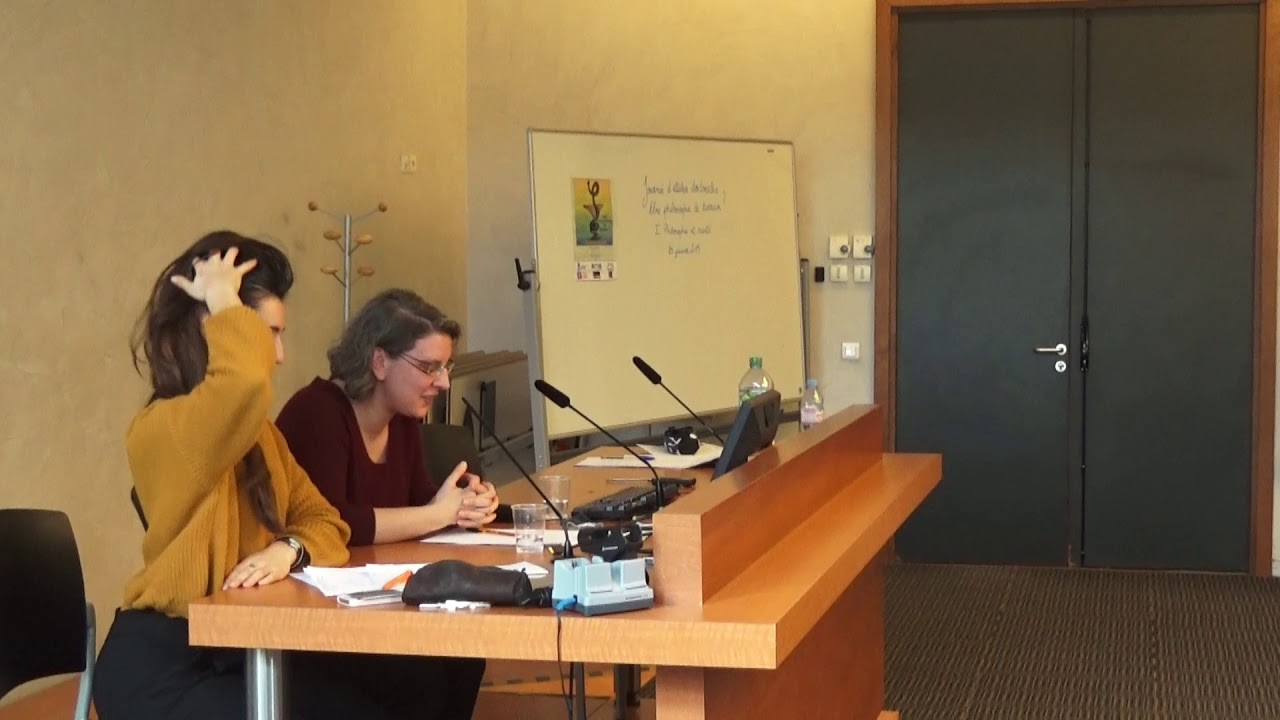
Journée d'études doctorales "Une philosophie de terrain?" - Intervention de Julie Henry (partie 2)
Doctoral study day "A field philosophy?" - Intervention by Julie Henry (part 2)
Keywords
Summary
179 words
Critical Evaluation
Value of the Information & Strength of the Argument
The value of this presentation lies in its original demonstration of how Spinoza’s philosophy can be pragmatically mobilized in a healthcare setting. Henry provides a concrete and nuanced argument for using philosophical concepts not as fixed doctrines but as tools for questioning and shedding new light on practical situations. She carefully avoids both the imposition of concepts onto the field and the naive projection of field realities onto Spinoza’s texts. The argumentation is strong because she gives a detailed example (the ‘person behind the pathology’) and shows how the field’s response pushed her to refine her questions. The discussion with the audience adds depth, especially the sociologist’s remarks about the history of the notion of ‘field’ and the potential for cross-disciplinary dialogue. However, the argumentation is based on anecdotal evidence and personal experience, which limits its generalizability.
Scientific Rigor, Source Quality, Title Accuracy
The scientific rigor is evident in the speaker’s careful handling of philosophical concepts and her transparent discussion of her research process. She acknowledges the limitations and open questions, which reflects intellectual honesty. The sources are primarily Spinoza’s works and the works of Françoise Proust, as mentioned, but no specific citations or links are provided in the description. The academic context (Labex Comod, ENS de Lyon) adds credibility. The title accurately describes the content, which is about field philosophy and oncology. The presentation is part of a doctoral study day, aligning with academic standards. The adequacy of title and content is high, as the video corresponds directly to the announced topic.
262 words
Title / Content Match
The title accurately reflects the content: a presentation on field philosophy with a focus on oncology, and the dialogue with Dewey, as promised. The recording is the second part, and the content matches.
Quality & Reliability
8/10
The speaker is a recognized philosopher and presents a well-argued reflection on the use of Spinoza's concepts in healthcare, demonstrating methodological rigor and openness to dialogue. The academic context ensures reliability, though it remains an opinion-based presentation without systematic evidence.
Key Moments
Markers derived by PSI from the transcript: the creator did not define chapters.
- Introduction to the presentation and the topic of using Spinoza in healthcare.
- Example of 'seeing the person behind the pathology' and unfolding the concept using Spinoza's body-mind distinction.
- Return to the field and the reaction of nursing staff, leading to a reassessment of the concept of professional posture.
- Discussion on the absence of a fixed methodology and the importance of an open, humble attitude in field philosophy.
- A sociologist in the audience comments on the notion of 'field' in social sciences and the relationship between philosophy and sociology.
- Anecdote of a nurse mentioning Spinoza during a practical task, illustrating the integration of theory and practice.
Contribution & Novelties
The original contribution lies in demonstrating a dialogical method between Spinoza’s philosophy and field practices in oncology. Henry shows how field work can produce new questions for Spinoza’s texts, challenging both an exegetical approach and a simple naive application. This bidirectional movement is illustrated with a concrete example, offering a model for other philosophers engaged in interdisciplinary work.
Pour aller plus loin :
- Spinoza’s Ethics — Foundational text for the concepts used.
- Affect (philosophy) — Central to Spinoza’s understanding of body-mind relations.
- Field research — Relevant to the methodological discussion on ‘field’ in social sciences.
95 words
Radar Profile
The radar profile shows strong scores in information quality and reliability, with slightly lower technical complexity, indicating a balanced presentation accessible to an informed academic audience. The low quantity score relative to others may reflect the focused nature of the talk, but the depth compensates.