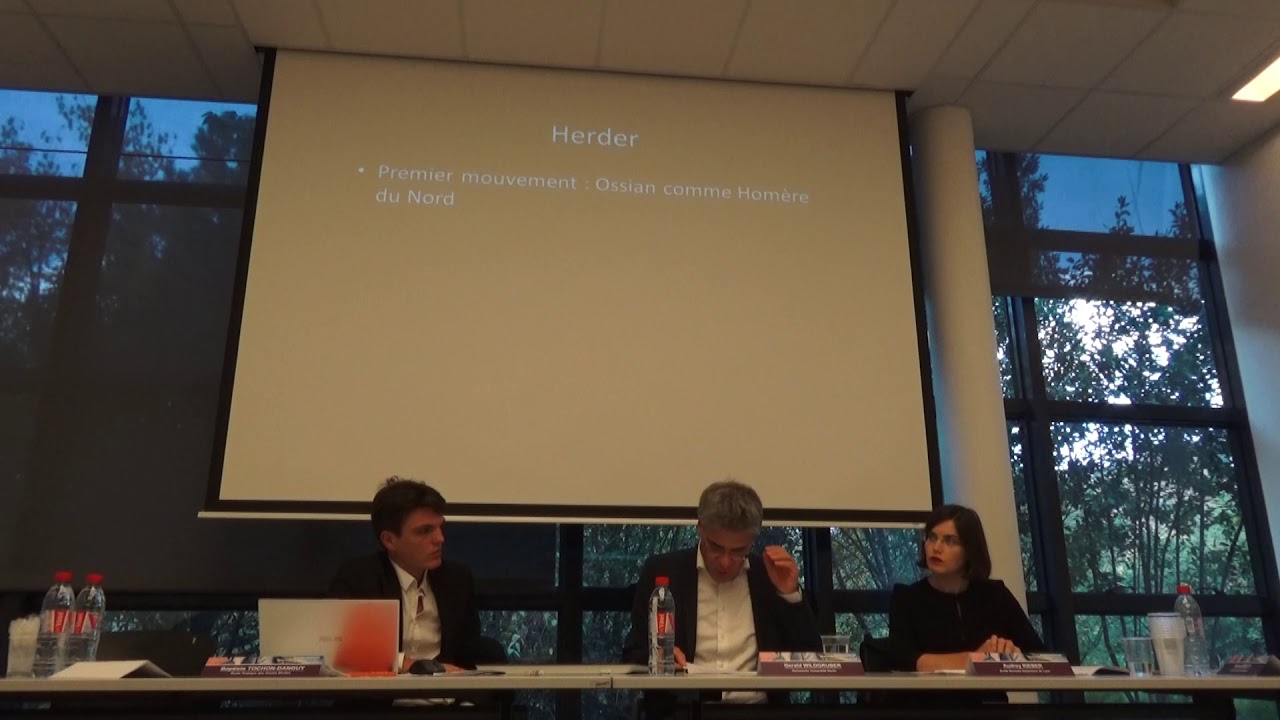
« Moderne / Modernisme. Qu’est-ce que la modernité en art ? » - Gerald Wildgruber
Modern / Modernism. What is modernity in art? - Gerald Wildgruber
Keywords
Summary
177 words
Critical Evaluation
Value of the Information & Strength of the Argument
The value of this presentation lies in its original synthesis of literary and visual art theory, demonstrating how a literary forgery could shape the discourse on modernity. The argumentation is rigorous, moving from historical reception to Herder’s aesthetic doctrine, then to concrete visual applications. The speaker carefully distinguishes between Herder’s theoretical limitations and the actual consequences in painting, acknowledging discrepancies while showing the deep influence. The reasoning is coherent and persuasive, though it assumes familiarity with European intellectual history, making it dense but rewarding.
Scientific Rigor, Source Quality, Title Accuracy
The scientific rigor is high: the speaker is an academic from TU Berlin, and the talk is part of a labex symposium. He draws on primary texts (Ossian, Herder, Goethe, Kleist) and secondary literature implicitly, though without explicit on-screen references. The absence of displayed sources is compensated by the scholarly tone and the detailed analysis. The title ‘Modern / Modernism’ is appropriate as a conference umbrella, but somewhat generic for this specific case study; however, the talk effectively illustrates the nature of modernity in art through a singular episode. The adéquation is acceptable, as the content addresses the question of modernity directly, albeit via a historical detour.
206 words
Title / Content Match
The title is broad, but the talk focuses on a specific case of modernity in art via Ossian and Herder, addressing the general question through a detailed historical analysis.
Quality & Reliability
8/10
Lecture by an academic expert with a well-structured historical and theoretical argument, but relies on textual analysis without on-screen citations; the auto-transcript is garbled, yet the content remains coherent and insightful.
Key Moments
Markers derived by PSI from the transcript: the creator did not define chapters.
- Introduction: the disproportionate influence of Ossian texts despite their inauthenticity, and the central question of how a forgery triggered modern aesthetic thought.
- Publication of Macpherson's Ossian (1760-1765) and its rapid translation into German, including the first verse translation in 1768 that framed it as a Homeric epic.
- Herder's 1795 essay 'Ossian' and the concept of the 'Ossianic discourse' that transcended authenticity, becoming a medium for discussing modern art and literature.
- Analysis of Ossian's poetic style: mist, vagueness, and subjectivity contrasted with Homeric clarity and object presence, illustrating a new mode of representation.
- Herder's notion of 'intellectual painting' and his skepticism about translating Ossianic effects into visual art, revealing his classical bias toward objectivity.
- Connection to Caspar David Friedrich's 'Monk by the Sea' as a realization of Ossianic aesthetics, with Goethe's negative reaction and Kleist's enthusiastic praise.
- Conclusion: Ossian as a 'mask' for the modern shift, and the anticipation of abstraction in the visual arts.
Cited Sources
- Colloque Moderne / Modernisme. Qu’est-ce que la modernité en art ? — Official page of the conference where this lecture was delivered, providing background and program.
Contribution & Novelties
The talk provides an original interpretation of Ossian’s role in the development of modern art, linking Herder’s literary aesthetics to the emergence of abstract and subjective painting. It highlights the paradox that a literary fraud could serve as a catalyst for genuine aesthetic innovation, and explicitly connects this to painting, a dimension often overlooked in Ossian studies.
Pour aller plus loin :
- Heroic and Anti-Heroic in Ossian - Overview of the poems and their cultural impact.
- Johann Gottfried Herder - His philosophical contributions to aesthetics and historicism.
- Monk by the Sea - Caspar David Friedrich’s painting discussed as modern art precursor.
101 words
Radar Profile
The radar profile shows high technical level (9) and good information quantity/quality, with slightly lower reliability due to reliance on theoretical interpretation and no explicit citations. The talk is advanced and well-informed, but its strength lies more in intellectual depth than empirical verification.