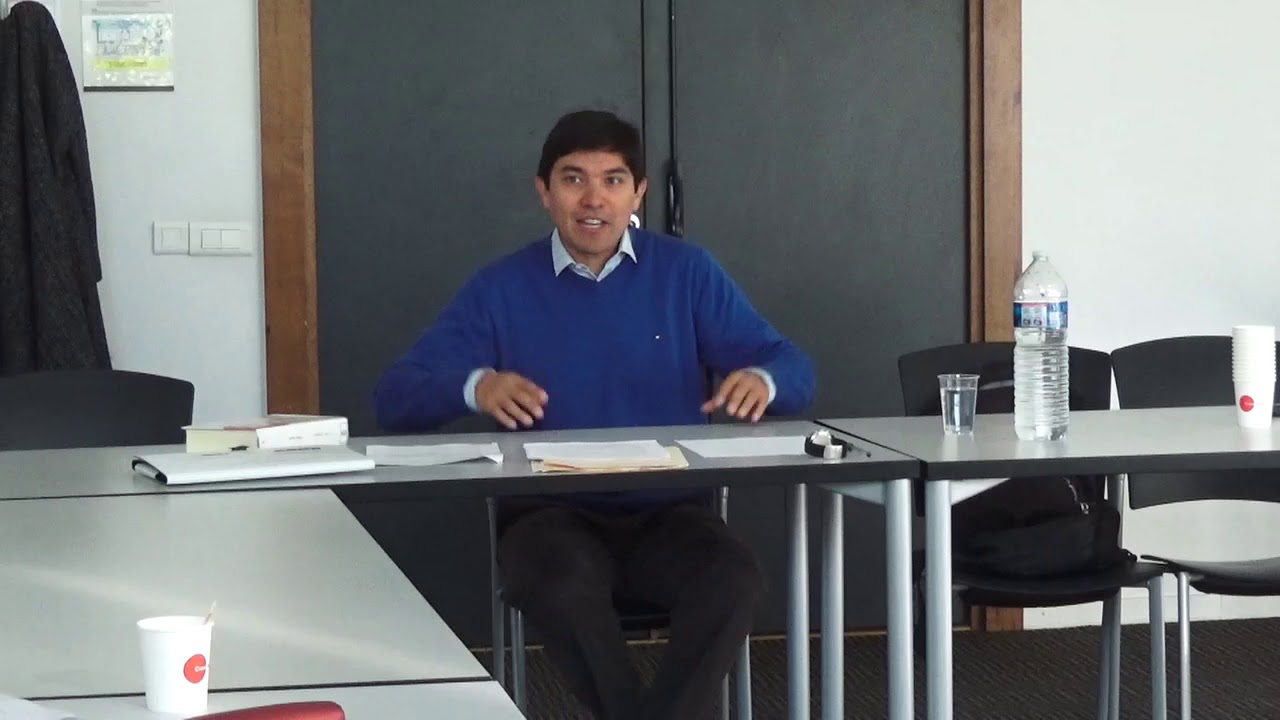
Francisco Ramirez Santacruz : "La Ortografía castellana de Mateo Alemán: autobiografía y modernidad"
Francisco Ramirez Santacruz: "La Ortografía castellana de Mateo Alemán: autobiography and modernity"
Keywords
Summary
161 words
Critical Evaluation
Value of the Information & Strength of the Argument
The lecture offers substantial value by situating a seemingly technical subject—orthography—within broader historical and ideological contexts. Ramirez Santacruz demonstrates how linguistic debates mirrored social tensions, particularly the clash between traditional honor codes and emerging mercantile values. His argument is persuasive: he uses primary sources (Alemán’s texts, contemporary treatises) and traces influences, such as Alemán’s engagement with the arbitrista movement. The inclusion of autobiographical readings adds a distinctive interpretive layer, supported by careful textual analysis. However, some claims, like the alleged confiscation of a book on arrival in Mexico, are presented with appropriate caution. The argumentation is rigorous, logically structured, and supported by ample historical detail, though it remains an academic presentation rather than a systematic review of all existing scholarship.
Scientific Rigor, Source Quality, Title Accuracy
The speaker demonstrates high scholarly rigor by referencing specific works, manuscripts, and historical events, and by distinguishing between confirmed facts and anecdotes. He explicitly mentions the recent discovery of Alemán’s death date in 1614, showing attention to current research. The title is coherent with content; the focus on autobiography is well supported by exemplary passages from the treatise. No external sources or URLs are provided in the description, so the lecture relies on the speaker’s expertise and cited works. The talk does not engage with dissenting viewpoints in detail, but it acknowledges uncertainties. Overall, the source base is solid for an expert lecture, and the title accurately foreshadows the argument.
245 words
Title / Content Match
The title accurately captures the core subject—Alemán's orthographic treatise analyzed as both a linguistic reform project and a vehicle for autobiographical expression within early modern Spanish culture.
Quality & Reliability
8/10
The lecture is delivered by a recognized specialist in Mateo Alemán, based on extensive scholarly research and a critical edition of the work. The argumentation is well-structured and grounded in historical and philological evidence, though it remains an expert opinion rather than a peer-reviewed publication.
Key Moments
Markers derived by PSI from the transcript: the creator did not define chapters.
- Introduction and welcome, framing of the seminar on modernity in Spain.
- Discussion of Carlos de Sigüenza y Góngora as a Mexican counterpart to Alemán, linking to broader Hispanic context.
- Biography of Mateo Alemán: studies, failures, and early commissions.
- Context of the arbritristas and social reformers; Alemán's connection to reformist circles.
- Analysis of the Ortografía: its chapters, and the unusual autobiographical prologue.
- Ideological battle between phonetic and etymological orthography, with examples of conservative opposition.
- Reception of the work in New Spain and conclusion on modernity, selfhood, and linguistic reform.
Contribution & Novelties
This lecture adds original interpretive value by linking Alemán’s orthographic treatise to the construction of a modern autobiographical self, an angle rarely explored in linguistic historiography. It also bridges peninsular and colonial Hispanic contexts, illuminating how linguistic ideas traveled and were adapted. The analysis of orthography as ideological warfare offers a fresh perspective on early modern language debates.
Pour aller plus loin :
- Mateo Alemán (Wikipedia) — Overview of the author, his works, and historical context.
- History of Spanish orthography (Wikipedia) — Background on orthographic reforms and debates in early modern Spanish.
- Guzmán de Alfarache (Wikipedia) — Alemán’s most famous work, essential for understanding his literary and ideological stance.
109 words
Radar Profile
The radar profile shows very high scores in information quantity and technical depth, with slightly lower but still strong marks in information quality and global reliability. This indicates a dense, expert-level lecture that prioritizes comprehensive coverage and specific analysis over broad accessibility, yet maintains credibility through academic rigor.