TheoMech-04.5: Simple theoretical problems
Keywords
Summary
212 words
Critical Evaluation
Value of the Information & Strength of the Argument
The video provides valuable insights into solving mechanics problems using calculus and energy methods. Each problem is approached systematically: setting up the geometry, identifying forces, and integrating to find work or velocity. The instructor emphasizes understanding the process over mere computation, which is pedagogically effective. The argumentation is generally solid, with clear logical steps, but sometimes the instructor himself doubts intermediate results (e.g., the terminal velocity integration), which may confuse viewers. Nonetheless, the core reasoning is sound, and the invitation to verify the algebra encourages active learning.
Scientific Rigor, Source Quality, Title Accuracy
The video is self-contained; no external sources are cited, which is acceptable for a tutorial but limits cross-checking. The instructor does not provide references to textbooks or papers, so the quality of sources cannot be assessed. The title is appropriate and matches the content: it is indeed a session of simple theoretical problems in mechanics. The presentation is rigorous in its use of calculus, but occasional algebraic uncertainties and the lack of final verification for the drag problem reduce the overall rigor. The audience is not explicitly stated, but the level is intermediate to advanced, requiring familiarity with differential equations and energy conservation.
205 words
Title / Content Match
The title accurately reflects the content: the video solves several classic theoretical mechanics problems, emphasizing method over novelty.
Quality & Reliability
7/10
The instructor is knowledgeable but occasionally doubts his own algebra; derivations are explained clearly but not always thoroughly verified. The overall approach is sound and standard, but the lack of external references and occasional uncertainty slightly reduce reliability.
Key Moments
Markers derived by PSI from the transcript: the creator did not define chapters.
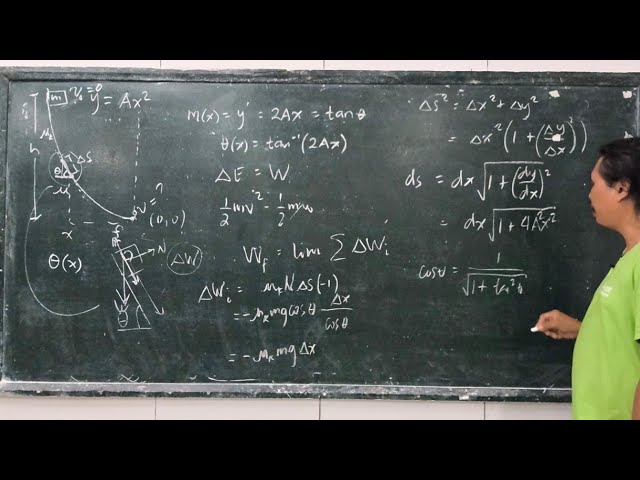
- Introduction and setup of first problem: block sliding on a parabolic ramp with friction.
- Derivation of the work done by friction using integration over arc length.
- Second problem: wave speed on a hanging rope as a function of position, leading to time integration.
- Third problem: time to reach 90% of terminal velocity with linear drag; calculation yields t = (m/b) ln 10.
- Integration of velocity to find distance fallen, with discussion of the zero-drag limit and challenges in inverting functions.
- Final remarks on the equivalence of Newton's second law and work-energy principle.
Contribution & Novelties
The video does not present original research but offers a clear, step-by-step approach to solving classic problems that are often covered in mechanics courses. Its contribution lies in the didactic style: breaking down each problem into manageable chunks and explicitly addressing common pitfalls, such as the correct expression for arc length and the behavior of the solution in limiting cases. The instructor’s suggestion to verify the algebra when uncertainties arise is a valuable practice for students.
Pour aller plus loin :
- Arc length — The underlying geometry used in the first problem.
- Terminal velocity — Relevant to the third problem on drag.
- Damping — Provides a broader context for linear drag forces and their solutions.
115 words
Radar Profile
The radar profile shows a very high technical level (9) and good information quantity (8), but slightly lower quality (7) and reliability (7). This suggests a mathematically intense but somewhat unpolished presentation, with occasional uncertainties that affect the overall confidence.