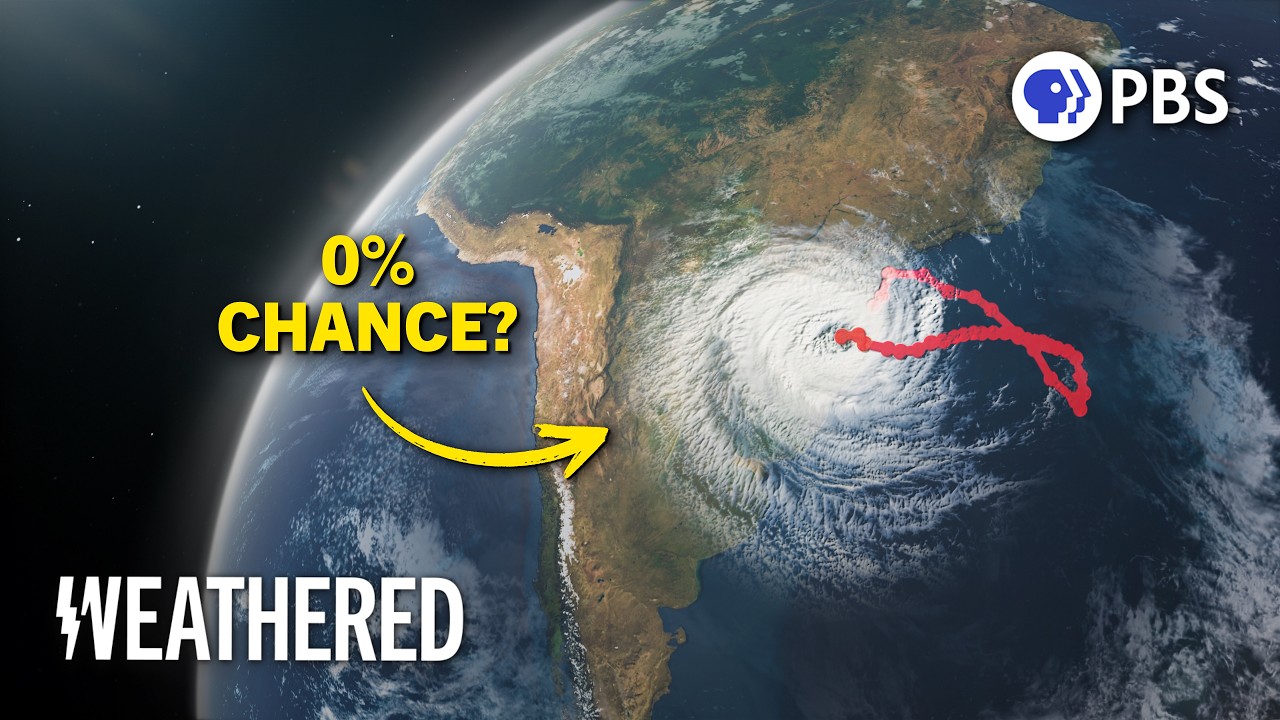
Why Are Hurricanes Terrified of South America?
Keywords
Summary
153 words
Critical Evaluation
Value of the Information & Strength of the Argument
The video provides substantial scientific value by explaining the global distribution of tropical cyclones through underlying physical mechanisms, such as the Coriolis effect, ocean heat content, and vertical wind shear. The argumentation is solid, building from the global pattern to the specific anomaly of Catarina, and consistently connects observed phenomena to fundamental meteorology. The use of expert quotes and references to real events (e.g., Typhoon Haiyan) strengthens the explanatory power. The heat engine analogy is particularly effective in conveying how hurricanes convert thermal energy into wind, and it illuminates why Catarina was possible despite cooler sea surface temperatures.
Scientific Rigor, Source Quality, Title Accuracy
The scientific rigor is high, with clear explanations grounded in established meteorological science. The video does not cite specific academic papers but relies on expert commentary and general consensus. The title is fully aligned with the content, as the video systematically addresses why hurricanes avoid South America and explores the lone exception. The sources provided in the description are promotional and support links, not primary scientific references, but the production quality and clarity of reasoning compensate. No comments are analyzed here.
194 words
Title / Content Match
The title is a captivating question that is directly addressed in the video, explaining why South America is rarely hit by hurricanes and highlighting the exceptional case of Hurricane Catarina.
Quality & Reliability
8/10
The video is produced by PBS Terra, a reputable public broadcaster, and relies on expert interviews and established meteorological concepts. The explanation of hurricane formation, Coriolis effect, and heat engine is accurate and well-illustrated.
Key Moments
Markers derived by PSI from the transcript: the creator did not define chapters.
- Introduction to the map of tropical cyclones and the question of why South America is an anomaly.
- Explanation of the Coriolis effect and why cyclones cannot form at the equator.
- Discussion of the Western Pacific warm pool and its role in super typhoons, referencing Haiyan.
- Analysis of why South America's Pacific and Atlantic coasts are hostile to hurricane formation.
- Introduction of Hurricane Catarina and the heat engine analogy explaining its formation.
- Exploration of how climate change may affect future hurricane tracks, expanding poleward.
Cited Sources
- Weather Hunters on PBS KIDS — Promotional video for a PBS KIDS series on meteorology, mentioned at the end of the episode.
- Support Weathered on Patreon — Link to the show's Patreon for viewer support and behind-the-scenes content.
- PBS Donate to Terra — Link to support PBS member stations, included in the description.
- Weathered Merch — Merchandise page for the series.
External References
Contribution & Novelties
The video’s original contribution lies in its effective use of a global tropical cyclone map to contextualize the rarity of hurricanes near South America, and its detailed physical explanation of Hurricane Catarina as a ‘heat engine’ powered by an unusual atmospheric setup. It demystifies the phenomenon without oversimplifying the science.
Pour aller plus loin :
- Hurricane Catarina — Comprehensive article on the 2004 storm, including its formation and impact.
- Coriolis force — Explains the inertial effect that influences cyclone rotation and trajectories.
- Maximum potential intensity — Theoretical upper limit of tropical cyclone intensity, relevant to the discussion of warm pool fuels.
- Indo-Pacific warm pool — Describes the largest warm ocean water reservoir, crucial for understanding Western Pacific cyclone activity.
119 words
Radar Profile
The scores portray a video with high information quantity and quality, moderate technical depth, and reliable overall presentation. The strong quantitative and qualitative scores indicate rich, well-structured content, while the technical level suggests accessibility to a general audience without sacrificing accuracy.