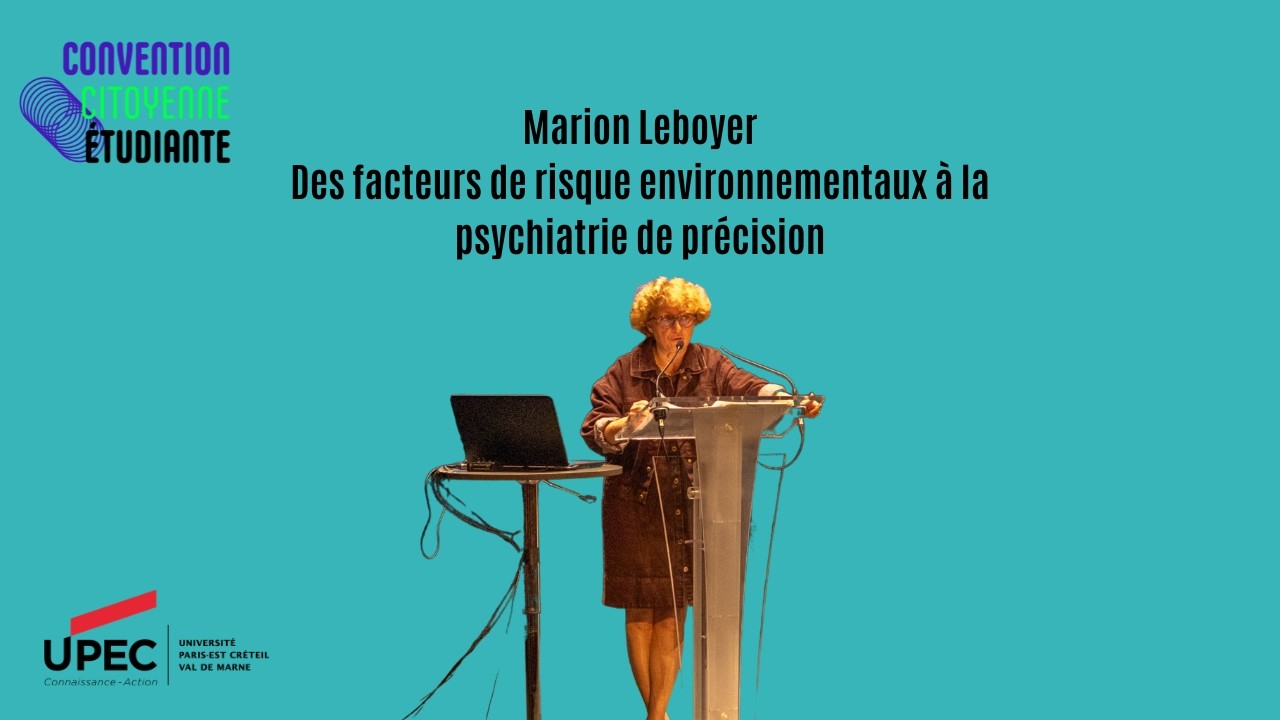
Marion Leboyer "Des facteurs de risque environnementaux à la psychiatrie de précision"
Keywords
Summary
171 words
Critical Evaluation
Value of the Information & Strength of the Argument
The value of this talk lies in its synthesis of recent research on how environmental factors interact with genetic vulnerability to trigger mental illness via inflammation. The argumentation is solid, building from historical evidence (Spanish flu, rubella) to modern immunopsychiatric findings. The speaker uses clear analogies (e.g., inflammation from a cut) to explain complex biology, and consistently links molecular mechanisms to public health implications. She convincingly argues for a paradigm shift from a purely symptomatic approach to a mechanism-based, precision-oriented psychiatry. The case for early prevention, such as preventing infections during pregnancy, is compelling, though one claim that one-third of schizophrenia cases could be prevented is stated without detailed supporting data in the talk, but is plausible given context.
Scientific Rigor, Source Quality, Title Accuracy
The speaker cites her own work and major projects, including European FP7 programs, publications in international journals, and coverage in L’Express. No external links are provided in the description, so external verification is not possible from the video alone. However, her credibility as a leading researcher and the specificity of her examples (e.g., 200-fold increase in autism after 1964 rubella pandemic) bolster reliability. The title is a faithful mirror of the content: it covers environmental factors and precision psychiatry without overpromising. The presentation is rigorous, and the speaker distinguishes between established findings and hypotheses, especially when discussing endogenous retroviruses and energy metabolism. No sponsored content is evident.
241 words
Title / Content Match
The title accurately reflects the content: the talk covers environmental risk factors for mental illness and explains the emergence of precision psychiatry.
Quality & Reliability
9/10
The speaker is a leading psychiatrist, professor at UPEC, director of research, and recipient of the Grand Prix de l'Inserm. She presented evidence-based findings from her laboratory and large European projects, with references to publications in major journals and media coverage. The presentation is clear, scientifically grounded, and avoids overstatement, though some claims (like one-third of schizophrenia cases preventable) are strong but presented with context.
Key Moments
Markers derived by PSI from the transcript: the creator did not define chapters.
- Introduction and welcome, speaker background and goals
- Mental health as public health priority: disability, costs, 20% impact
- Definition of precision psychiatry and heterogeneity of mental disorders
- Genetic-environment interaction and the role of chronic inflammation
- Infections as environmental risk factors: Spanish flu, rubella, COVID
- Nutrition and metabolic syndrome as modifiable factors
- Examples of new therapeutic targets and call for student collaboration
Cited Sources
- Swedish study on genetic and environmental contributions to mental illness — Discussed when showing a slide on the relative weight of genetic vs environmental factors
- EU FP7 program on environmental factors — Mentioned as a large European project she participated in with colleagues
- L'Express top 10 discoveries 2025 — Cited as media coverage of her findings
- Colloquium on endogenous retroviruses at Princeton University — Referenced as a recent meeting where she presented work
Contribution & Novelties
This talk offers an up-to-date synthesis of how environmental factors, especially infections and nutrition, may trigger mental illness through chronic inflammation. Its novel contribution is the strong emphasis on immunopsychiatry as a distinct discipline, linking genetic vulnerability to immune dysfunction and specific clinical phenotypes. The speaker also introduces precision psychiatry as a practical framework to go beyond broad diagnostic categories and tailor treatments, using biomarkers and risk profiles.
Pour aller plus loin :
- Psychoneuroimmunology — Explores the bidirectional link between the immune system and the brain, foundational for immunopsychiatry.
- Precision medicine — Describes the general approach of tailoring therapies to individual characteristics, directly relevant to precision psychiatry.
- Endogenous retrovirus — These ancient viral elements in our genome can be activated and may contribute to disease, as mentioned in the talk.
130 words
Radar Profile
The profile shows very high reliability and information quality, with moderate technical level and high quantity of information. This reflects an expert talk that is dense yet accessible, suitable for informed lay audiences.