Lecture 37 CNN 2021 12 07 at 01 34 GMT 8
Keywords
Summary
163 words
Critical Evaluation
Value of the Information & Strength of the Argument
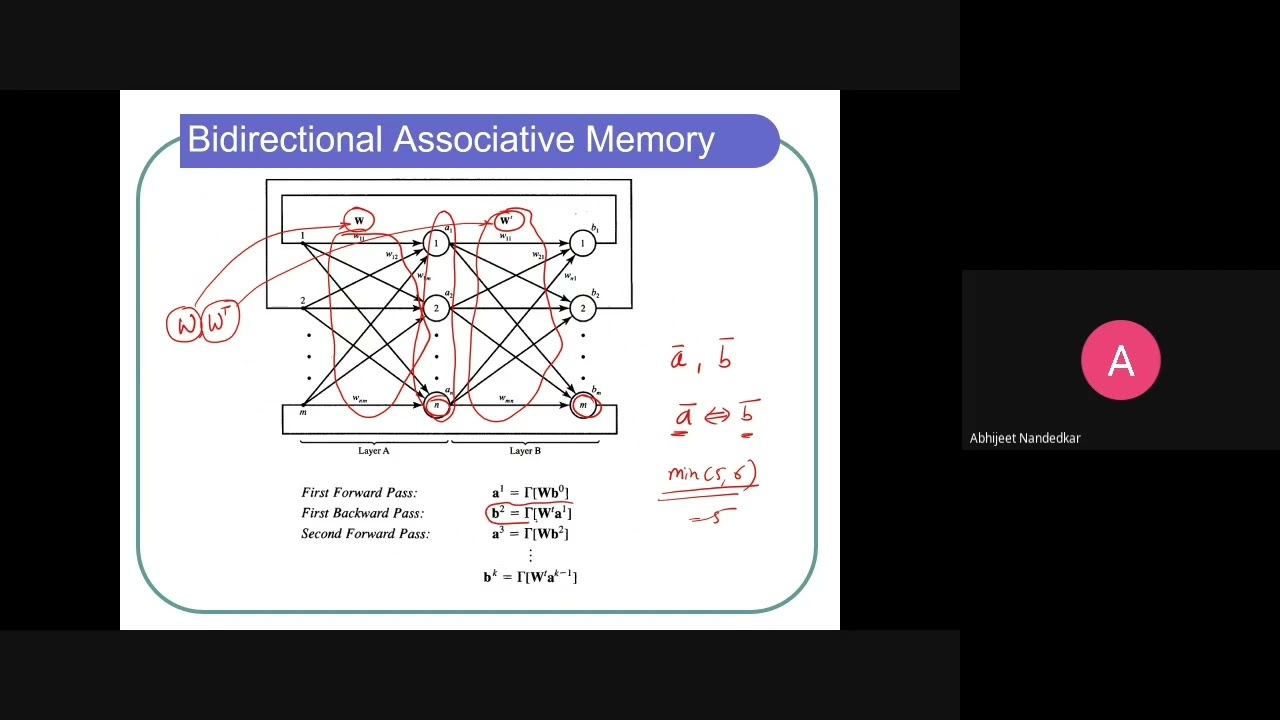
The lecture provides a clear, step-by-step explanation of BAM and CNN fundamentals. The argumentation is pedagogical: it builds from a recap of BAM, uses simple numerical examples (e.g., storing four vector pairs, computing weight matrices), and then motivates CNNs by their biological origins. The instructor effectively contrasts handcrafted features with automatic feature extraction in CNNs, and explains the convolution operation as a correlation for pattern matching. The value lies in its structured introduction to core concepts, suitable for learners. However, the depth is moderate; complex details such as exact capacity proofs, training algorithms, and modern CNN variants are not covered. The argument for the biological inspiration is somewhat simplified, and the historical timeline of CNN development is presented with minor inaccuracies (e.g., claiming CNN was proposed in 1995).
Scientific Rigor, Source Quality, Title Accuracy
Scientific rigor is adequate for a lecture but lacks explicit citations. The instructor refers to ‘old papers’ from 1959 and 1968 from Harvard Medical School without naming authors (likely Hubel & Wiesel), and mentions LeCun and Bengio without specific references. The description contains no links or sources. The title is a generic recording label that does not reflect the content, which covers BAM and CNN. No comments were provided for analysis.
214 words
Title / Content Match
The title is a generic recording label ('Lecture 37 CNN 2021 12 07 at 01 34 GMT 8') that does not describe the actual content, which covers Bidirectional Associative Memory and an introduction to Convolutional Neural Networks. The title is minimally informative and does not mislead, but it fails to reflect the lecture's substance.
Quality & Reliability
7/10
The lecture is delivered by an instructor in an academic-style course and covers standard, well-established material on Bidirectional Associative Memory (BAM) and Convolutional Neural Networks (CNN). The technical content is accurate and consistent with mainstream textbooks and the original literature (e.g., Hubel & Wiesel, LeCun et al.). However, the presentation lacks explicit citations in the transcript, and the description contains no links or references. The historical claims (e.g., CNN proposed in 1995 by Yann LeCun and Yoshua Bengio) are slightly imprecise—LeCun's LeNet was developed in the late 1980s and early 1990s, and the 1995 date is not standard. No sources are provided for the capacity heuristics of BAM. Overall, the information is reliable for educational purposes but not rigorously sourced.
Key Moments
Markers derived by PSI from the transcript: the creator did not define chapters.
- Recap of Bidirectional Associative Memory (BAM) and its weight matrix encoding.
- Explanation of capacity heuristics for BAM: minimum of layer sizes or its square root.
- Example of storing four vector pairs in BAM using outer products.
- Demonstration of recall with distorted input and iterative settling.
- Extension to multi-directional associative memory with three or more vectors.
- Transition to Convolutional Neural Networks (CNNs) and biological inspiration.
- Description of Hubel and Wiesel's experiments on cat and monkey visual cortex.
- Introduction to LeNet-5 architecture: input, C1, S2, C3, S4, C5 layers.
- Explanation of convolution operation as correlation with a 3x3 filter example.
- Discussion of feature extraction vs. classification in CNNs.
Contribution & Novelties
The lecture does not present original research; it is a pedagogical synthesis of established concepts. Its main value is in the clear, example-driven explanation of BAM and the transition to CNNs, including the biological motivation and the LeNet-5 architecture. It highlights the distinction between handcrafted features and automatic feature learning, and clarifies that the ‘convolution’ in CNNs is mathematically correlation. For learners, it provides a coherent narrative linking associative memory to modern deep learning.
Pour aller plus loin :
- Bidirectional Associative Memory — Wikipedia article on BAM, covering architecture and capacity.
- Convolutional Neural Network — Wikipedia article on CNNs, including history and LeNet.
- Hubel and Wiesel’s visual cortex experiments — Wikipedia page on David Hubel, detailing the 1959 and 1968 studies.
- LeNet-5 paper: LeCun, Y., Bottou, L., Bengio, Y., & Haffner, P. (1998). Gradient-based learning applied to document recognition. Proceedings of the IEEE, 86(11), 2278-2324. — Foundational paper on CNN architecture.
151 words
Radar Profile
The radar profile shows a balanced emphasis on information quantity and quality, with a moderate technical level. The reliability score is solid for an educational lecture, though the lack of explicit sources slightly lowers it. The overall shape indicates a competent tutorial that is informative but not deeply advanced.