Lect 16 ML Discriminant III
Keywords
Summary
235 words
Critical Evaluation
Value of the Information & Strength of the Argument
The informational value lies in a clear, step-by-step exposition of classical Gaussian discriminant analysis. The instructor builds from the simple maximum-output classifier to the formal Bayes decision rule, then systematically explores the three covariance cases, showing how the shape of the decision boundary depends on the covariance structure. The argumentation is logically structured: assumptions are stated (normality, equal priors), the likelihood equality is derived, and the resulting boundary equations are interpreted geometrically (threshold in 1D, line in 2D, plane in 3D, parabola in the general case). The worked exercise provides concrete numbers and a final equation, reinforcing the theory. The main limitation is the absence of a full derivation of the covariance matrix computation and the matrix inverses, which are left as an exercise; this reduces the self-containedness for a learner. Nevertheless, the reasoning is sound and the progression from simple to general cases is pedagogically effective.
Scientific Rigor, Source Quality, Title Accuracy
The lecture is technically rigorous and consistent with standard textbooks on pattern recognition, particularly Duda, Hart & Stork’s ‘Pattern Classification’, which is explicitly recommended (‘go through this duda book’). No other sources or URLs are provided in the description. The title ‘ML Discriminant III’ accurately reflects the content as the third installment on discriminant functions. The video is a classroom recording with no external citations, but the mathematical content is verifiable and correct. No comments were provided for analysis.
241 words
Title / Content Match
The title 'ML Discriminant III' accurately reflects a third lecture in a series on machine-learning discriminant functions; the content matches, covering Gaussian discriminant analysis and decision boundaries.
Quality & Reliability
7/10
The content is a standard, mathematically correct exposition of classical discriminant analysis (Bayes decision rule, Gaussian class-conditional densities, three covariance cases, quadratic decision boundaries). The derivations are consistent with the canonical reference (Duda, Hart & Stork). No external sources are cited in the description, and the video is a lecture recording with limited production polish, but the technical substance is sound and verifiable.
Key Moments
Markers derived by PSI from the transcript: the creator did not define chapters.
- Review of the basic classifier structure: input x, discriminant functions g1…gC, and max-output decision rule.
- Extension to multiclass problems (e.g., 10 digits, 26 letters) and the need for one discriminant function per class.
- Introduction of Gaussian class-conditional densities N(μi, Σi) and the two-class decision boundary concept.
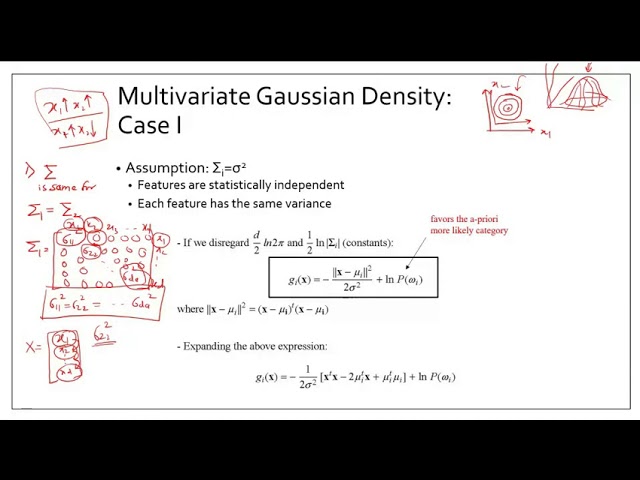
- Case 1: shared spherical covariance (Σi = σ²I) — circular Gaussian, linear boundary perpendicular to the mean-joining line.
- Case 2: shared but non-spherical covariance — elliptical Gaussian, linear boundary not perpendicular and not centered.
- Case 3: class-specific covariances — quadratic (parabolic) decision boundaries, suitable for nonlinear problems.
- Multiclass and multivariate extension: four Gaussian classes and their Bayes decision regions.
- Worked exercise: given μ1, μ2, Σ1, Σ2, and equal priors, find the decision boundary; final equation x2 = 3.514 − 1.125 x1 + 0.875 x1².
- Derivation hints: equate likelihoods, compute determinants and inverses, simplify to obtain the parabola; vertex via −b/2a.
Contribution & Novelties
This lecture does not present original research; it is a pedagogical consolidation of classical discriminant analysis. Its value lies in the structured walkthrough of the three covariance cases and the concrete worked exercise that bridges theory and practice. The explicit assignment of a numerical problem with a final parabolic boundary equation provides a tangible takeaway for learners.
Pour aller plus loin :
- Duda, Hart & Stork, Pattern Classification — The canonical textbook referenced in the lecture; covers Gaussian discriminant analysis in depth.
- Linear discriminant analysis — Wikipedia article on the linear case (shared covariance), directly related to Cases 1 and 2.
- Quadratic discriminant analysis — Wikipedia article on the quadratic case (class-specific covariances), corresponding to Case 3.
- Bayes classifier — Background on the Bayes decision rule used throughout the lecture.
130 words
Radar Profile
The radar profile shows high technical level and good information quality, with moderate quantity and reliability. The content is mathematically dense but self-contained, suitable for advanced learners. The absence of external citations slightly lowers the reliability score, but the material aligns with standard textbooks.