Lect 13 ML Risk Problem
Keywords
Summary
170 words
Critical Evaluation
Value of the Information & Strength of the Argument
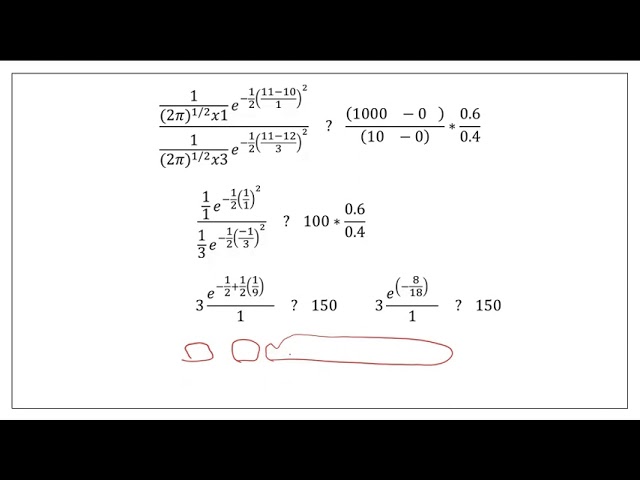
The pedagogical value is high for students learning Bayesian decision theory. The example is concrete and well-chosen: the asymmetric loss (1000 vs 10) illustrates why minimizing error probability is not always the right objective, and the lecturer explicitly contrasts this with the simple Bayes classifier that only minimizes error. The step-by-step derivation of the likelihood ratio test, including substitution of the normal density formula, is clear and reproducible. The transition from binary to multiclass classification via discriminant functions is logically motivated and sets up the next lecture. The argumentation is coherent and builds from a specific numerical problem to a general framework. However, the lecture assumes prior familiarity with the notation (lambda_ij, omega_i) and does not re-derive the threshold formula from first principles, which may leave some viewers behind. The explanation of why the threshold is 150 is somewhat rushed; the lecturer states the result without showing all intermediate algebra. Overall, the reasoning is sound and the example effectively demonstrates the core concepts.
Scientific Rigor, Source Quality, Title Accuracy
The scientific rigor is adequate for a classroom lecture: the mathematics is correct, the notation is consistent, and the example is well-posed. No external sources are cited, which is typical for a lecture but limits the viewer’s ability to verify or deepen the material. The title ‘ML Risk Problem’ is accurate and appropriately descriptive; it does not overpromise. There is no advertising segment in the video. No comments were provided for analysis.
250 words
Title / Content Match
The title 'ML Risk Problem' accurately reflects the content, which is a worked example of risk-based classification using Bayesian decision theory. The title is terse but not misleading.
Quality & Reliability
7/10
The lecture is a standard, mathematically correct treatment of Bayesian decision theory with asymmetric loss. The derivation of the likelihood ratio test and the threshold computation are sound and reproducible. However, no external sources, references, or citations are provided, and the video is a classroom recording with no peer review or editorial oversight. The content is reliable as a pedagogical exercise but lacks the sourcing expected of a research-grade presentation.
Key Moments
Markers derived by PSI from the transcript: the creator did not define chapters.
- Introduction of the robot navigation problem: road vs. mud, priors 0.4 and 0.6, normal feature distributions with means 10 and 12.
- Explanation of the loss matrix: lambda_12 = 1000 (mud classified as road), lambda_21 = 10 (road classified as mud), correct decisions cost 0.
- Derivation of the likelihood ratio test: decide omega_1 if p(x|omega_1)/p(x|omega_2) > threshold, where threshold depends on priors and losses.
- Substitution of normal density formulas into the likelihood ratio and computation of the threshold value (150).
- Numerical evaluation for x = 11: likelihood ratio = 1.92, which is less than 150, so the decision is mud (omega_2).
- Introduction of discriminant functions g_i(x) and the max selector for multiclass classification.
- Generalization to c classes: input vector x is fed to functions g_1(x) through g_c(x), and the class with the maximum output is chosen.
- Open question: how to design the discriminant functions? The lecturer indicates that Bayesian principles will be used, to be discussed in the next class.
- Lecture ends early due to an upcoming exam; students are dismissed.
Contribution & Novelties
This lecture does not present original research; it is a pedagogical exposition of classical Bayesian decision theory. Its value lies in the clear, worked example that integrates priors, class-conditional densities, and asymmetric losses into a single decision rule. The transition to discriminant functions provides a bridge to more advanced topics such as linear and quadratic discriminant analysis, and ultimately to neural network classifiers. The lecture is part of a course on artificial neural networks and machine learning, and it lays the groundwork for understanding how risk minimization can be implemented in a classifier architecture.
Pour aller plus loin :
- Bayesian decision theory — Overview of the theoretical framework used in this lecture.
- Likelihood-ratio test — The statistical test that underlies the decision rule derived here.
- Linear discriminant analysis — A classical method for designing discriminant functions, closely related to the multiclass extension discussed.
- Pattern recognition — Broader field that encompasses the classification problem presented.
154 words
Radar Profile
The radar profile shows a strong emphasis on information quality and technical depth, with moderate scores for quantity and overall reliability. The content is mathematically rigorous but limited in scope and external sourcing, which is typical for a single lecture. The balance suggests a solid educational resource rather than a comprehensive or research-level treatment.