lect 14 Minimum Distance Classifier
Keywords
Summary
178 words
Critical Evaluation
Value of the Information & Strength of the Argument
The lecture provides a clear, step-by-step derivation of the minimum distance classifier, starting from the limitations of the manual graphical approach for multi-class problems. The argumentation is logical: it first establishes the need for an automatic method, then introduces the concept of prototypes and the bisecting hyperplane, and finally derives the equation using vector algebra. The value lies in the pedagogical progression from a simple two-class example to a general multi-class formulation. The instructor explicitly connects the new method to the earlier discriminant function framework, showing how the decision boundary emerges as the intersection of planes. The derivation is mathematically sound and can be followed by anyone with basic linear algebra knowledge. However, the lecture does not discuss practical issues such as computational complexity, numerical stability, or the limitations of the minimum distance classifier when classes have different variances or are not linearly separable. The argumentation is strong for an introductory course but lacks depth on real-world applicability.
Scientific Rigor, Source Quality, Title Accuracy
The lecture is rigorous in its mathematical treatment, with consistent notation and logical steps. However, no external sources, textbooks, or research papers are cited. The instructor relies solely on the course material and board work. The title ’lect 14 Minimum Distance Classifier’ accurately reflects the main content, although the first part of the video is a test review and a recap of previous material. The ad-equation between title and content is good, with the core topic occupying the majority of the lecture. The absence of citations means the viewer cannot easily verify the material against standard references, but the derivations are standard and can be found in pattern recognition textbooks. The lecture is part of a series, and the instructor references previous classes, which provides context but also assumes prior knowledge.
304 words
Title / Content Match
The title accurately reflects the core topic: the lecture introduces and derives the minimum distance classifier after reviewing a previous test and a graphical two-class discriminant function example. The content is well aligned with the title, though the first portion covers exam corrections and a recap, which is a minor deviation.
Quality & Reliability
7/10
The lecture is delivered by an instructor in a structured academic course setting, with consistent mathematical derivations that can be independently verified. The content is internally coherent and follows standard pattern recognition theory. However, no external references, textbooks, or datasets are cited, and the video relies entirely on the instructor's board work. The absence of citations and the informal classroom Q&A format slightly reduce the formal reliability score.
Key Moments
Markers derived by PSI from the transcript: the creator did not define chapters.
- Review of previous test answers, covering biological neurons, perceptron learning, Hebbian learning, and logic gates.
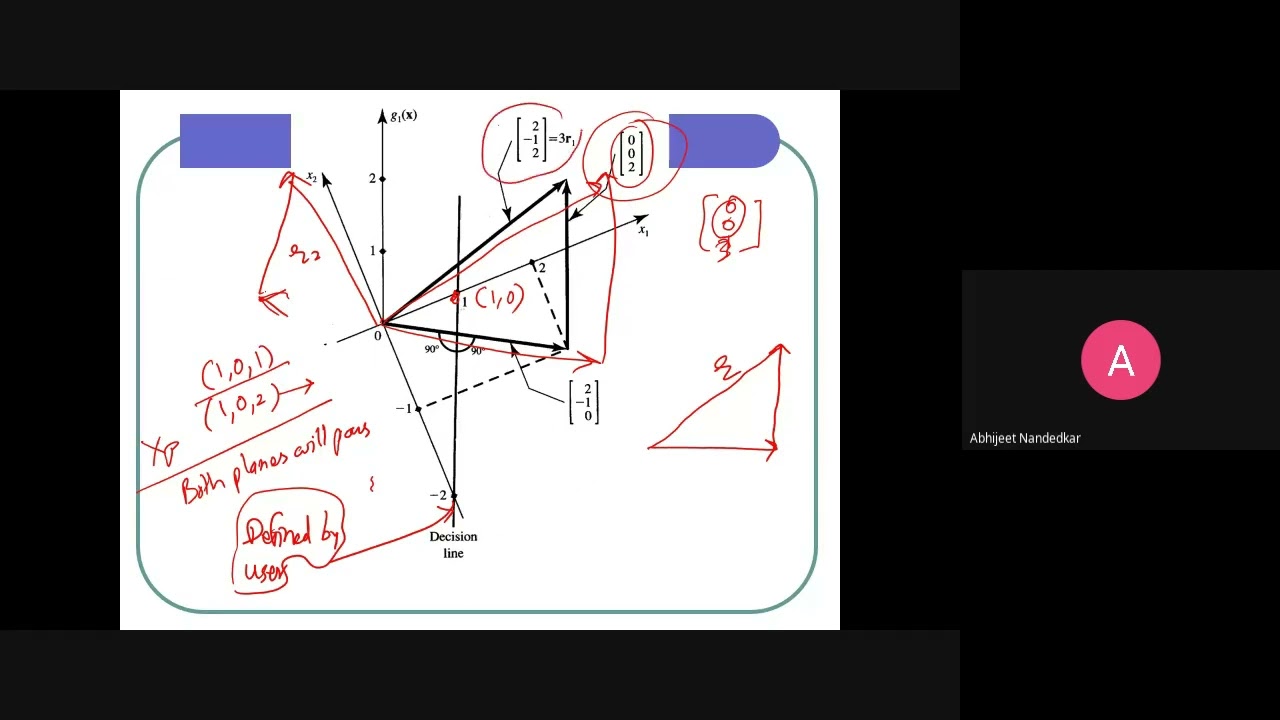
- Recap of discriminant functions for a two-class problem and the graphical method using normal vectors.
- Derivation of g1(x) and g2(x) planes from the decision line and normal vectors, with a point of intersection at (1,0,1).
- Verification of the classifier using training samples, showing correct classification for class 1 and class 2.
- Transition to multi-class problems and introduction of the minimum distance classifier.
- Explanation of prototypes (cluster centroids) and the bisecting hyperplane construction.
- Derivation of the hyperplane equation for the minimum distance classifier and its relation to the dichotomizer.
Contribution & Novelties
The lecture’s main contribution is a clear, pedagogical derivation of the minimum distance classifier as a solution to multi-class linear classification. It bridges the gap between the manual graphical design of discriminant functions and an automatic method based on prototypes. The step-by-step vector algebra is valuable for learners. However, the material is standard and can be found in pattern recognition textbooks; the novelty lies in the instructional presentation rather than in new research.
Pour aller plus loin :
- Minimum-distance classifier — Wikipedia article providing a concise overview and references.
- Linear classifier — Wikipedia article on linear classifiers, including the minimum distance classifier as a special case.
- Pattern recognition — Wikipedia article for broader context on classification methods.
- Duda, Hart, and Stork, ‘Pattern Classification’ — Standard textbook covering discriminant functions and minimum distance classifiers in detail.
135 words
Radar Profile
The radar profile shows high scores in information quality and technical level, reflecting the rigorous mathematical derivation and clear explanation. The quantity of information is moderate, as the lecture includes a test review and recap, reducing the time spent on the main topic. Overall reliability is good for an educational video, though limited by the absence of external citations.