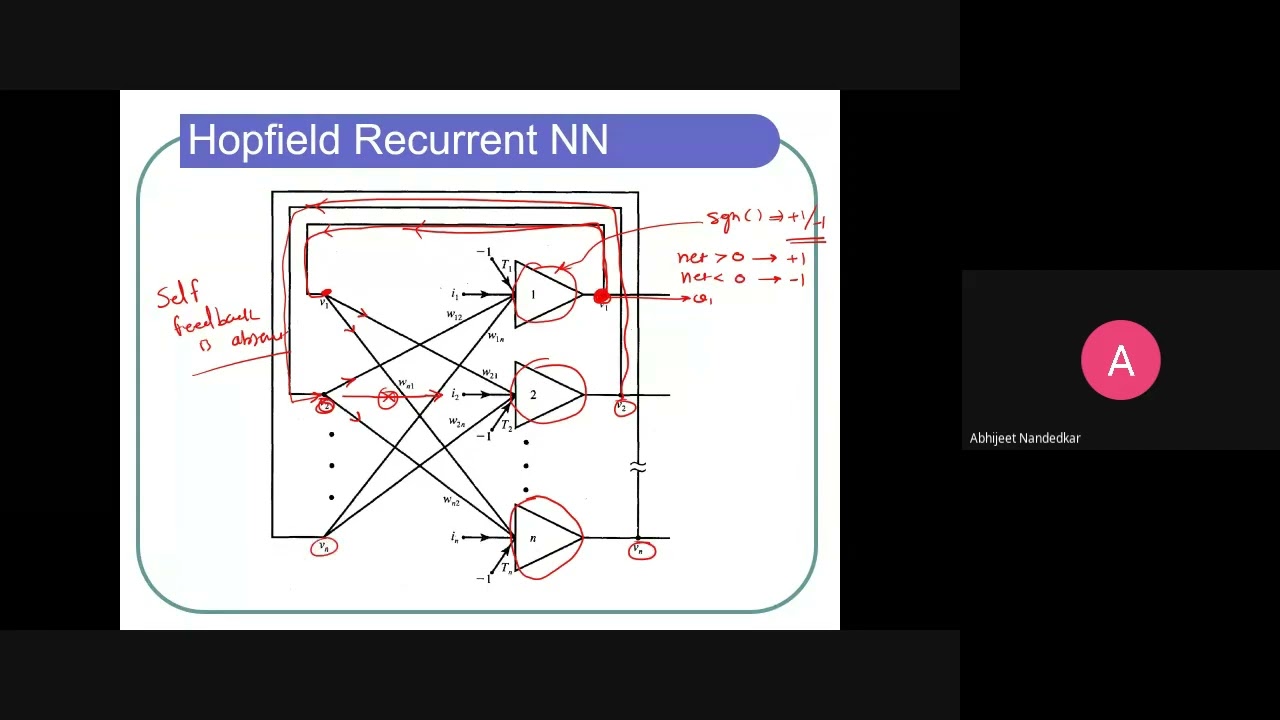
Lecture 34 Hopfield Recurrent N w 2021 12 02 at 01 33 GMT 8
Keywords
Summary
203 words
Critical Evaluation
Value of the Information & Strength of the Argument
The lecture provides a clear, pedagogically structured introduction to Hopfield networks, building from the limitations of the linear associator to the need for feedback and thresholding. The argumentation is logical: it first establishes the network architecture (single layer, sign activation, no self-feedback, symmetric weights), then explains the storage mechanism via energy minima, and finally justifies the asynchronous update rule through the Lyapunov stability theorem. The explanation of dynamical systems and stability concepts (Lyapunov stability, asymptotic stability, local/global minima, saddle points) is accurate and well-integrated, giving the audience the theoretical tools to understand why the network converges. The value lies in connecting abstract concepts (energy functions, attractors) to a concrete neural network model, which is essential for understanding associative memory. However, the lecture remains largely descriptive; the actual derivation of energy decrease is deferred, and no empirical results or examples are shown, which slightly limits the depth of the argumentation.
Scientific Rigor, Source Quality, Title Accuracy
The scientific rigor is solid for a lecture: the mathematical definitions (net input, weight symmetry, asynchronous update) are precise, and the Lyapunov stability argument is correctly invoked. The mention of Lyapunov as a Russian mathematician and the historical note (circa 19th century) is accurate, though no specific references are given. The title accurately reflects the content, as it is a lecture on Hopfield recurrent networks. No sources are cited in the description or transcript, which is a weakness for a scientific presentation, but typical for a classroom lecture. The absence of citations means the audience cannot easily verify claims or explore primary literature, though the material itself is standard textbook knowledge.
275 words
Title / Content Match
The title accurately reflects the content: it is a lecture (number 34) on Hopfield recurrent networks, delivered on 2021-12-02. The title is purely descriptive and matches the material covered.
Quality & Reliability
7/10
The lecture presents standard, well-established material on Hopfield networks and dynamical systems. The technical content is accurate: the symmetric weight matrix with zero diagonal, asynchronous stochastic updates, the Lyapunov (energy) function argument, and the distinction between local/global minima and saddle points are all correctly described. However, no primary sources, citations, or references are provided in the description or transcript, and the mathematical derivations are deferred to a future class, limiting verifiability within this single video.
Key Moments
Markers derived by PSI from the transcript: the creator did not define chapters.
- Introduction and recap of linear associator limitations with noisy data.
- Introduction of recurrent networks with feedback and the Hopfield network architecture.
- Explanation of sign activation function and no self-feedback property.
- Concept of energy-based system and storing patterns as energy minima.
- Net input formula and symmetric weight matrix with zero diagonal.
- Asynchronous update rule: one neuron updated at a time in random sequence.
- Convergence criterion: iteration stops when state vector stabilizes.
- Lyapunov function and asymptotic stability principle.
- Review of dynamical systems: state space and dynamical rule.
- Lyapunov stability vs. asymptotic stability, and energy landscape (local/global minima, saddle points).
Contribution & Novelties
This lecture does not present new research; it is an educational exposition of the Hopfield network, a classic model in neural computation. Its original contribution lies in the clear, step-by-step explanation of how energy-based associative memory works, bridging dynamical systems theory and neural network design. It emphasizes the asynchronous update rule and the Lyapunov stability argument, which are often glossed over in introductory treatments.
Pour aller plus loin :
- Hopfield network — Wikipedia article providing a comprehensive overview of the model, its history, and mathematical details.
- Lyapunov stability — Wikipedia article explaining the stability concepts used in the lecture.
- Associative memory — Wikipedia article on associative memory in neural networks, relevant to the auto-associator aspect.
- John J. Hopfield, “Neural networks and physical systems with emergent collective computational abilities” (1982), PNAS — the seminal paper introducing the Hopfield network.
138 words
Radar Profile
The radar profile shows a balanced emphasis on information quantity and quality, with a slightly lower technical level due to the lecture's introductory nature. Reliability is solid, reflecting standard textbook material, but the lack of citations and deferred derivations slightly reduce the overall score.