Lecture 12 Problems 2
Keywords
Summary
162 words
Critical Evaluation
Value of the Information & Strength of the Argument
The pedagogical value is high for students learning the fundamentals of perceptrons and multilayer networks. Each problem is solved step by step, with the instructor explicitly deriving the net input equations from the circuit diagrams. The argumentation is deductive and transparent: for the ADC, the instructor starts from the assumption that all outputs are zero, then tests a specific input to show how the code changes, and invites students to complete the table. For the bipolar network, the method of using coefficient vectors to determine the positive side of a decision boundary is clearly explained and demonstrated with sample points. For the continuous activation problem, the algebraic inversion of the sigmoid is shown in detail, leading to a system of two equations solved for X1 and X2. The reasoning is rigorous and free of logical gaps. The only limitation is that the problems are standard textbook exercises, so the novelty is low; the value lies in the clear exposition of solution techniques.
Scientific Rigor, Source Quality, Title Accuracy
No external sources are cited; the lecture relies entirely on the instructor’s derivations. The mathematical rigor is good: equations are set up correctly, and the sign conventions for bipolar neurons are stated. The title ‘Lecture 12 Problems 2’ is adequate, indicating a continuation of problem-solving sessions. There is no advertising segment in the video. The absence of references is typical for a classroom recording, but it means the viewer cannot easily consult additional material. The instructor’s method for determining the positive region of a neuron (using the coefficient vector) is a standard and correct technique. Overall, the scientific rigor is solid for an educational context, though not at the level of a research publication.
291 words
Title / Content Match
The title 'Lecture 12 Problems 2' accurately reflects the content: a problem-solving session following a previous lecture on neural network rules. The title is generic but not misleading.
Quality & Reliability
7/10
The content is a university lecture-style problem-solving session on neural networks. The reasoning is mathematically sound and self-contained: the ADC perceptron problem, the bipolar neuron plane partition, and the continuous activation function inversion are all worked through with explicit equations. No external sources are cited, but the derivations are verifiable and internally consistent. The main weakness is the absence of references and the informal, classroom-recording nature of the material.
Key Moments
Markers derived by PSI from the transcript: the creator did not define chapters.
- Introduction and recap of previous lecture on neural network rules.
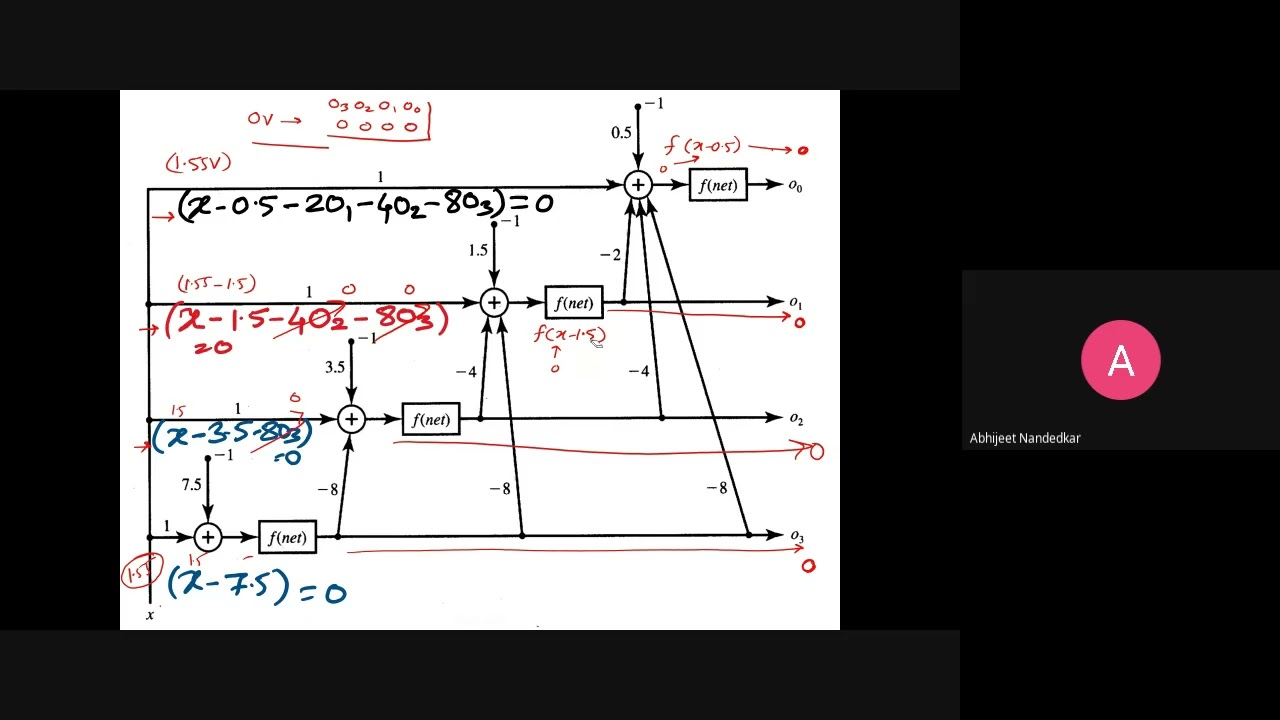
- Problem 1: Analog-to-digital converter using perceptrons with unipolar binary neurons.
- Derivation of net values for each of the four neurons in the ADC circuit.
- Testing input 0 V: all outputs zero, code 0000.
- Testing input 1.55 V: output code 0100, illustrating code change.
- Transition to Problem 2: feedforward network with bipolar binary neurons.
- Deriving the condition for the final neuron to fire: O1+O2+O3-2.5 > 0.
- Plotting decision boundaries of the three hidden neurons on the X1-X2 plane.
- Identifying the common region where all three neurons fire, defining class +1.
- Problem 3: continuous activation function, back-calculating input vector from outputs.
- Solving for X1 and X2 using the inverted sigmoid equations.
- Administrative announcements about exam and assignment.
Contribution & Novelties
This lecture does not present new research; it is a pedagogical session that reinforces standard neural network concepts through worked examples. The original contribution is the clear, step-by-step demonstration of how to analyze perceptron-based circuits and multilayer networks, which can serve as a study aid. The instructor’s method of using coefficient vectors to determine the positive side of a decision boundary is a useful heuristic for students.
Pour aller plus loin :
- Perceptron — Wikipedia article covering the history and mathematics of the perceptron.
- Sigmoid function — Wikipedia article explaining the sigmoid and its derivative, relevant to the continuous activation problem.
- Artificial neuron — Wikipedia article on the mathematical model of artificial neurons.
- Decision boundary — Wikipedia article on decision boundaries in classification.
123 words
Radar Profile
The radar profile shows a strong emphasis on technical depth and information quantity, reflecting the detailed mathematical derivations. Reliability is moderate due to the lack of external sources, but the internal consistency is high. The overall profile is typical of a solid educational lecture.