32 ML MarkovChain
Keywords
Summary
182 words
Critical Evaluation
Value of the Information & Strength of the Argument
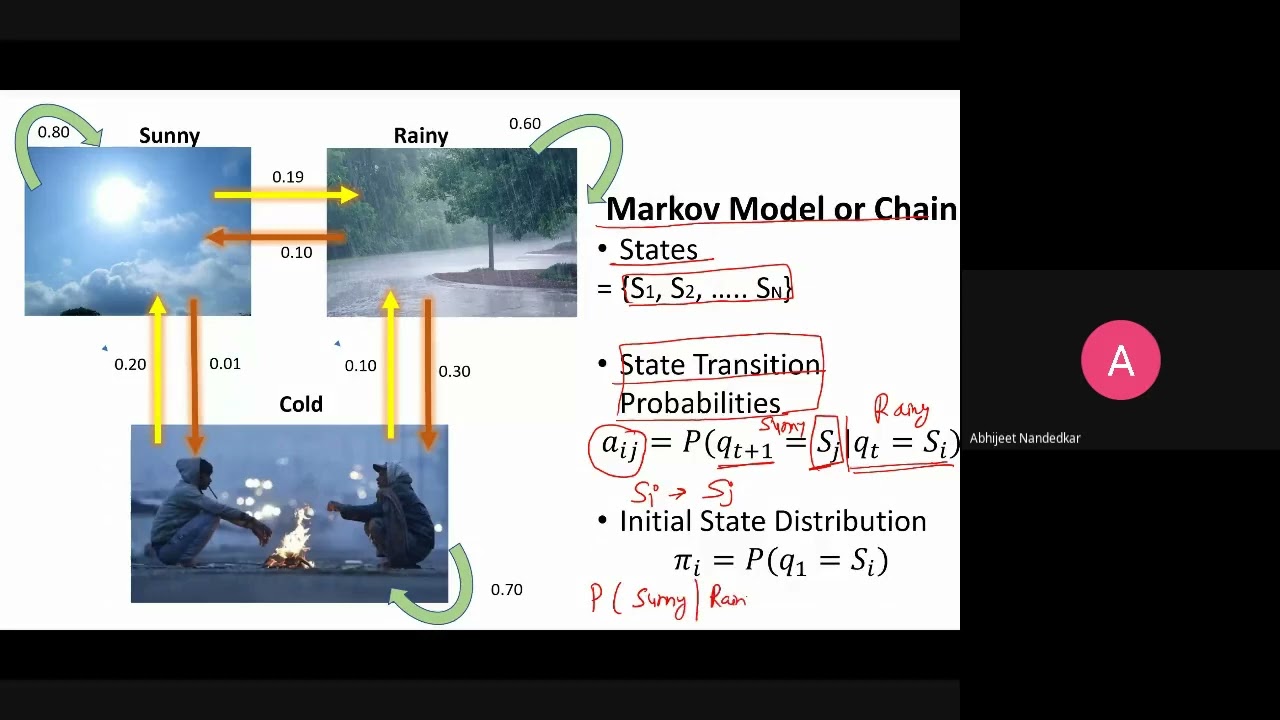
The video offers substantial educational value for beginners in machine learning and probabilistic modeling. It clearly defines key concepts: states, transition probabilities, initial distribution, emission probabilities, and the Markov property. The argumentation is logical and step-by-step, building from simple Markov chains to HMMs. The weather example is intuitive and effectively demonstrates how to construct a transition matrix and compute sequence probabilities. The hidden Markov model section is particularly valuable, as it explains the distinction between hidden states and observable emissions using a relatable scenario (a locked room with a food server). The calculation of joint probability for a sequence of hidden states and observations is detailed and correct. However, the video does not discuss limitations, assumptions (e.g., stationarity), or more advanced topics like the Baum-Welch algorithm or Viterbi decoding. The explanation of the evaluation problem is brief and could be expanded. Overall, the argumentation is sound but limited in depth, suitable for an introductory audience.
Scientific Rigor, Source Quality, Title Accuracy
The video does not cite any external sources, academic papers, or textbooks. The only historical reference is to Andrey Markov, but no specific works are mentioned. The content is self-contained and mathematically correct, but the lack of citations reduces its scientific rigor. The title ‘32 ML MarkovChain’ accurately reflects the content, indicating a tutorial on Markov chains within a machine learning series. The ‘32’ likely denotes a lecture number. There is no misleading or clickbait element. The video does not include any advertising sequences. No comments were provided for analysis.
260 words
Title / Content Match
The title '32 ML MarkovChain' accurately reflects the content, which is a tutorial on Markov chains and hidden Markov models. The '32' likely indicates a lecture number in a series.
Quality & Reliability
6/10
The video provides a clear, mathematically consistent introduction to Markov chains and hidden Markov models, with correct definitions, transition matrices, and joint probability calculations. However, it lacks citations to primary sources, relies on a single hypothetical weather example, and contains minor transcription errors (e.g., 'Marco' for 'Markov'). The content is accurate but not peer-reviewed or sourced.
Key Moments
Markers derived by PSI from the transcript: the creator did not define chapters.
- Introduction to Andrey Markov and stochastic processes.
- Explanation of first-order Markov property: next state depends only on current state.
- Weather example with three states: sunny, rainy, cold.
- Definition of state transition probability matrix and row sum property.
- Calculation of sequence probability using initial and transition probabilities.
- Introduction to hidden Markov models: hidden vs observable states.
- Emission matrix and observable symbols (sweater, umbrella, shorts).
- Joint probability calculation for hidden state and observation sequence.
- Overview of the evaluation problem in HMMs and speech recognition application.
Contribution & Novelties
The video provides a clear, example-driven introduction to Markov chains and hidden Markov models, suitable for learners new to the topic. It distinguishes itself by using a simple weather model and a locked-room scenario to explain hidden states and emissions, making abstract concepts accessible. The step-by-step calculation of joint probabilities reinforces understanding. However, it does not present new research or novel applications; it is a pedagogical tutorial.
Pour aller plus loin :
- Markov chain — Wikipedia article covering the mathematical foundations and applications.
- Hidden Markov model — Wikipedia article explaining HMMs, algorithms (Baum-Welch, Viterbi), and use cases.
- Andrey Markov — Biographical article on the Russian mathematician who introduced Markov chains.
- Speech recognition with HMMs — Classic application; see Jurafsky & Martin, ‘Speech and Language Processing’ (no URL provided due to uncertainty).
131 words
Radar Profile
The radar profile shows moderate scores across all dimensions, with quantity and quality of information slightly higher than technical depth and global reliability. This reflects a solid introductory tutorial that is accurate but not exhaustive or heavily sourced.