21 ml parzen
Keywords
Summary
241 words
Critical Evaluation
Value of the Information & Strength of the Argument
The lecture provides solid pedagogical value by building from the simple histogram method to the more flexible Parzen window approach. The argumentation is clear and logical: it first establishes the limitations of histograms (curse of dimensionality, empty bins, manual partitioning difficulties) and then presents Parzen windows as a solution that avoids partitioning the entire space. The step-by-step numerical example reinforces the theoretical explanation and shows how to apply the method in practice. The discussion of the trade-off between window width H and sample size n is particularly instructive, illustrating the bias-variance trade-off in non-parametric estimation. The argument that with infinite samples any window width yields the true density is correctly stated. However, the lecture does not delve into theoretical convergence properties, optimal bandwidth selection, or comparisons with other non-parametric methods like k-nearest neighbors, which limits the depth of the argumentation.
Scientific Rigor, Source Quality, Title Accuracy
The lecture is mathematically rigorous and follows standard textbook material, but it does not cite any sources, references, or further reading. The content aligns with classical pattern recognition literature (e.g., Duda & Hart), but no explicit attribution is made. The title ‘21 ml parzen’ is not descriptive and does not reflect the depth or scope of the lecture; it appears to be an internal course code. The adéquation between title and content is weak, as the title gives no indication of the topic beyond the keyword ‘parzen’. No comments were provided for analysis.
248 words
Title / Content Match
The title '21 ml parzen' is a cryptic abbreviation that does not clearly describe the content; the video is a lecture on Parzen window density estimation and classification. The title is minimally adequate but not informative.
Quality & Reliability
7/10
The lecture presents standard, well-established material on non-parametric density estimation (histogram, Parzen window) with a clear worked example. The mathematical content is accurate and the pedagogical progression is sound. However, the video is a classroom recording with no citations, no references to primary literature, and no discussion of limitations or alternatives beyond the basics. The reliability of the information itself is high because it reflects textbook knowledge, but the lack of sourcing and the informal delivery reduce the score.
Key Moments
Markers derived by PSI from the transcript: the creator did not define chapters.
- Introduction to non-parametric techniques and histogram approach.
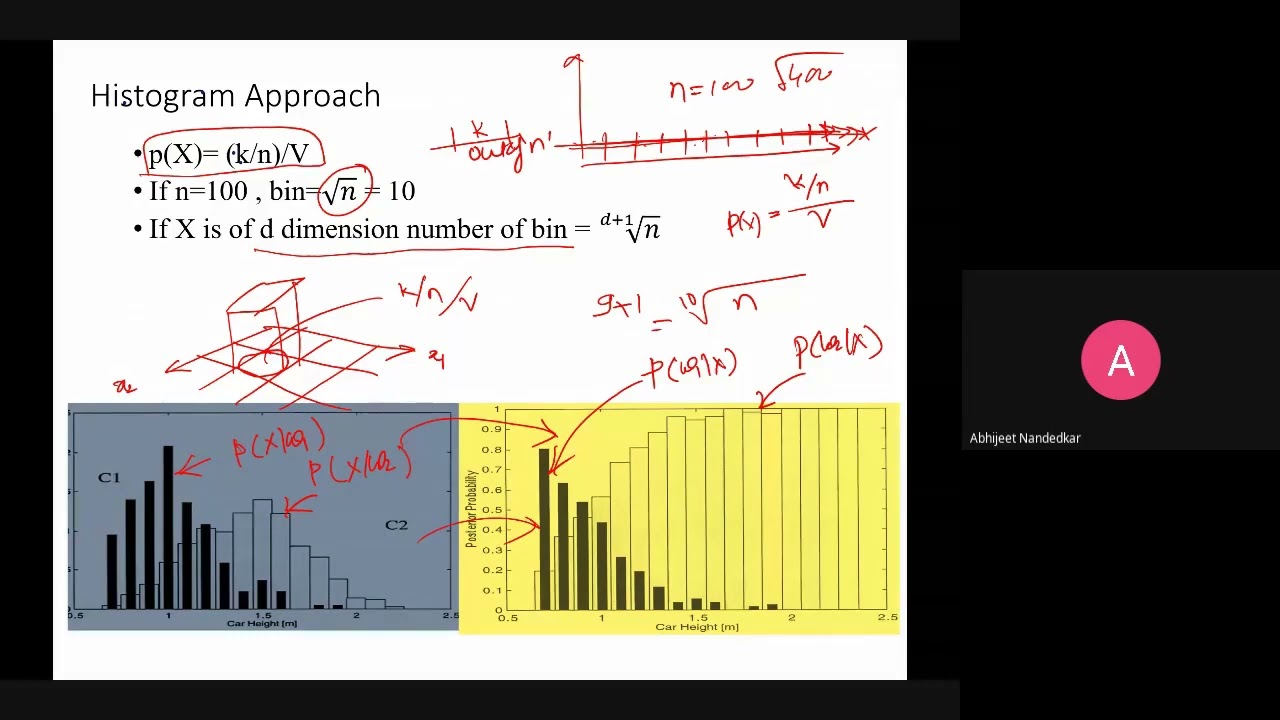
- Explanation of histogram binning rule: number of bins = sqrt(n) for 1D, (D+1)-th root for D dimensions.
- Limitations of histogram method in high dimensions and with sparse data.
- Introduction to Parzen window: centering a hypercube at the point of interest.
- Definition of the window function ψ(u) and counting samples inside the hypercube.
- Demonstration of Parzen window with Gaussian kernel in 1D, showing effect of H and n.
- 2D example with mixture of uniform and triangular distributions, illustrating estimation quality.
- Numerical example: estimate density at x=3.1 with H=1, resulting in p=0.3.
- Extension to classification: two classes, Bayes rule, posterior calculation.
- Conclusion: test point classified as class 1; mention of probabilistic neural network (PNN).
Contribution & Novelties
The lecture does not present original research; it is a standard educational presentation of Parzen window density estimation. Its value lies in the clear, step-by-step explanation and the worked numerical example, which is not always found in textbooks. The mention of the probabilistic neural network (PNN) as a parallel implementation provides a bridge to neural network approaches.
Pour aller plus loin :
- Parzen window — Wikipedia article on the method.
- Kernel density estimation — Generalization of Parzen window.
- Probabilistic neural network — Neural network implementation of Parzen window.
- Pattern Recognition and Machine Learning — Textbook by Christopher Bishop covering density estimation.
- The Elements of Statistical Learning — Textbook by Hastie et al. covering kernel methods.
115 words
Radar Profile
The radar profile shows moderate information quantity and quality, with a technical level appropriate for an introductory graduate course. Reliability is relatively high due to the standard nature of the material, but the lack of sources and the informal delivery lower the overall score. The profile reflects a solid but not exceptional educational video.