03 ML Regression
Keywords
Summary
167 words
Critical Evaluation
Value of the Information & Strength of the Argument
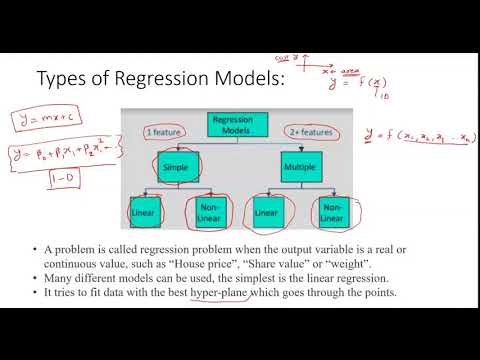
The lecture provides a solid, self-contained introduction to regression. The value lies in its clear progression from intuitive concepts (fitting a line through data points) to formal mathematical derivation. The instructor uses simple examples (house price vs. area) and visual aids (squared error as areas of boxes) to build intuition. The argumentation is logical: define the problem, define the error metric, then minimize it using calculus. The derivation of the normal equations is correct and detailed, which is valuable for learners who need to see intermediate steps often omitted in textbooks. However, the content is standard and does not offer novel insights or advanced techniques. The interactive quiz reinforces the distinction between regression and classification, which is pedagogically useful. The main limitation is the lack of discussion on assumptions (e.g., linearity, independence, homoscedasticity) and potential pitfalls (e.g., outliers, overfitting).
Scientific Rigor, Source Quality, Title Accuracy
The scientific rigor is high for the mathematical content: the derivation is accurate and the definitions are precise. However, no sources or references are cited, which is a weakness for a lecture that could benefit from pointing to textbooks or papers. The title ‘03 ML Regression’ accurately reflects the content, as the entire video is dedicated to regression. The absence of sources means the viewer cannot easily verify or deepen the material, but the internal consistency and correctness of the mathematics compensate partially. The lecture is part of a series (indicated by ‘03’), suggesting a structured course, but no external validation is provided.
257 words
Title / Content Match
The title '03 ML Regression' accurately reflects the content, which is a lecture on regression in machine learning. The match is direct and unambiguous.
Quality & Reliability
7/10
The content is a standard, mathematically correct lecture on regression and ordinary least squares. The derivation of the normal equations is performed step by step and is accurate. No external sources are cited, but the material is textbook-level and internally consistent. The absence of references and the classroom setting limit the score to 7.
Key Moments
Markers derived by PSI from the transcript: the creator did not define chapters.
- Introduction to regression as a machine learning task.
- Definition of regression: approximating a mapping function f from x to continuous y.
- Explanation of root mean squared error (RMSE) as an evaluation metric.
- Introduction to simple linear regression and fitting a straight line.
- Visualization of squared errors as areas of boxes to minimize.
- Derivation of the normal equations: differentiation with respect to beta 0.
- Derivation continued: differentiation with respect to beta 1.
- Final formulas for beta 0 and beta 1 in terms of means and sums.
- Interactive quiz: classifying problems as regression or classification.
- Summary and announcement of practical implementation next class.
Contribution & Novelties
The video does not present new research or novel findings; it is a pedagogical lecture on standard regression techniques. Its originality lies in the clear, step-by-step derivation of the ordinary least squares solution, which is often glossed over in textbooks. The instructor’s use of visual analogies (squared errors as areas) and interactive quizzes enhances understanding for beginners. The content is a review of established knowledge rather than a contribution to the field.
Pour aller plus loin :
- Linear regression — Wikipedia article covering the basics and extensions.
- Ordinary least squares — Detailed explanation of the method and its properties.
- Mean squared error — Overview of the error metric and its variants.
- Regression analysis — Broader context of regression in statistics.
120 words
Radar Profile
The radar profile shows high scores in information quality and reliability, reflecting the accurate mathematical content. The technical level is moderate, suitable for an introductory audience. The quantity of information is good but not exhaustive, as it focuses on simple linear regression. Overall, the profile indicates a solid educational resource with room for deeper exploration.