Lect 11 ML Bayes Problem
Keywords
Summary
215 words
Critical Evaluation
Value of the Information & Strength of the Argument
The informational value lies in the clear, step-by-step application of Bayes’ theorem to concrete classification tasks. The instructor carefully distinguishes likelihood, prior, evidence, and posterior, and shows how the evidence term is computed via marginalization (sum rule). The numerical examples are simple enough to follow and verify, and the transition from discrete histograms to parametric models is motivated by a genuine limitation (zero likelihood for unseen values). The argumentation is pedagogical and logically sequenced: define the problem, compute posteriors, make a decision, quantify error, expose a failure case, and propose a solution. However, the depth is limited to introductory material; there is no discussion of alternative classifiers, decision boundaries, or the consequences of violating the normality assumption. The reasoning is sound but not novel, and the lecture remains at the level of a standard textbook exposition.
Scientific Rigor, Source Quality, Title Accuracy
Scientifically, the content is rigorous within its scope: the Bayes rule is applied correctly, the probabilities sum to one, and the error is correctly identified as 1 minus the maximum posterior. The formulas for the univariate and multivariate normal distributions are standard and correctly stated. However, no external sources, references, or datasets are cited; the lecture relies entirely on the instructor’s own examples. The title ‘Lect 11 ML Bayes Problem’ accurately describes the content, which is a lecture on Bayes problems in machine learning. No comments were provided, so no audience analysis is included.
245 words
Title / Content Match
The title 'Lect 11 ML Bayes Problem' accurately reflects the content: a lecture on Bayes' theorem applied to machine learning classification problems. The match is direct and unambiguous.
Quality & Reliability
7/10
The content is a standard, mathematically correct exposition of Bayesian decision theory for a classroom setting. The formulas and numerical examples are accurate and internally consistent. However, the lecture relies entirely on the instructor's own worked examples without citing external textbooks, papers, or datasets, and the board work is not visible in the transcript, which limits independent verification. The treatment is introductory and omits deeper discussion of assumptions, limitations, or alternative methods.
Key Moments
Markers derived by PSI from the transcript: the creator did not define chapters.
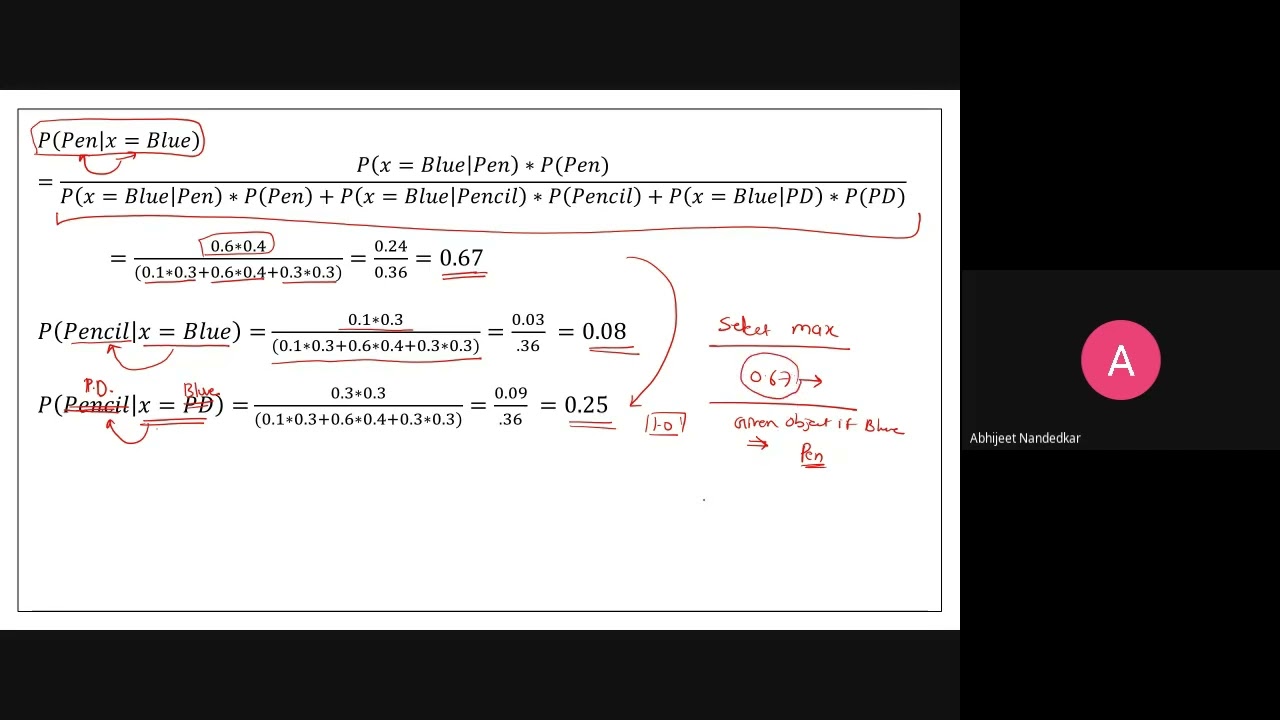
- Introduction of the three-class problem (pen, pencil, pen drive) with three colors.
- Definition of priors and likelihood table for the three-class problem.
- Application of Bayes' rule to compute posterior probabilities for a blue object.
- Decision based on maximum posterior (pen) and calculation of error probability (0.33).
- Homework assignment: repeat for red and green objects.
- Introduction of the two-class problem (plate vs. bucket) with diameter measurements.
- Construction of histograms and computation of likelihoods for diameter 0.1.
- Bayesian computation for plate vs. bucket, yielding posteriors 0.86 and 0.14.
- Discussion of the zero-likelihood problem for unseen measurements (e.g., 0.15).
- Introduction to parametric methods and the normal distribution model.
- Presentation of the univariate normal density formula and parameter estimation.
- Extension to multivariate normal distribution and covariance matrix.
Contribution & Novelties
This lecture does not present original research; it is a pedagogical walkthrough of Bayesian classification. Its value is in the clear, incremental development from discrete histograms to parametric models, using simple examples that make the concepts accessible. The instructor explicitly motivates the need for parametric methods by showing the failure of the discrete approach when a test value is unseen. The multivariate normal formula and the covariance matrix are introduced, but the lecture stops before solving a full multivariate problem.
Pour aller plus loin :
- Bayes’ theorem — Fundamental principle underlying the entire lecture.
- Naive Bayes classifier — A direct application of the Bayesian approach to classification.
- Multivariate normal distribution — The parametric model introduced at the end of the lecture.
- Covariance matrix — Key concept for multivariate parametric methods.
- Pattern Recognition and Machine Learning by Christopher M. Bishop — Standard textbook covering Bayesian decision theory and parametric methods.
149 words
Radar Profile
The radar profile shows moderate to high scores in information quantity, quality, and reliability, reflecting a solid but introductory treatment. The technical level is moderate, as the lecture covers basic probability and introduces multivariate concepts without deep mathematical derivation. Overall, the profile is typical of a well-structured undergraduate lecture.