Lect05 Mc-Culloch - Pitts Model and Learning Rules- Part-1
Keywords
Summary
250 words
Critical Evaluation
Value of the Information & Strength of the Argument
The informational value of this lecture lies in its clear, step-by-step exposition of foundational concepts in neural network learning. The instructor builds from the McCulloch-Pitts model to the Hebbian and perceptron rules in a logical progression, using concrete numerical examples that make the abstract update equations tangible. The argumentation is pedagogical rather than argumentative: the instructor does not defend a thesis but rather explains established mechanisms. The distinction between unsupervised (Hebbian) and supervised (perceptron) learning is made explicit and is central to the lecture’s structure. The categorization of learning rules (supervised/unsupervised, competitive/reinforcement, online/batch) provides a useful conceptual map, though each category is only briefly described. The worked example for Hebbian learning is detailed and reproducible, with all intermediate values shown. The perceptron example is introduced but not completed, which slightly reduces the standalone value of this part. The instructor’s explanation of why the perceptron rule adds the (d − o) term — to incorporate a teacher signal — is a key conceptual point well conveyed. Overall, the lecture is a solid, if conventional, introduction to the topic, with no original research or novel synthesis.
Scientific Rigor, Source Quality, Title Accuracy
The lecture does not cite any external sources, papers, or textbooks, either in the description or during the talk. Historical attributions are made verbally (Hebb 1949, Rosenblatt 1958, McCulloch-Pitts ‘46 or 47’), but no references are provided. The dating of the McCulloch-Pitts model is imprecise; the canonical paper is from 1943. The mathematical content is rigorous and correct: the update rules are stated accurately, and the numerical examples are consistent. The title accurately reflects the content, covering the McCulloch-Pitts model and learning rules, with the ‘Part-1’ qualifier justified by the unfinished perceptron example. No comments were provided for analysis.
298 words
Title / Content Match
The title accurately reflects the content: the lecture covers the McCulloch-Pitts model and introduces learning rules (Hebbian and perceptron), matching the stated topic. The 'Part-1' designation is consistent with the fact that the perceptron example is left unfinished at the end.
Quality & Reliability
7/10
The lecture is delivered by an instructor in an academic course setting and covers well-established, textbook-level material (McCulloch-Pitts neuron, Hebbian rule, perceptron rule). The historical attributions (Hebb 1949, Rosenblatt 1958, McCulloch-Pitts 1943) are broadly correct, though the instructor's dating of the McCulloch-Pitts model as '46 or 47' is imprecise (the canonical paper is 1943). No external sources or references are cited, and no primary literature is pointed to, which limits verifiability. The mathematical content is correct and reproducible, and the worked examples are consistent. The main weakness is the absence of any bibliography or pointers to primary sources.
Key Moments
Markers derived by PSI from the transcript: the creator did not define chapters.
- Recap of the McCulloch-Pitts neuron: net = w^T x, output o = f(net), threshold activation.
- Review of logic gates (NOT, AND, NAND) implemented with hand-set ±1 weights.
- Introduction to learning rules: goal is to find w automatically from training data.
- General weight update form: w_new = w_old + Δw, applied per training sample.
- Categorization of learning rules: supervised/unsupervised, competitive/reinforcement, online/batch.
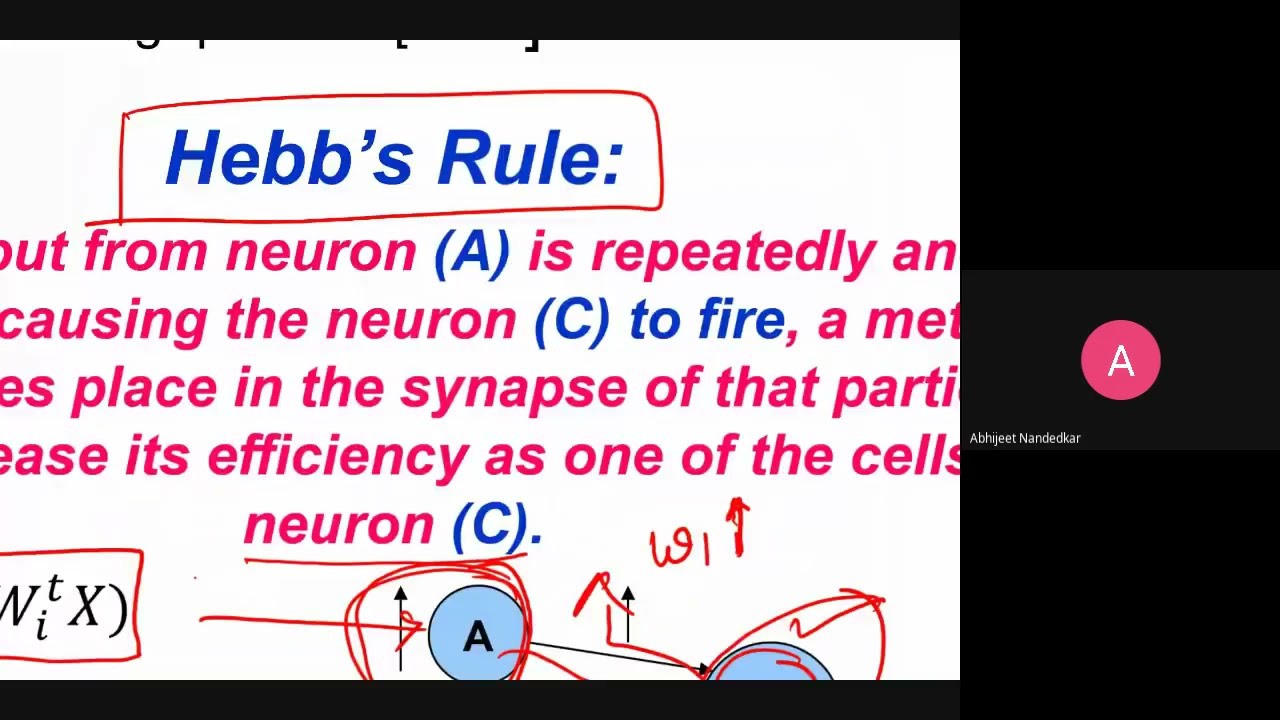
- Hebbian learning rule (Hebb, 1949): Δw = c · o · x, inspired by biological neurons.
- Worked Hebbian example: three training samples, sign activation, sequential weight updates w1→w4.
- Explanation of iterations: reusing w4 as initial weights for a second pass over the same samples.
- Introduction to the perceptron learning rule (Rosenblatt, 1958): Δw = c · (d − o) · x.
- Start of perceptron numerical example with desired responses; left for students to complete.
Contribution & Novelties
This lecture does not present original research; it is a pedagogical exposition of classical material. Its value lies in the clear, worked-through numerical examples that illustrate how Hebbian and perceptron learning rules operate in practice. The instructor’s step-by-step walkthrough of weight updates across multiple training samples is a useful complement to textbook treatments, which often omit intermediate calculations. The lecture also provides a concise taxonomy of learning paradigms, which helps situate the rules historically and conceptually.
Pour aller plus loin :
- McCulloch-Pitts neuron — Wikipedia article on the McCulloch-Pitts model and its historical context.
- Hebbian theory — Wikipedia article on Hebbian learning and its biological inspiration.
- Perceptron — Wikipedia article on the perceptron, including the learning rule and its history.
- Rosenblatt, F. (1958). The perceptron: A probabilistic model for information storage and organization in the brain. Psychological Review, 65(6), 386–408. — The original perceptron paper.
- Hebb, D. O. (1949). The Organization of Behavior. Wiley. — The original Hebbian learning book.
160 words
Radar Profile
The radar profile shows moderate to high scores in information quality and reliability, reflecting the accurate and well-structured presentation of established material. The technical level is moderate, appropriate for an introductory course. Information quantity is moderate, as the lecture covers a limited set of concepts in depth. The overall profile is that of a solid, conventional educational lecture with no notable weaknesses in accuracy but limited breadth.