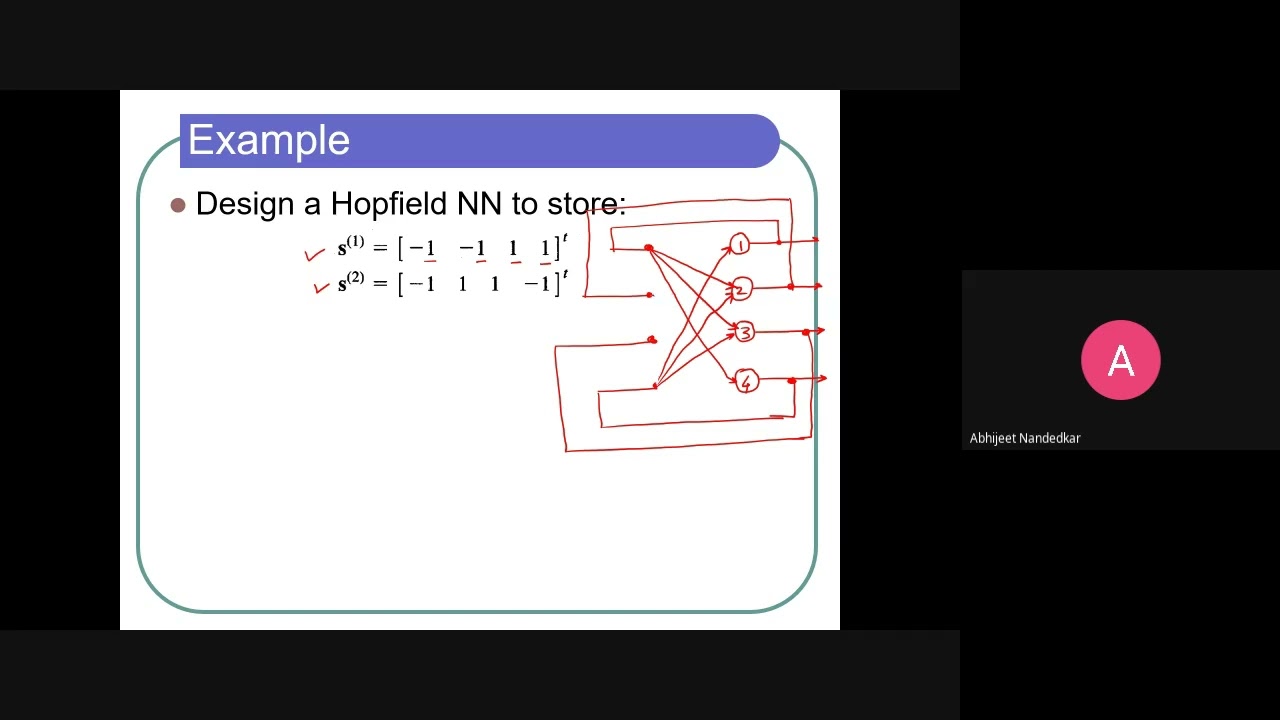
Lecture 36 Hopfield Neural Network
Keywords
Summary
213 words
Critical Evaluation
Value of the Information & Strength of the Argument
The informational value of this lecture lies in its clear, step-by-step exposition of the Hopfield network’s mechanics and the transition to the Bidirectional Associative Memory. The instructor provides a concrete numerical example that walks through the outer-product storage rule and the subtraction of P times the identity matrix, making the abstract formula tangible. The argumentation is structured logically: properties of the network, energy function, storage algorithm, capacity, and then an extension. The reasoning is sound and follows standard textbook derivations. The discussion of capacity, while brief, correctly conveys the practical limitation of Hopfield networks. The introduction of BAM is well-motivated by contrasting auto-association with hetero-association and highlighting the two-layer architecture with W and W^T. The main weakness is the lack of deeper critical analysis or comparison with alternative memory models; the lecture remains largely descriptive and procedural.
Scientific Rigor, Source Quality, Title Accuracy
The scientific rigor is generally good for a lecture: the derivations are correct, the notation is consistent, and the examples are verified. However, the lecture does not cite any primary sources, papers, or textbooks, either in the description or during the talk. The capacity formula is attributed to ‘scientist Ami’ without a precise reference, which is a notable gap in sourcing. The title accurately reflects the content, as the video is indeed a lecture on the Hopfield neural network, with a natural extension to BAM. No comments were provided, so no analysis of audience trends is included.
249 words
Title / Content Match
The title 'Lecture 36 Hopfield Neural Network' accurately reflects the content: the video is a lecture on Hopfield networks, their energy function, storage algorithm, capacity, and an extension to Bidirectional Associative Memory.
Quality & Reliability
7/10
The lecture is delivered by an instructor in an academic course setting and covers standard, well-established material on Hopfield networks and Bidirectional Associative Memory. The mathematical derivations (energy function, Hebbian outer-product storage rule, capacity bound) are correct and consistent with the classical literature. However, no primary sources, citations, or references are provided in the description or during the talk, and the capacity formula is attributed vaguely to 'scientist Ami' without a precise reference. The content is reliable as a pedagogical summary but lacks explicit sourcing.
Key Moments
Markers derived by PSI from the transcript: the creator did not define chapters.
- Recap of Hopfield network properties: no self-feedback, symmetric weight matrix.
- Energy function E = -1/2 V^T W V and its monotonic decrease under asynchronous updates.
- Worked example with four bipolar neurons and 16 possible states; minimum energy of -6.
- Storage algorithm: W = sum of outer products minus P times identity matrix.
- Full numerical example storing two 4-dimensional patterns, computing the weight matrix.
- Verification of the weight matrix: zero diagonal and symmetry.
- Capacity of Hopfield network: approximately n/(4 log n); example with 100 neurons storing 5-11 vectors.
- Application: recalling a clean pattern from a distorted input (auto-associative memory).
- Introduction to Bidirectional Associative Memory (BAM): hetero-associative, two-layer feedback network.
- Working of BAM: forward and backward passes, settling to associated patterns.
Contribution & Novelties
This lecture does not present original research; it is a pedagogical synthesis of well-known material on Hopfield networks and Bidirectional Associative Memory. Its value lies in the clear, worked examples that illustrate the storage algorithm and the energy function, as well as the concise introduction to BAM as an extension of auto-associative memory. The instructor effectively connects the theoretical properties (no self-feedback, symmetric weights) to the practical steps of network design.
Pour aller plus loin :
- Hopfield network — Wikipedia article covering the architecture, energy function, and capacity.
- Bidirectional associative memory — Wikipedia article on BAM, its structure and learning rule.
- Hebbian theory — Background on the outer-product learning rule used for storage.
- John J. Hopfield, ‘Neural networks and physical systems with emergent collective computational abilities’, PNAS, 1982 — The foundational paper introducing the Hopfield network.
- B. Kosko, ‘Bidirectional associative memories’, IEEE Transactions on Systems, Man, and Cybernetics, 1988 — The original paper on BAM.
155 words
Radar Profile
The radar profile shows a balanced content with moderate-to-high scores in information quantity, quality, technical level, and overall reliability. The lecture is technically solid and well-structured, though it lacks explicit sourcing and original research. The profile reflects a competent educational resource rather than a cutting-edge research presentation.