20 ML Non Parametric
Keywords
Summary
172 words
Critical Evaluation
Value of the Information & Strength of the Argument
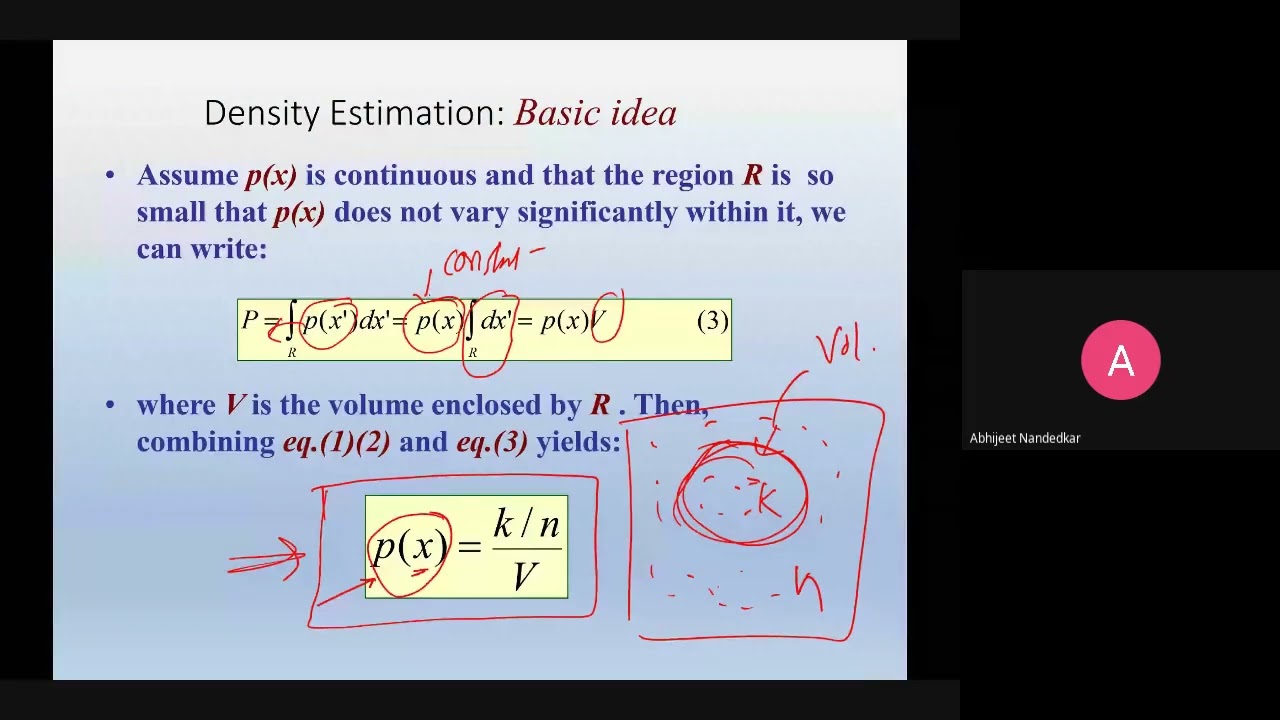
The lecture provides a clear and mathematically rigorous introduction to non-parametric density estimation. The value lies in its step-by-step derivation of the estimator from the binomial distribution and the discussion of the trade-offs between volume size and sample count. The argumentation is logical: it starts with the limitations of parametric methods, motivates the need for non-parametric approaches, derives the estimator, and then presents two concrete algorithms. The explanation of the contradictory theoretical conditions (n → ∞, V → 0, K → ∞, K/n → 0) is particularly insightful, highlighting the practical compromises required. The use of simple examples (1D and 2D) aids understanding. However, the lecture is interrupted and does not cover the full implementation or comparison of the methods, leaving some concepts (e.g., kernel functions, choice of window shape) for future sessions. Overall, the argumentation is solid and well-structured for an educational setting.
Scientific Rigor, Source Quality, Title Accuracy
The lecture is scientifically rigorous, with derivations that are correct and consistent with standard pattern recognition literature (e.g., Duda & Hart). However, no external sources or references are cited, which is typical for a classroom lecture but reduces the ability to verify claims independently. The title ‘20 ML Non Parametric’ accurately reflects the content, though it is somewhat generic. The lecture does not include a bibliography or suggested readings, which would have enhanced its academic value. The interruption by a non-academic announcement is a minor distraction but does not affect the scientific content. Overall, the rigor is high in terms of mathematical correctness, but the lack of citations and the abrupt ending slightly diminish the completeness.
275 words
Title / Content Match
The title '20 ML Non Parametric' accurately reflects the lecture's focus on non-parametric methods in machine learning, specifically density estimation. It is concise and directly relevant.
Quality & Reliability
7/10
The content is a standard academic lecture on non-parametric density estimation, covering Parzen windows and k-nearest neighbor methods. The mathematical derivations are correct and align with classic pattern recognition textbooks. However, no external sources are cited, and the lecture is interrupted by a non-academic announcement, slightly reducing the overall reliability score.
Key Moments
Markers derived by PSI from the transcript: the creator did not define chapters.
- Introduction to non-parametric methods: Parzen and k-nearest neighbor for density estimation.
- Contrast with parametric methods: assumption of known density form vs. arbitrary distributions.
- Derivation of density estimation: probability that a vector falls in a region R.
- Binomial law and expected value: K = nP, leading to P ≈ K/n.
- Density estimate: p(x) ≈ K/(nV), with discussion on volume and sample size.
- Theoretical conditions for convergence: n→∞, V→0, K→∞, K/n→0.
- Introduction to Parzen window (shrinking) and k-NN (growing) methods.
- Parzen window: V = 1/√n; k-NN: K = √n. Visual comparison with increasing n.
- Lecture interrupted by announcement of pandemic-related institute closure.
Contribution & Novelties
The lecture does not present new research but serves as a clear educational exposition of classical non-parametric density estimation techniques. Its originality lies in the pedagogical approach: deriving the estimator from the binomial distribution and explicitly discussing the theoretical contradictions in the convergence conditions. The visual comparison of Parzen and k-NN methods with increasing sample sizes is helpful for intuitive understanding.
Pour aller plus loin :
- Parzen-Rosenblatt window method — Wikipedia article on kernel density estimation, which generalizes the Parzen window method.
- k-nearest neighbors algorithm — Wikipedia article covering the k-NN algorithm, including its use in density estimation.
- Pattern Recognition and Machine Learning — Book by Christopher Bishop, a standard reference for non-parametric methods (Chapter 2).
116 words
Radar Profile
The radar profile shows high scores in technical level and information quality, reflecting the rigorous mathematical content. Information quantity is moderate due to the lecture's focus on a specific topic and its interruption. Overall reliability is good, but the lack of citations and the abrupt ending slightly lower the score.