33 ml HMM
Keywords
Summary
222 words
Critical Evaluation
Value of the Information & Strength of the Argument
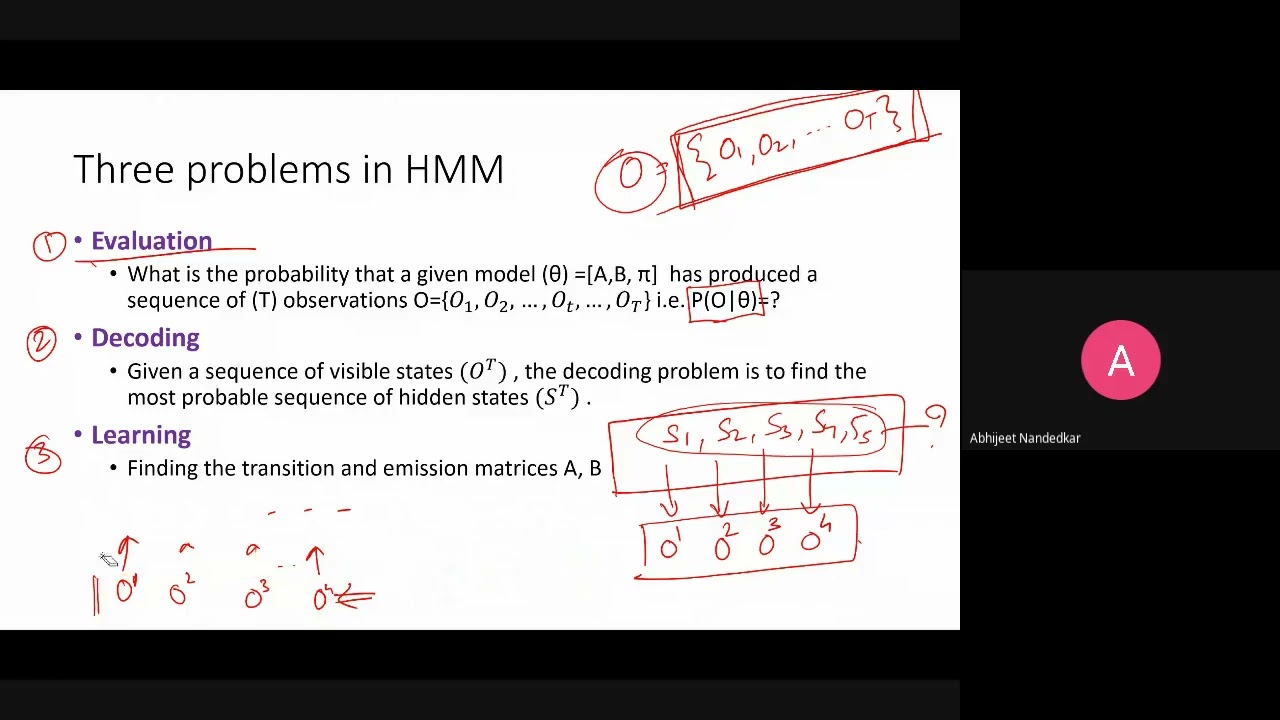
The informational value lies in a clear, example-driven introduction to HMM fundamentals. The weather/symbol example is pedagogically effective: it concretely grounds abstract quantities (transition matrix, emission matrix, initial distribution) in an intuitive scenario, and the step-by-step joint-probability calculation is easy to follow. The distinction between the three HMM problems is well articulated, and the motivation for the forward algorithm — avoiding the exponential blow-up of enumerating all N^T hidden-state sequences — is presented convincingly with a numerical illustration (10^21 vs. 10^3). The argumentation is largely sound and follows the standard textbook logic. However, the reasoning is occasionally loose: the complexity expression is stated rather than derived, the reduction to 10^3 is asserted without showing the intermediate steps, and the transition from the forward algorithm to the Viterbi-style decoding is sketched only briefly. The lecture relies on verbal explanation and a whiteboard-style trellis diagram rather than formal proofs, which is appropriate for a classroom but limits the depth of the argument. Overall, the value is solid for an introductory audience but does not go beyond standard material.
Scientific Rigor, Source Quality, Title Accuracy
Scientific rigor is moderate. The mathematical content is standard and correct in its broad strokes, consistent with canonical treatments of HMMs. However, no sources, references, or citations are provided at any point — neither in the description nor in the transcript. The lecturer does not attribute the forward algorithm, the three-problem framing, or the complexity analysis to any author or textbook, which weakens the scholarly rigor. The title ‘33 ml HMM’ is essentially uninformative: it does not describe the topic, the level, or the scope, and gives a viewer almost no basis for deciding whether to watch. The match between title and content is therefore poor in terms of communicative adequacy, even though the content itself does address HMMs. No comments were provided for analysis.
316 words
Title / Content Match
The title '33 ml HMM' is opaque and minimally informative; it appears to be a course/session label rather than a descriptive title. The content does match the implied topic (HMMs), but the title gives almost no indication of the subject matter.
Quality & Reliability
6/10
The lecture presents standard, well-established material on Hidden Markov Models (HMMs) — emission matrices, joint probability, the three canonical problems (evaluation, decoding, learning), and the forward algorithm. The mathematical content is broadly correct and consistent with textbook treatments (Rabiner, Jurafsky & Martin). However, no sources, references, or citations are provided, and the delivery is informal and occasionally imprecise (e.g., the complexity is stated as NS^T·T without careful derivation, and the reduction to ~10^3 is asserted rather than demonstrated). The absence of any bibliography or external validation limits the reliability score.
Key Moments
Markers derived by PSI from the transcript: the creator did not define chapters.
- Introduction of the weather example: hidden states (sunny, rainy, cold) and observable symbols (sweater, umbrella, shorts).
- Explanation of the emission matrix and its row-sum-to-one property.
- Introduction of the initial state distribution and the joint probability calculation.
- Presentation of the three HMM problems: evaluation, decoding, and learning.
- Detailed discussion of the evaluation problem and the naive summation over N^T state sequences.
- Derivation of the complexity of the naive approach (e.g., 10^21 operations).
- Introduction of the forward algorithm and definition of the alpha variables.
- Step-by-step trellis computation of alpha values across time steps.
- Demonstration of the complexity reduction from 10^21 to ~10^3.
- Sketch of the decoding problem via maximum-alpha path and mention of absorbing states.
Contribution & Novelties
This video does not present original research or novel findings; it is a pedagogical lecture covering standard HMM material. Its contribution is didactic: it offers a concrete, example-driven walkthrough of HMM fundamentals, the three canonical problems, and the forward algorithm, with an intuitive trellis-based explanation of the complexity reduction. The value is in the clarity of the weather example and the step-by-step alpha computation, which may help learners new to the topic.
Pour aller plus loin :
- Hidden Markov model — Wikipedia overview of HMMs, including the three problems and the forward algorithm.
- Forward–backward algorithm — Wikipedia article on the forward-backward algorithm, closely related to the forward algorithm discussed here.
- Viterbi algorithm — Wikipedia article on the Viterbi algorithm, the standard solution to the decoding problem sketched in the lecture.
- Rabiner, L. R. (1989), ‘A Tutorial on Hidden Markov Models and Selected Applications in Speech Recognition’, Proceedings of the IEEE — the canonical tutorial reference for HMMs.
- Jurafsky, D. & Martin, J. H., ‘Speech and Language Processing’ — textbook chapter on HMMs and sequence labeling.
175 words
Radar Profile
The profile shows moderate scores across the board, with information quantity and quality both at 6, technical level at 6, and overall reliability at 6. This reflects a solid but standard introductory lecture: it covers the essential material correctly but without depth, formal rigor, or external references. The radar is balanced rather than spiky, indicating a generalist pedagogical treatment rather than a specialized or research-grade presentation.