27 ml DT 03
Keywords
Summary
175 words
Critical Evaluation
Value of the Information & Strength of the Argument
The lecture provides a solid conceptual foundation for decision tree algorithms. It clearly explains the rationale behind feature selection: choosing features that lead to pure subsets reduces tree complexity and improves generalization. The argumentation is logical, moving from problem definition to impurity measures, with a concrete example. The explanation of entropy as a measure of uncertainty is accurate and well-motivated, linking to information theory. The comparison of entropy, Gini, and misclassification error is insightful, highlighting computational trade-offs. The example with the contact lens dataset effectively demonstrates entropy calculation, though the actual splitting process is deferred to the next lecture. The value lies in its pedagogical clarity, making abstract concepts accessible. However, it lacks discussion of advanced topics like pruning techniques or handling continuous features, which are only briefly mentioned.
Scientific Rigor, Source Quality, Title Accuracy
The scientific rigor is high: formulas for entropy, Gini impurity, and misclassification error are correctly presented. The instructor attributes entropy to Shannon and correctly places it in information theory. However, no external sources or references are cited, and the video description is empty, so there is no way to verify the material against textbooks or papers. The title ‘27 ml DT 03’ is not descriptive but follows a course numbering scheme; it does not mislead about the content. The adéquation between title and content is acceptable given the context of a lecture series. No comments were provided, so no audience analysis is included.
247 words
Title / Content Match
The title '27 ml DT 03' is a cryptic course code, likely meaning 'Machine Learning, Decision Trees, lecture 3'. It does not describe the content explicitly, but the video does cover decision tree construction, so it is consistent with the series numbering.
Quality & Reliability
7/10
The content is a standard academic lecture on decision tree construction, covering established algorithms (ID3, C4.5, CART) and impurity measures (entropy, Gini, misclassification). The mathematical formulas are correct and the explanations are clear. However, no external sources or references are cited, and the video is part of a course series, so it relies on the instructor's expertise rather than verifiable citations. The absence of a description with links limits traceability.
Key Moments
Markers derived by PSI from the transcript: the creator did not define chapters.
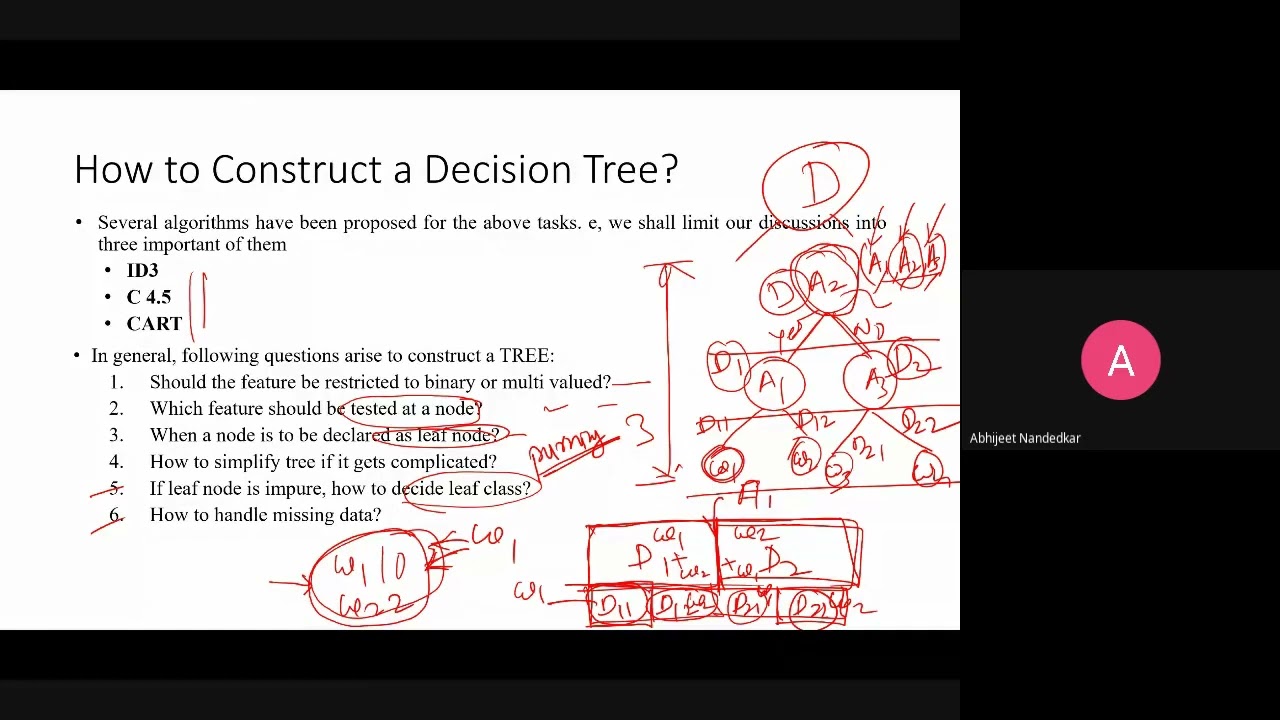
- Introduction to decision tree structure and key questions in construction.
- Discussion on feature selection: which feature to test first to minimize tree depth.
- Explanation of pure nodes and majority voting for impure leaf nodes.
- Introduction to pruning and overfitting.
- Example of good vs. bad feature using a 2D dataset with X and Y features.
- Recursive splitting and tree growth.
- Introduction to impurity measures: entropy, Gini, misclassification.
- Entropy formula and its properties.
- Plot of impurity measures for binary classification.
- Example: entropy calculation on contact lens dataset (24 instances, 3 classes).
Contribution & Novelties
This lecture does not present new research but serves as an educational overview of decision tree construction. Its originality lies in the clear, step-by-step explanation of feature selection and impurity measures, with a practical example. It synthesizes classical algorithms (ID3, C4.5, CART) and provides intuitive reasoning for their design choices.
Pour aller plus loin :
- Decision tree learning — Wikipedia article covering algorithms and concepts.
- Entropy (information theory) — Background on Shannon entropy.
- Gini impurity — Explanation of Gini impurity in decision trees.
- ID3 algorithm — Details on the ID3 algorithm.
- C4.5 algorithm — Extension of ID3.
- CART — Classification and Regression Trees.
103 words
Radar Profile
The radar profile shows high scores in information quality and reliability, with moderate technical level and quantity of information. This reflects a well-structured lecture that is accurate and clear but not highly advanced or dense. The balance suggests it is suitable for learners seeking a solid introduction to decision trees.