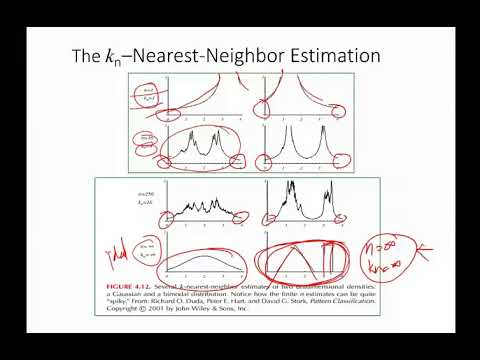
23 ml KNN estimate
Keywords
Summary
211 words
Critical Evaluation
Value of the Information & Strength of the Argument
The lecture provides high informational value for students of pattern recognition and machine learning. It clearly articulates the conceptual difference between Parzen window (shrinking window) and k-NN estimation (growing window), and derives the density estimate k/(nV) from first principles. The argumentation is logical and step-by-step: starting from the need for non-parametric density estimation, introducing the k-NN approach, illustrating with simple 1D examples, and then extending to classification via posterior estimation. The instructor uses concrete numerical examples (e.g., x_test = 3.1, k = 6, h = 0.5 then 1.0) to demonstrate the window-growing procedure and the calculation of likelihoods for two classes. The derivation of the posterior P(ω_i|x) = k_i/k from the joint probability is mathematically sound and pedagogically effective. The discussion of the method’s limitation—unbounded volume growth leading to improper density—is a valuable critical insight often omitted in introductory treatments. The argumentation is self-contained and does not rely on external sources, but it is rigorous within its scope.
Scientific Rigor, Source Quality, Title Accuracy
The lecture is scientifically rigorous in its mathematical treatment, with correct formulas and logical derivations. However, it lacks citations to textbooks, papers, or datasets; the instructor does not reference foundational works such as Fix & Hodges (1951) or Cover & Hart (1967). The title ‘23 ml KNN estimate’ is not descriptive and does not accurately reflect the breadth of the content, which includes both density estimation and classification. The adéquation between title and content is weak, as the title appears to be an internal code rather than a meaningful descriptor. No comments were provided for analysis.
269 words
Title / Content Match
The title '23 ml KNN estimate' is cryptic and likely an internal course label; it does not clearly describe the content, which covers k-nearest neighbor density estimation and the k-NN classification rule. The match is partial but the title is not informative for a general audience.
Quality & Reliability
7/10
The lecture is delivered by an instructor with clear command of non-parametric density estimation and pattern recognition. The mathematical derivations (Parzen window vs. k-NN estimation, posterior probability from k-NN rule) are correct and internally consistent. However, no external references, textbooks, or datasets are cited, and the presentation relies entirely on the instructor's authority. The content is standard graduate-level material, accurately presented but without independent verification or sourcing.
Key Moments
Markers derived by PSI from the transcript: the creator did not define chapters.
- Recap of Parzen window and introduction to k-NN estimation as a growing window method.
- Distinction between k-NN estimation and k-NN rule; warning not to confuse them.
- Procedure of k-NN estimation: fix k, grow volume until k samples are captured; density = k/(nV).
- Illustration with 1D samples and effect of increasing k on smoothness of density estimate.
- Discussion of limitation: with n=1, volume grows unbounded, integral diverges.
- Numerical example: estimate density at x=3.1 with k=6, h=0.5 then h=1.0, n=20.
- Classification example with two classes: compute likelihoods for ω1 and ω2 using k-NN estimation.
- Application of Bayes rule to obtain posterior probabilities and final decision.
- Introduction to k-NN rule: direct posterior estimation via majority voting among k neighbors.
- Derivation of posterior P(ω_i|x) = k_i/k and extension to multi-class problems.
Contribution & Novelties
The lecture does not present original research but offers a clear pedagogical synthesis of standard non-parametric methods. Its main value lies in the step-by-step numerical examples and the explicit contrast between Parzen window and k-NN estimation, as well as the derivation of the k-NN rule as a direct posterior estimator. The discussion of the unbounded volume limitation is a useful practical caveat.
Pour aller plus loin :
- k-nearest neighbors algorithm — Wikipedia article covering the classification rule and its properties.
- Parzen window — Wikipedia article on the Parzen window method for density estimation.
- Kernel density estimation — Wikipedia article providing broader context on non-parametric density estimation.
- Fix, E., & Hodges, J. L. (1951). Discriminatory analysis, nonparametric discrimination: Consistency properties. — Foundational report introducing the k-NN rule.
- Cover, T. M., & Hart, P. E. (1967). Nearest neighbor pattern classification. IEEE Transactions on Information Theory. — Classic paper establishing theoretical properties of k-NN.
151 words
Radar Profile
The radar profile shows high scores in information quantity, quality, and technical level, reflecting a dense, mathematically rigorous lecture. Reliability is slightly lower due to the absence of external citations, but the content is accurate and well-structured. Overall, the profile indicates a solid educational resource for advanced students.