Lect 14 ML Discriminant Function I
Keywords
Summary
171 words
Critical Evaluation
Value of the Information & Strength of the Argument
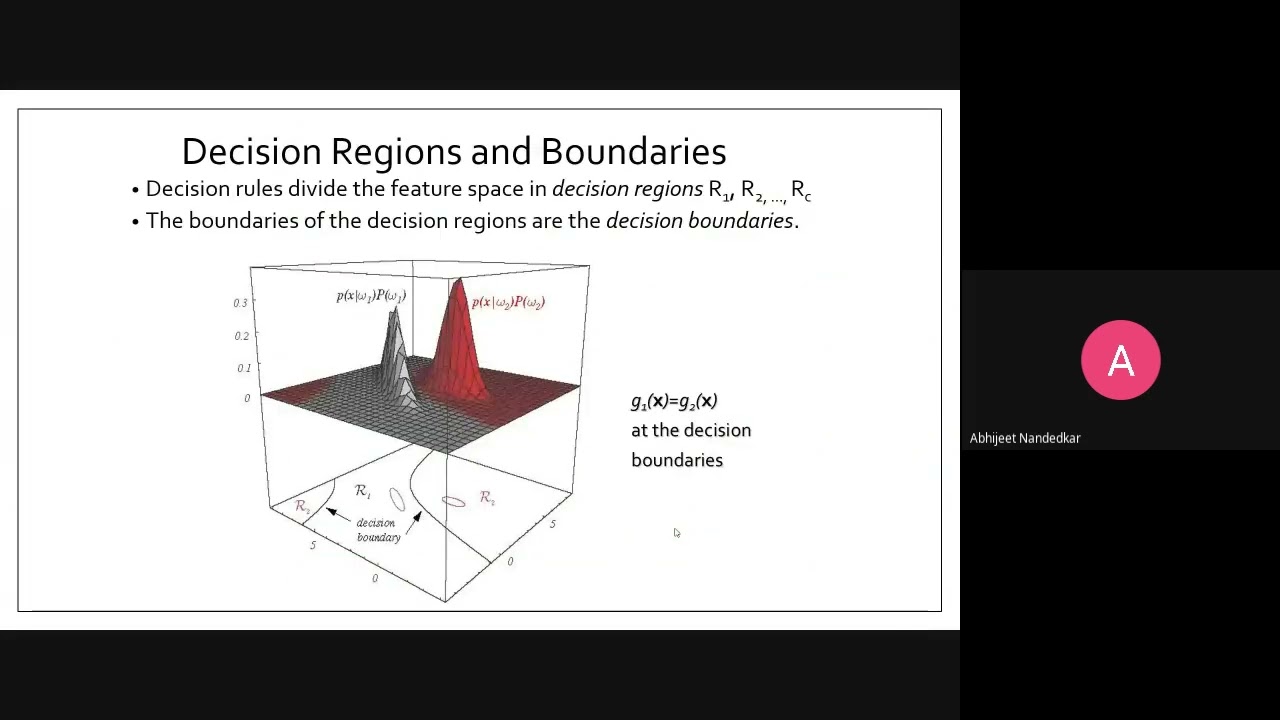
The lecture provides a clear, step-by-step derivation of discriminant functions from Bayesian decision theory. The argumentation is logical and pedagogical: the instructor motivates each step (dropping p(x), taking logs, using the difference of posteriors for two classes) and explains the underlying assumptions. The value lies in connecting probability theory to practical classifier design, emphasizing that the decision boundary is where the discriminant functions are equal. The discussion of the multivariate Gaussian and the estimation of mean and covariance from data is standard but well presented. The introduction of simplifying assumptions (Case 1) is useful for understanding how linear discriminant functions arise. The argument is coherent and builds progressively, though the lack of visual aids in the transcript makes some geometric intuitions harder to follow. Overall, the information is valuable for learners seeking a foundational understanding of Bayesian classification.
Scientific Rigor, Source Quality, Title Accuracy
The scientific rigor is high: the derivations follow standard textbook procedures and the mathematical steps are correct. However, no external sources, references, or citations are provided, which is typical for a lecture but limits the ability to trace the material to specific works. The title ‘ML Discriminant Function I’ accurately reflects the content, which focuses on the first part of discriminant functions. The lecture does not claim novelty; it is an educational exposition. The absence of sources is not a flaw in this context, but it means the content relies solely on the instructor’s expertise. The title is not misleading; it clearly indicates the topic and that it is the first part of a series.
268 words
Title / Content Match
The title accurately reflects the content: the lecture introduces and derives linear/quadratic discriminant functions for machine learning classification, focusing on the first part of the topic. It is a faithful match.
Quality & Reliability
7/10
The lecture presents standard, well-established material from pattern recognition (Bayesian decision theory, discriminant functions, Gaussian likelihoods, covariance matrices). The derivations are mathematically sound and consistent with canonical textbooks. However, no external sources or references are cited, and the presentation relies entirely on the instructor's board work. The occasional audio issues and the absence of visual aids in the transcript limit full verification, but the content itself is reliable and accurate.
Key Moments
Markers derived by PSI from the transcript: the creator did not define chapters.
- Introduction to the classifier structure: input features fed to multiple discriminant functions, max selector chooses class.
- Using risk or Bayes decision procedure to obtain discriminant functions; negative sign for maximization.
- Derivation from posterior probabilities: dropping p(x) denominator and taking logarithms.
- Defining g1(x) and g2(x) as log posterior; decision boundary at g1(x)=g2(x).
- Two-class case: difference g1(x)-g2(x) as a single discriminant function (dichotomizer).
- Review of normal distribution for likelihood: mean and standard deviation for each class.
- Multivariate Gaussian formula: mean vector and covariance matrix.
- Procedure to compute covariance matrix: outer product of deviations, average over samples.
- Data modeling: storing mean and covariance per class instead of raw data.
- Substituting Gaussian into discriminant function; introduction of Case 1 assumptions.
Contribution & Novelties
This lecture does not present new research; it is an educational exposition of classical discriminant analysis. Its value is in the clear, incremental derivation of discriminant functions from Bayesian principles, suitable for students. The instructor emphasizes the steps that are often omitted in textbooks, such as dropping the denominator and taking logarithms, which aids understanding. The discussion of data modeling and the simplifying assumptions of Case 1 provides a foundation for linear discriminant analysis.
Pour aller plus loin :
- Linear discriminant analysis — Wikipedia article covering the derivation and assumptions of LDA, closely related to Case 1.
- Bayes classifier — Wikipedia article on the Bayes classifier and its relation to discriminant functions.
- Multivariate normal distribution — Wikipedia article providing the mathematical background for the Gaussian likelihood used here.
- Pattern Classification by Duda, Hart, and Stork — Classic textbook that covers discriminant functions and Bayesian decision theory in depth.
148 words
Radar Profile
The radar profile shows high technical level and quality of information, with good quantity of information. Reliability is solid but not maximal due to lack of external sources. The overall profile indicates a rigorous, educational lecture suitable for advanced learners.