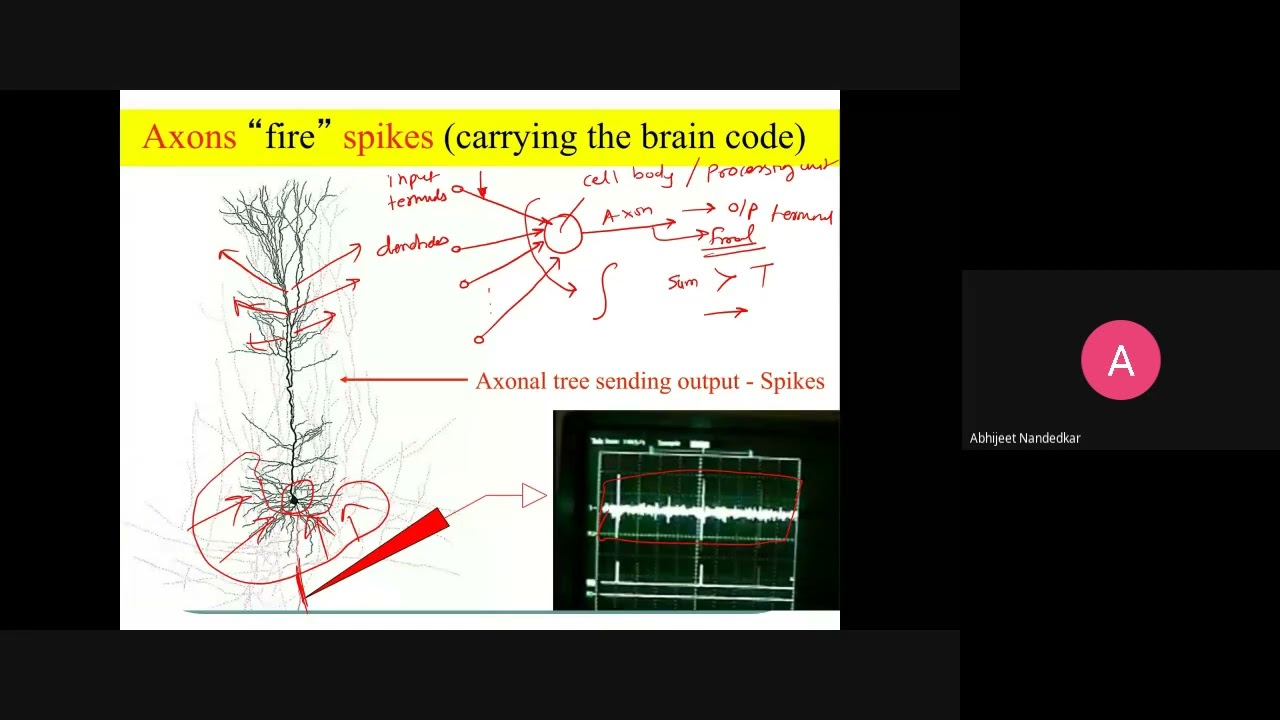
Lect 03 AI NN A 2021 08 12 at 23 43 GMT 7
Keywords
Summary
163 words
Critical Evaluation
Value of the Information & Strength of the Argument
The lecture provides a clear and accurate introduction to the biological inspiration behind artificial neural networks and the foundational McCulloch-Pitts model. The historical timeline is well-structured, linking key discoveries in neuroscience to the development of artificial neurons. The explanation of how a single neuron can implement logic gates is pedagogically effective, using simple examples and truth tables. However, the argumentation remains at a basic level, without delving into the limitations of the McCulloch-Pitts model (e.g., inability to solve non-linearly separable problems) or the learning mechanisms that later became central to neural networks. The value lies in its accessibility for beginners, but it does not offer novel insights or advanced analysis.
Scientific Rigor, Source Quality, Title Accuracy
The lecture does not cite any specific sources, papers, or references, which weakens its scientific rigor. While the historical facts presented are accurate and widely known, the absence of citations makes it difficult to verify claims or explore further. The title is a generic recording identifier that does not reflect the content, which is a missed opportunity for discoverability and clarity. No comments were provided for analysis.
192 words
Title / Content Match
The title is a generic recording label ('Lect 03 AI NN A 2021 08 12 at 23 43 GMT 7') that does not describe the actual content, which covers the biological neuron, its history, and the McCulloch-Pitts artificial neuron model. The title is therefore poorly aligned with the lecture's substance.
Quality & Reliability
6/10
The lecture accurately presents well-established historical facts and the McCulloch-Pitts model, but it lacks citations, references, or any source attribution. The content is delivered as an oral lecture with no supporting materials, and the technical depth is limited to introductory concepts.
Key Moments
Markers derived by PSI from the transcript: the creator did not define chapters.
- Introduction to prediction and generalization as core aims of neural networks.
- Historical timeline: Robert Hooke's microscope (1665), cell theory (1839), Golgi's staining (1870), Cajal's neuron doctrine (1887).
- Explanation of neuron anatomy: dendrites, cell body, axon, and signal integration.
- Description of brain regions and their functions, including the visual cortex.
- Comparison of conventional computers and neural networks; introduction to the McCulloch-Pitts model (1943).
- Detailed explanation of the McCulloch-Pitts neuron: binary inputs/outputs, weights, threshold.
- Implementation of a NOT gate using a single neuron.
- Implementation of NOR logic using two neurons and three inputs.
- Implementation of NAND logic and discussion of universal gates.
- Mention of Karnaugh maps for analyzing unknown circuits and class logistics.
Contribution & Novelties
This lecture does not present new research or original findings; it is an educational overview of well-known historical and technical material. Its value is primarily didactic, offering a concise walkthrough of the biological roots of artificial neural networks and the McCulloch-Pitts model for students encountering the topic for the first time.
Pour aller plus loin :
- McCulloch-Pitts neuron — Wikipedia article detailing the model and its historical context.
- History of neuroscience — Overview of key discoveries including Golgi and Cajal.
- Perceptron — The next major development after McCulloch-Pitts, addressing learning and limitations.
92 words
Radar Profile
The radar profile shows moderate information quantity and quality, with a low technical level, reflecting the introductory nature of the lecture. Reliability is moderate due to the lack of citations, while the overall score is balanced by the accuracy of the presented facts.