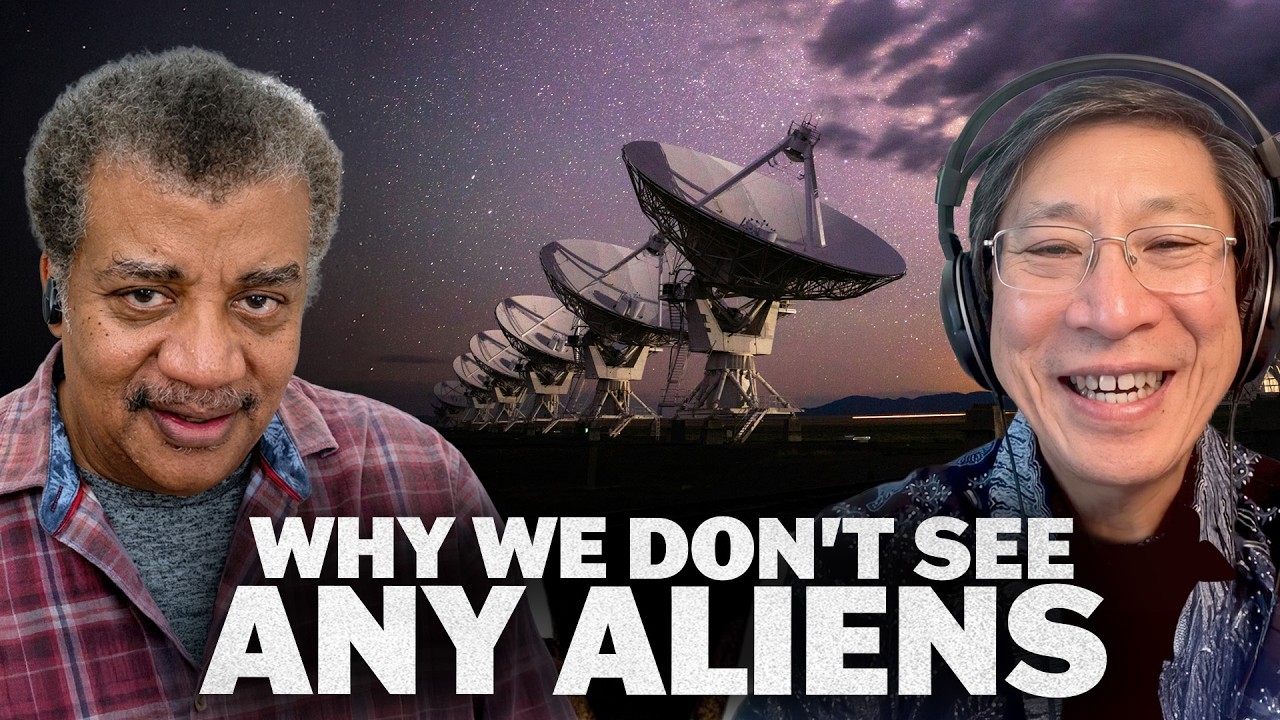
Why Humans May Never Leave the Solar System, with Charles Liu
Keywords
Summary
197 words
Critical Evaluation
Value of the Information & Strength of the Argument
The value of this episode lies in its ability to tackle profound cosmological and physical questions with a blend of rigorous explanation and accessible dialogue. The argumentation is solid: each topic is approached with logical reasoning, and participants are careful to distinguish between established science, speculative but mathematically plausible ideas, and pure speculation. For instance, when discussing fractal similarities, Charles Liu clearly separates mathematical commonality from physical equivalence, and when addressing the multiverse, he emphasizes that the equations are open-ended rather than showing a forced pattern. The hosts also challenge each other’s assertions, adding depth to the analysis. The presence of diverse viewpoints (experts and co-hosts) enriches the discussion without undermining scientific integrity.
Scientific Rigor, Source Quality, Title Accuracy
The scientific rigor is high, with experts citing established concepts such as Einstein’s relativity, the many-worlds interpretation, and the Planck length, all presented accurately. However, the episode does not systematically cite external sources; instead, it relies on the expertise of the guests. The title is a bit narrow—while the episode does explore why humans may never leave the solar system, it covers many other topics, making the title somewhat incomplete. The viewer comments are overwhelmingly positive, praising Charles Liu’s teaching style and the overall presentation, with no negative trends.
217 words
Title / Content Match
The title is partially adequate: the episode covers multiple topics, but interstellar travel and its constraints constitute a significant part of the discussion.
Quality & Reliability
9/10
The participants are experts (astrophysicist, professor), concepts are explained with rigor and the limits of knowledge are clearly acknowledged. Although popularized, the discussion remains scientifically solid and nuanced.
Chapters
- Introduction: Charles Liu
- Could We Use Iron Man’s Arch Reactor to Travel the Universe?
- Robot Space Travel
- Fractal Patterns in the Universe & the Brain
- Do Fractals Indicate Simulated Reality?
- Is The Multiverse The Result of Apophenia?
- Wavelengths Smaller Than a Planck Length
- Did Aliens Seed Life Across the Universe?
- How Do We Know Galaxies Are Moving Due to Expansion?
- Born Too Late for The Big Bang
- Closing Thoughts
Contribution & Novelties
This episode offers an original synthesis of seemingly disparate topics—deep space travel, fractals, and the multiverse—by connecting them through the theme of human cognitive limits and the power of mathematics. It provides clarity on the distinction between fractal similarity and physical identity, and critically examines the multiverse notion from an epistemological perspective.
Pour aller plus loin :
- Mandelbrot set – Related to the fractal discussion, defines a classic mathematical fractal with self-similarity.
- Many-worlds interpretation – The quantum interpretation discussed in the segment on the multiverse.
- Fermi paradox – The apparent contradiction between high probability of extraterrestrial civilizations and lack of contact.
- Planck length – The scale below which current physics breaks down, mentioned as the boundary of scientific knowledge.
119 words
Radar Profile
The radar profile shows high scores in quality, reliability, and informativeness, with a moderate technical complexity, indicating a well-balanced presentation accessible to a general audience while maintaining scientific depth.
💬 Très positif. Les 30 commentaires analysés expriment un enthousiasme marqué pour la présence de Charles Liu et la qualité pédagogique de l'épisode, plusieurs le qualifiant de meilleur invité de la chaîne.