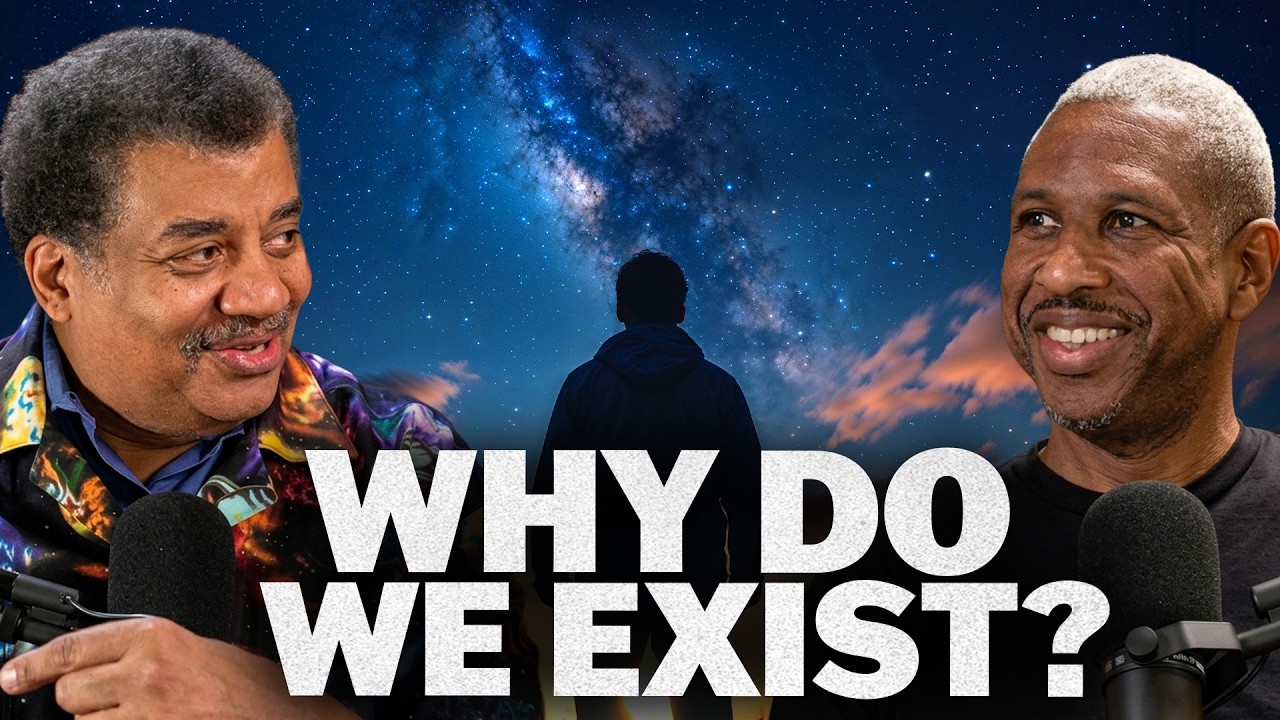
Why Do We Exist? With Hakeem Oluseyi
Keywords
Summary
147 words
Critical Evaluation
Value of the Information & Strength of the Argument
The episode offers valuable insights into advanced cosmological concepts presented in an accessible manner. Oluseyi’s ‘Nine Realms’ framework provides a coherent narrative that connects disparate areas of physics, from particle physics to galactic dynamics, offering a fresh perspective that encourages deeper reflection. The argumentation is generally solid: when discussing plasma, inflation, and the Oluseyi Equation, he grounds his explanations in established scientific principles, while clearly distinguishing his speculative ideas as ‘scientific wild ass guesses’ (SWAG). The discussion on moving Earth, though fanciful, is presented as a provocative thought experiment illustrating the scalability of human engineering. However, some claims, such as the existence of a multiverse or the fundamental nature of spacetime, are presented with less epistemic caution, though he does acknowledge the speculative nature. Overall, the value lies in stimulating curiosity and providing a holistic view of the universe’s structure and our place within it.
Scientific Rigor, Source Quality, Title Accuracy
The scientific rigor is high for a general-audience show. Oluseyi, a professor and CEO of the Astronomical Society of the Pacific, brings credible expertise. He references standard cosmological models (e.g., inflationary theory) and recent JWST observations. The title accurately reflects the content, which indeed addresses the question of existence from a cosmological perspective. Sources mentioned include his own book, the Drake Equation, and the Seager equation, but no direct external citations are given. The description includes a link to Ground News for unbiased news, which is not directly related to the scientific content. The absence of specific citations limits verifiability, but the conversation stays within scientifically plausible boundaries. No comment analysis was performed due to lack of provided comments.
279 words
Title / Content Match
The title accurately reflects the central theme of the episode, which tackles existential questions through a cosmological lens, featuring guest Hakeem Oluseyi.
Quality & Reliability
7/10
Discussion with a practicing astrophysicist (Hakeem Oluseyi) on advanced cosmology topics, grounded in established physics but including speculative ideas presented as informed guesses. The tone is accessible but maintains scientific rigor in explanations of plasma, inflation, and the Drake equation variant.
Chapters
Cited Sources
- Why Do We Exist: The Nine Realms of the Universe That Make You Possible — Hakeem Oluseyi's new book, discussed throughout the episode, outlining his nine-realms cosmological framework.
Concurring Sources
- Why Do We Exist: The Nine Realms of the Universe That Make You Possible — The book aligns with the episode's content, providing detailed exposition of the ideas discussed.
External References
Contribution & Novelties
The episode introduces Oluseyi’s unique conceptual framework of nine realms, which attempts to unify physics across scales. His ‘Oluseyi Equation’ is a simplified alternative to the Drake Equation, focusing on the conditions for multicellular life rather than civilizations. The discussion also presents thought experiments like moving Earth, and speculates on fundamental building blocks of the universe. While some ideas are speculative, they are explicitly framed as informed guesses, making the contribution original in its synthesis of existing knowledge.
Pour aller plus loin :
- Inflation (cosmology) — Provides background on the inflationary epoch and the inflaton field, central to the multiverse discussion.
- Drake equation — Context for Oluseyi’s variant, comparing his approach to the classic equation.
- Plasma (physics) — Explains plasma properties and magnetic confinement, relevant to the discussion on fusion and astrophysical plasmas.
133 words
Radar Profile
The radar profile shows high scores in quantity of information and moderate quality, reflecting the dense but accessible discussion. The technical level is moderate, suitable for an interested general audience. The overall reliability is good, with clear separation between established physics and speculative ideas.