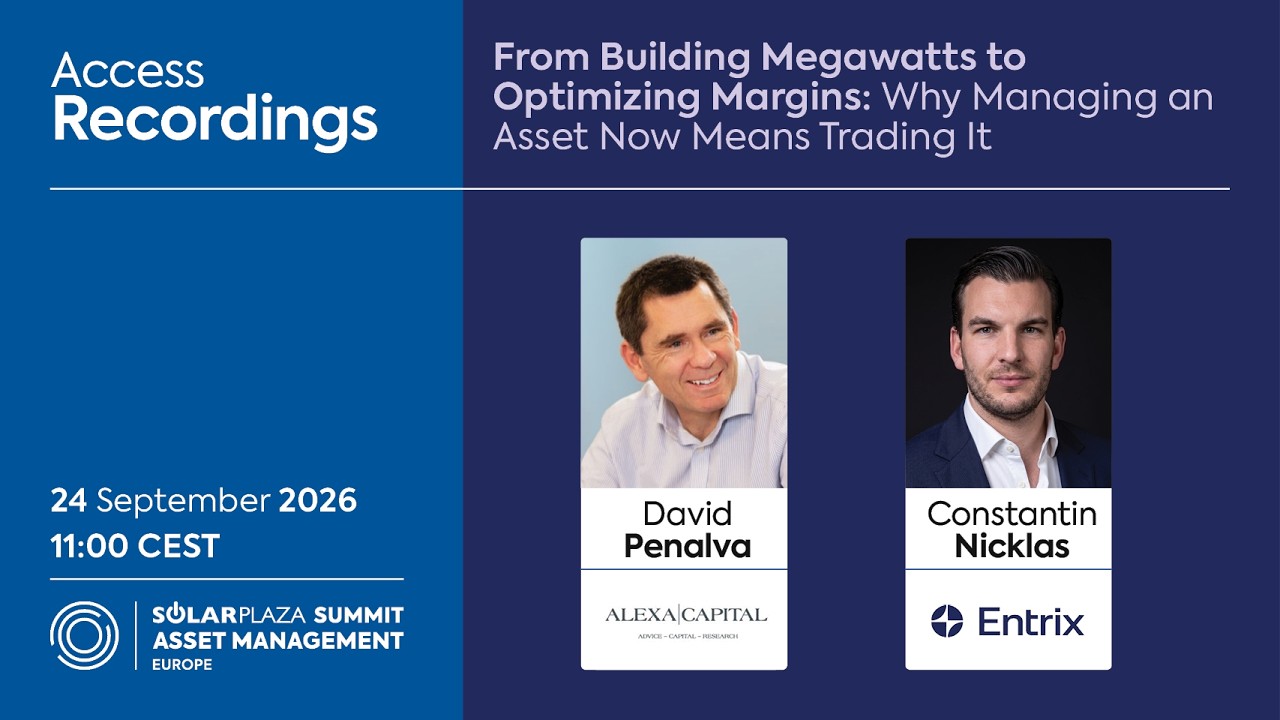
Solarplaza Webinar | From building megawatts to optimizing margins
Keywords
Summary
224 words
Critical Evaluation
Value of the Information & Strength of the Argument
The value of this webinar lies in its timely focus on the transformation of renewable asset management from a purely technical discipline to a commercial and financial one. Gerard Reid provides a compelling narrative linking global trends (AI demand, grid bottlenecks, policy shifts) to direct market implications such as negative pricing and PPA repricing. His argumentation is logical and supported by examples like the financial troubles of major IPPs and the rise of home solar with batteries. Constantin Nicklas adds practical depth with a structured framework (4 dimensions of battery success) and real case studies, strengthening the actionable value. The panel Q&A section adds further insights on niche but relevant topics like data center power procurement and regulatory challenges. The argumentation is coherent and persuasive, though some claims (e.g., AI power demand forecasts) are not sourced, and the discussion stays at a high strategic level rather than deep technical detail.
Scientific Rigor, Source Quality, Title Accuracy
The webinar is a professionally produced industry event with clear structure and expert guests. However, scientific rigor is moderate: the speakers reference market data and trends but do not cite specific public sources or studies. The only external link provided is Solarplaza’s LinkedIn page, which is not a primary source for the content. The title accurately reflects the content—there is a clear focus on the economic and operational shift from building capacity to optimizing margins. While the content is plausible and aligns with known industry trends, the lack of explicit citations limits its verifiability. The presentation style is more of an expert opinion and market commentary than a peer-reviewed analysis. Overall, the title is well matched, and the content is credible but not extensively sourced.
290 words
Title / Content Match
The title accurately reflects the shift from simply building renewable capacity to actively managing and trading assets to optimize financial margins, as discussed throughout.
Quality & Reliability
7/10
The webinar features two experienced industry professionals (Gerard Reid from Alexa Capital, Constantin Nicklas from Entrix) providing practical and strategic insights on energy market shifts. They reference real market data and case studies, but without formal citations or verifiable sources. Some claims (e.g., OpenAI's 230 GW by 2033) are presented without source, reducing absolute reliability. Overall, the content is credible but not fully rigorous.
Chapters
- Welcome & Introduction
- Agenda & Speaker Introductions
- About Solarplaza
- Solarplaza Summit Asset Management Europe Preview
- Housekeeping & Audience Q&A Instructions
- Gerard Reid: Market Shifts & Power Volatility
- Big Picture Shifts in Energy & AI Power Demand
- The Grid Bottleneck & Infrastructure Vulnerabilities
- The Era of Market Volatility & Price Spreads
- Cannibalization & Structural Negative Pricing
- Repricing Risk in PPA Markets
- The Financial Distress of Traditional IPPs
- The New Optimization Stack & Future Outlook
- Constantin Nicklas: Battery Trading & Optimization Best Practices
- The 4 Dimensions of Battery Asset Success
- Case Studies: Algorithmic Revenue Execution
- Asset-Specific Constraints & Opportunity Space
- Structuring Bankable Offtake Deals
- Operational Excellence & Multi-Stakeholder Alignment
- Panel Q&A: Key Actionable Takeaways for Asset Owners
- Panel Q&A: Bypassing Grid Cues for AI Data Center Demand
- Panel Q&A: Managing Split Contracted & Merchant Capacity
- Panel Q&A: The Future of Standalone Ground-Mounted Solar
- Panel Q&A: Regulatory Battery Mandates vs. Market Signals
- Closing Remarks
Cited Sources
- Solarplaza on LinkedIn — Official company page referenced in the video description for staying updated and connecting with Solarplaza.
Contribution & Novelties
The webinar contributes original perspectives by framing renewable asset management as an active trading discipline rather than passive plant maintenance. It synthesizes current market challenges (cannibalization, grid bottlenecks, AI demand) and proposes a strategic shift toward commercial optimization. The practical insights from battery trading and revenue stacking offer actionable advice for asset owners. While many points are known in the industry, the combination of macro and micro views in one session is valuable.
Pour aller plus loin :
- Merchant power plant — Overview of unsubsidized power plants selling on competitive markets, central to the ‘merchant pivot’ discussed.
- Electricity market — Provides background on pricing mechanisms, including negative pricing and volatility, relevant to the webinar’s market analysis.
- Battery energy storage system — Explains the technology and applications behind storage optimization, a key theme of Constantin Nicklas’s presentation.
- Cannibalization (electricity market) — Directly addresses the phenomenon of renewable cannibalization mentioned by Reid, though exact URL may vary.
155 words
Radar Profile
The radar profile shows a balanced but moderate performance across all dimensions. Quantite and qualite of information are consistent, with a slightly lower fiability due to lack of formal sources. Niveau technique is adequate for a professional but non-specialist audience. The overall shape indicates a solid industry webinar that provides practical insights rather than pioneering research.