Systems Architecture for Quantum Random Access Memory
Keywords
Summary
180 words
Critical Evaluation
Value of the Information & Strength of the Argument
The talk delivers a valuable contribution to the quantum computing systems literature by addressing a largely neglected practical bottleneck: the physical implementation of quantum queries at scale. The argumentation follows a clear problem-solution structure: starting from the functional abstraction of a quantum oracle, moving through circuit-level optimization, then hardware mapping, and finally noise analysis. Resource tradeoffs are made explicit via parameters such as circuit depth, qubit count, T-count, and interaction depth, with quantitative comparisons against established baselines. Each design decision is motivated by a specific limitation of existing implementations; for instance, the virtual QRAM concept is introduced as a direct response to the complementary weaknesses of SQC and Bucket Brigade QRAM. The teleportation-based routing section is particularly well-argued, as the speaker clarifies the underlying hardware assumption (availability of intermediate qubits) that enables the constant-depth connectivity, and acknowledges that routing alone is insufficient without a compatible mapping strategy. The analogy with classical virtual memory is pedagogically effective and provides intuitive grounding for the novelty. Occasionally, the density of technical content makes the argumentative chain hard to follow without prior familiarity with quantum circuit compilation, but the internal logic remains coherent and well-supported.
Scientific Rigor, Source Quality, Title Accuracy
The scientific rigor is high: the talk is based on original research available as an arXiv preprint (2306.03242), and prior work is referenced with explicit details (e.g., the Bucket Brigade QRAM attributed to Connor 2021, and an earlier implementation by Guang Hao Low 2018). The methods are quantitative, with comparisons of circuit depth, T-count, Clifford depth, and spatial overheads. The speaker consistently distinguishes between circuit-level results and hardware-level assumptions, which strengthens the credibility of the claims. Theoretical claims are supported by numerical simulation (Feynman-path simulator) and quantum hardware experimentation, as stated in the abstract and reiterated during the talk. The title accurately reflects the content, as the presentation indeed covers a full systems architecture for QRAM, integrating circuit, compilation, and noise aspects. Potential limitations include the compressed treatment of simulator details and noise model parameters, which are not fully specified during the talk, leaving the listener reliant on the arXiv paper for complete methodological reproducibility.
361 words
Title / Content Match
The title accurately reflects the content: the talk centers on proposing and analyzing a systems architecture for QRAM, covering circuit-level design, hardware mapping, and noise resilience.
Quality & Reliability
8/10
The talk presents original research published on arXiv (2306.03242), with a clear methodology, explicit quantitative comparisons to prior baselines (Connor 2021, Guang Hao Low 2018), and validation via classical simulation and quantum hardware experiments. The speaker is a Yale researcher presenting in a formal academic seminar context. Minor limitations include the seminar format compressing some technical details, and the absence of peer-review status explicitly stated during the talk.
Key Moments
Markers derived by PSI from the transcript: the creator did not define chapters.
- Introduction of the speaker and seminar context; topic announced as Systems Architecture for QRAM.
- Motivation: defining quantum oracles and their role in algorithms like Grover's search; distinction from classical oracles via superposition.
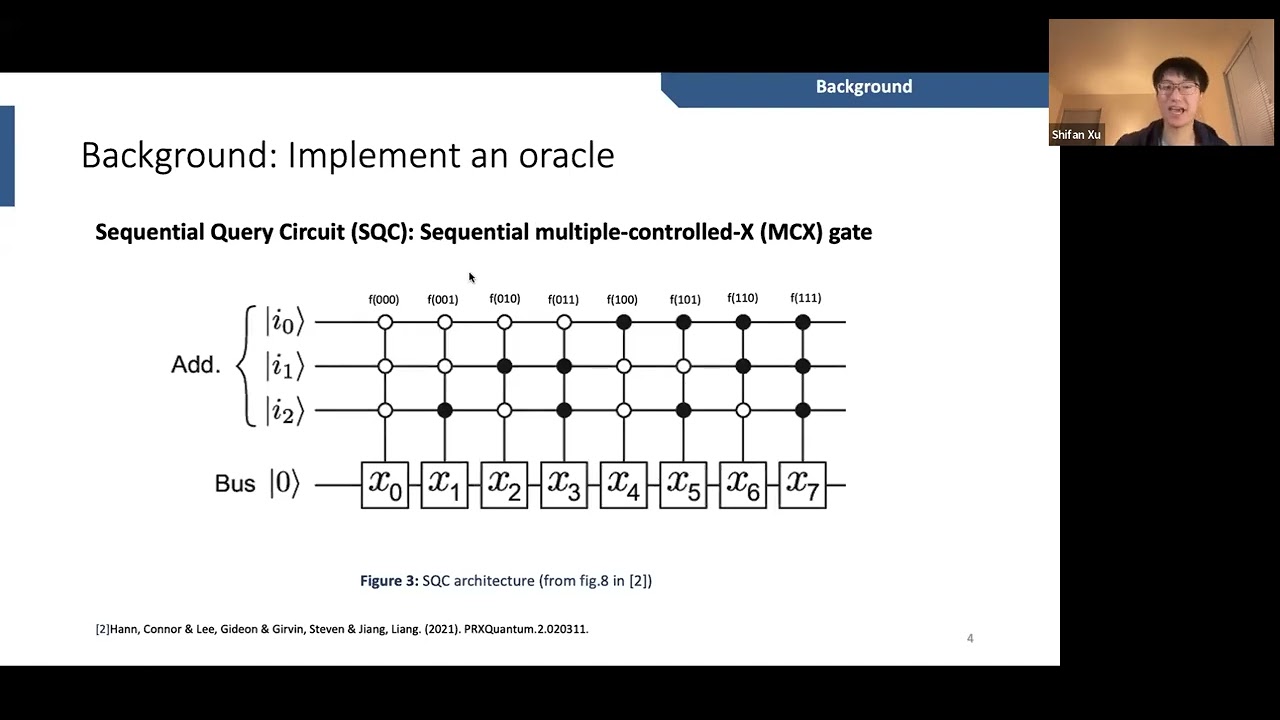
- Sequential Query Circuit (SQC) presented: exponential circuit depth in address width, illustrated with a 3-qubit address example.
- Quantum router introduced as the building block of Bucket Brigade QRAM; controlled-swap behavior with superposition addressing.
- Bucket Brigade QRAM tree structure: linear circuit depth with exponential qubit overhead; comparison of tradeoffs with SQC.
- Virtual QRAM concept introduced: hybridizing SQC and QRAM to query a larger virtual address space with a smaller physical QRAM.
- Circuit-level optimization: cancelling redundant address-loading stages between block queries; significant savings in T-count and Clifford depth.
- Hardware mapping: recursive 2D grid embedding of QRAM trees and minimal routing overhead for realistic topologies.
- Teleportation-based routing strategy: constant-depth connectivity via entanglement swapping and Bell-state measurements.
- Summary of results and discussion of the software and hardware controls needed for practical QRAM implementation.
Cited Sources
- Systems Architecture for Quantum Random Access Memory (arXiv preprint) — The paper associated with this seminar talk, containing the full methodology and results.
Concurring Sources
- Quantum random access memory — Giovannetti, Lloyd & Maccone (arXiv:0708.1879) — The foundational Bucket Brigade QRAM proposal, whose architecture the talk builds upon and optimizes.
- Grover's algorithm — Wikipedia — The algorithm used as the primary example motivating quantum oracles and QRAM in the talk.
Contribution & Novelties
The original contribution is threefold: (1) a hybrid SQC/QRAM circuit architecture (Virtual QRAM) that achieves asymptotically better scaling in space and time compared to either baseline, and allows querying a virtual address space larger than the physical hardware; (2) the first end-to-end compilation framework for embedding large-scale QRAM circuits on 2D Euclidean hardware (grid layout) with minimal routing overhead; (3) a Feynman-path-based simulator enabling efficient noisy QRAM circuit simulation at larger scales than previously possible. The analysis of bias-noise resilience adds practical guidance for deploying the architecture on NISQ or FTQC hardware.
Pour aller plus loin :
- Grover’s algorithm — Wikipedia — The canonical quantum search algorithm whose oracle is the primary motivating use case for QRAM.
- Quantum random access memory — Giovannetti, Lloyd & Maccone (arXiv:0708.1879) — The original Bucket Brigade QRAM proposal, foundational baseline referenced in the talk.
- Quantum error correction — Wikipedia — Relevant to the fault-tolerant quantum computing (FTQC) implications of the proposed architecture.
- Noisy intermediate-scale quantum era — Wikipedia — Context for the NISQ-oriented parts of the talk and noise resilience considerations.
177 words
Radar Profile
The radar profile shows a very high technical level (9) with strong information quantity and quality (8 each), reflecting a dense, expert-oriented presentation. The global reliability (8) is consistent with the academic origin of the work, though the compressed seminar format leaves some technical details referenced rather than fully elaborated.