Improved machine learning algorithm for predicting ground state properties
Keywords
Summary
160 words
Critical Evaluation
Value of the Information & Strength of the Argument
The talk provides a clear and coherent argument for the new algorithm, building on previous work and explaining the key innovations. The speaker justifies the assumptions and provides intuitive explanations for the technical steps. The numerical experiments support the theoretical claims, showing practical feasibility. The presentation is persuasive and well-supported.
Scientific Rigor, Source Quality, Title Accuracy
The talk is based on a peer-reviewed paper available on arXiv (2301.13169). The speaker cites relevant previous work and uses standard tools from quantum information and machine learning. The title accurately reflects the content: an improved algorithm for predicting ground state properties. The talk presents formal proofs and discusses limitations, such as the computational hardness result, indicating high scientific rigor.
125 words
Title / Content Match
The title exactly matches the content: the talk presents an improved machine learning algorithm for predicting ground state properties, with detailed analysis and experiments.
Quality & Reliability
9/10
The presentation is based on a rigorous arXiv paper (2301.13169), with formal proofs, detailed algorithm description, and supporting numerical experiments. The speaker clearly explains the theoretical contributions and validates them with computational results.
Key Moments
Markers derived by PSI from the transcript: the creator did not define chapters.
- Introduction and motivation for finding ground states
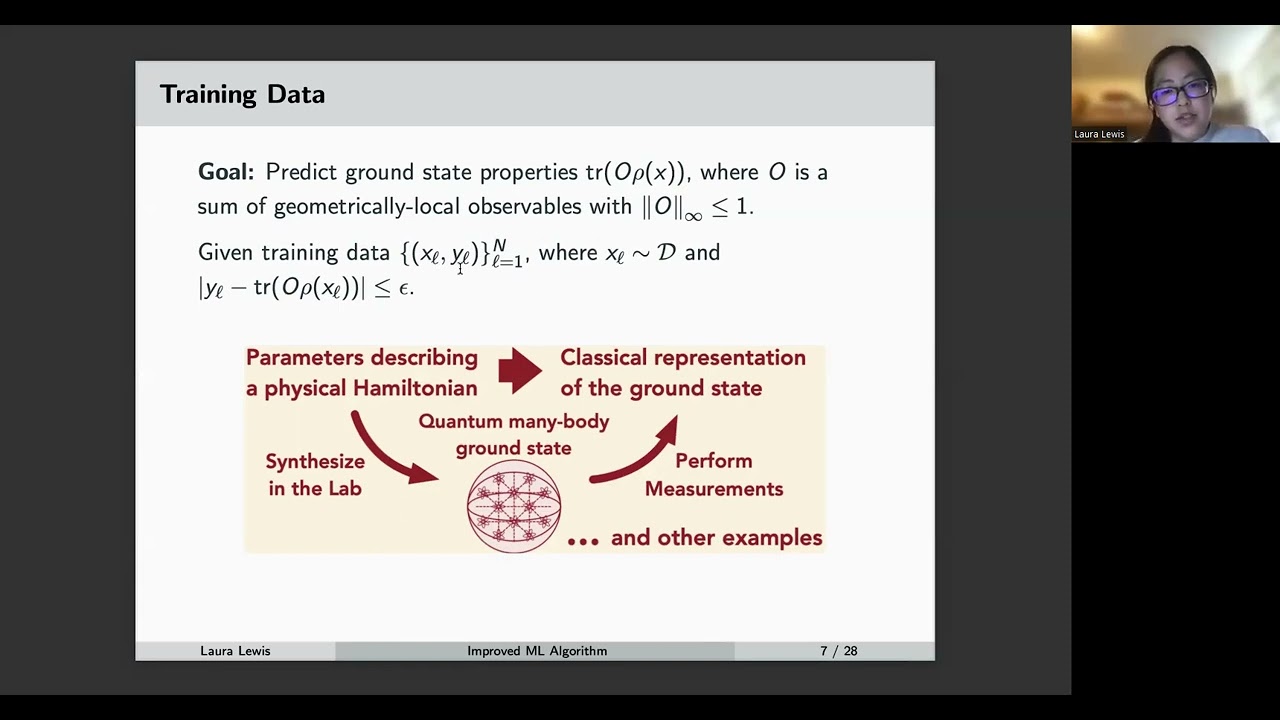
- Problem statement and formal definition of ground state property prediction
- Overview of the machine learning algorithm and feature mapping
- Main result: logarithmic sample complexity improvement
- Proof ideas: simplifications using spectral flow and Lieb-Robinson bounds
- Numerical experiments on 2D Heisenberg model
Cited Sources
- Improved machine learning algorithm for predicting ground state properties — The paper describing the algorithm and results presented in the talk.
Contribution & Novelties
103 words
Radar Profile
The radar profile shows high scores across all dimensions, with particularly strong technical level and information quality, reflecting the advanced nature of the talk. The quantitative and qualitative information are both substantial, and the reliability is high due to rigorous proofs and published results.