Barren plateaus are swamped with traps
Keywords
Summary
197 words
Critical Evaluation
Value of the Information & Strength of the Argument
The talk offers a conceptually valuable reframing: instead of treating barren plateaus and local minima as separate phenomena, it shows they can be causally linked. The argument is built on a simple but powerful observation: if the total loss has a barren plateau, each individual loss term also tends to be concentrated, so local minima of individual terms can survive as local minima of the total loss. The speaker is careful to flag that this is not formally always true, giving the example of frustrated Hamiltonians where individual terms may not be flat even if the sum is. The quantitative part relies on a restricted class of Clifford VQAs, and the speaker acknowledges this restriction while claiming it covers most reasonable VQAs except those with correlated angles. The key technical step is the discretization of the variance as a sum over Clifford points, which allows counting non-zero configurations. The argument that these points are likely to be poor local minima is plausible but, as the speaker admits, the hardest part is proving uncorrelatedness. The talk is honest about what is proven versus conjectured, and the audience questions probe the assumptions, which strengthens the overall argumentation.
Scientific Rigor, Source Quality, Title Accuracy
The talk is based on a single preprint, arXiv:2405.05332, which is directly cited in the description. The speaker also references prior work by Bittel and Kliesch on NP-hardness of VQA training, and by Anschuetz and Kiani on local minima in shallow circuits, as well as the work by Eric Kitz and Bakani on barren plateaus and traps. These references are mentioned by name but not linked in the description. The title matches the content well: the central claim is that barren plateaus are swamped with traps, i.e., poor local minima. The presentation is technically rigorous, with explicit assumptions and a clear distinction between proven results and conjectures. The main limitation is that the transcript is truncated, so the full proof and conclusions are not available for assessment. No advertising sequence is present in the transcript.
345 words
Title / Content Match
The title accurately reflects the core claim: barren plateaus are shown to coexist with exponentially many poor local minima, described as traps. The content delivers on this promise, though the transcript cuts off before the full quantitative proof is presented.
Quality & Reliability
8/10
The talk presents a preprint with a clearly stated abstract, a named author and affiliation, and a direct arXiv reference. The reasoning is structured, the assumptions are explicitly flagged (Clifford VQAs, uncorrelated angles, polynomial-size Pauli sums), and the speaker distinguishes proven results from conjectures. The main limitation is that the transcript is truncated and the talk is a seminar-style presentation rather than a peer-reviewed publication, so some claims remain provisional.
Key Moments
Markers derived by PSI from the transcript: the creator did not define chapters.
- Introduction of the speaker and the topic: barren plateaus can coexist with local minima.
- Overview of variational quantum algorithms and the two main training problems: local minima and barren plateaus.
- Discussion of local minima in shallow circuits and the overparameterization regime.
- Explanation of barren plateaus as vast flat regions and their connection to the curse of dimensionality.
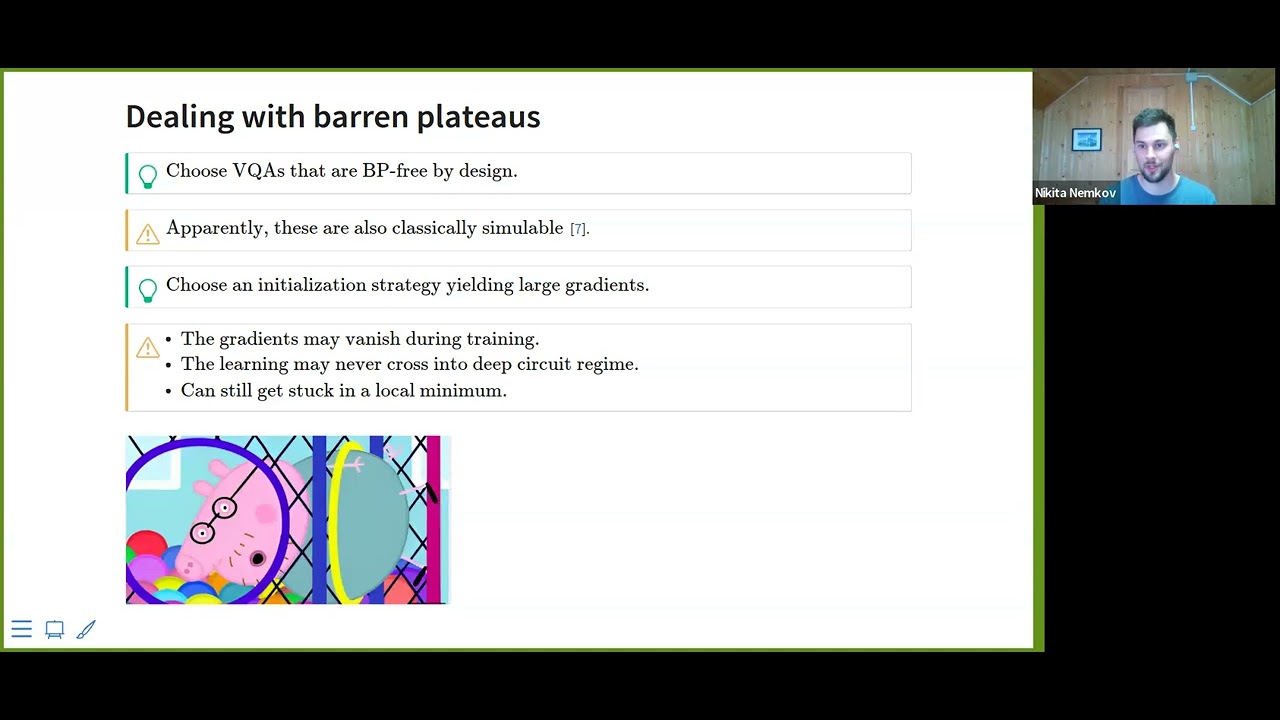
- Proposals to avoid barren plateaus: design and smart initialization, and their limitations.
- Central argument: if the total loss has a barren plateau, each individual term also has one, leading to poor local minima.
- Definition of barren plateaus quantitatively via variance of the loss.
- Introduction of Clifford VQAs and the discretization of variance over Clifford points.
- Key corollary: exponentially many Clifford points have non-zero loss values.
- Description of the local structure as narrow gorges with flat directions.
Cited Sources
- Barren plateaus are swamped with traps — The preprint on which the talk is based, cited in the description.
Concurring Sources
- Training Variational Quantum Algorithms Is NP-Hard — Cited in the talk as evidence that training VQAs is NP-hard, supporting the difficulty of optimization.
- Beyond Barren Plateaus: Quantum Variational Algorithms Are Swamped With Traps — The work by Anschuetz and Kiani that inspired the title and the central claim about traps.
Contribution & Novelties
The talk presents a novel connection between two central problems in variational quantum algorithms: barren plateaus and local minima. It argues that in the barren plateau regime, exponentially many poor local minima exist, each optimizing only a few terms of the loss function. This challenges the common view that barren plateaus and local minima are separate issues and implies that large gradients alone do not guarantee successful training. The introduction of Clifford VQAs and the discretization of variance over Clifford points provides a new analytical tool for studying these landscapes.
Pour aller plus loin :
- Barren plateau — Wikipedia article providing background on the phenomenon.
- Variational quantum eigensolver — Wikipedia article on a key class of VQAs discussed.
- Clifford algebra — Wikipedia article on the mathematical structure underlying Clifford circuits.
- Bittel and Kliesch, “Training Variational Quantum Algorithms Is NP-Hard” — referenced in the talk as a formal result on training difficulty.
- Anschuetz and Kiani, “Beyond Barren Plateaus: Quantum Variational Algorithms Are Swamped With Traps” — the work that inspired the title and central claim.
174 words
Radar Profile
The radar profile shows very high technical level and strong reliability, with good information quality. The quantity of information is solid but limited by the truncated transcript. Overall, the talk is a rigorous, specialized research presentation.