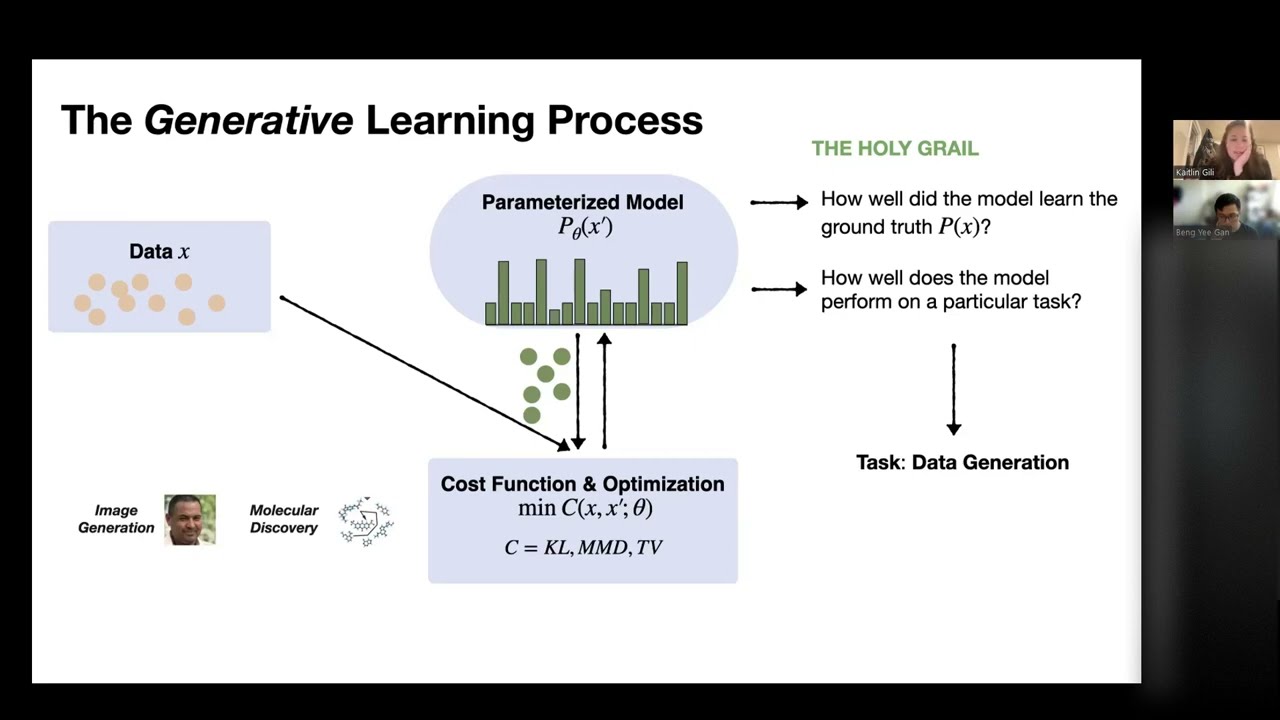
Generative Modeling with Quantum Neurons
Keywords
Summary
136 words
Critical Evaluation
Value of the Information & Strength of the Argument
The presentation offers a strong, well-structured argument for the QNBM as a promising quantum generative model. The speaker systematically motivates the integration of non-linear activations, provides empirical benchmarks against classical models, and acknowledges the limitations of the current study. The results are presented with appropriate scientific caution, noting that quantum advantage is not claimed but that the model shows potential for larger-scale tasks. The argumentation is coherent, supported by data and references, and ends with clear next steps.
Scientific Rigor, Source Quality, Title Accuracy
The research is grounded in a peer-reviewed arXiv paper (2302.00788), which is directly referenced. The speaker explains the methodology clearly, including training details, cost functions, and optimization schemes. Sources are appropriately cited for the quantum neuron subroutine (introduced in a 2017 paper) and the classical RBM benchmark. The title accurately reflects the content: the talk does indeed focus on generative modeling using quantum neurons. The presentation is rigorous, with careful attention to the limitations of the study and the need for further benchmarking.
176 words
Title / Content Match
The title accurately reflects the content, which focuses on generative modeling using quantum neurons (QNBM).
Quality & Reliability
8/10
The talk presents original research with a peer-reviewed arXiv paper (2302.00788) as a direct reference. Methodology and results are described in detail, with clear benchmarking and limitations acknowledged.
Key Moments
Markers derived by PSI from the transcript: the creator did not define chapters.
- Introduction and overview of generative learning
- Definition of generative model and cost functions
- Why quantum circuits fit generative modeling
- Introduction to Quantum Neuron Born Machine (QNBM)
- Key results: QNBM vs QBM on constrained distributions
- Comparison with Restricted Boltzmann Machine (RBM)
- Generalization and learning potential results
- Simulatability discussion and future directions
Cited Sources
- Generative Modeling with Quantum Neurons (arXiv paper) — Main paper presenting the QNBM, including theoretical analysis and benchmarking results.
Concurring Sources
- Generative Modeling with Quantum Neurons — The main reference supporting the claims made in the talk.
Contribution & Novelties
The talk contributes a comprehensive analysis of the Quantum Neuron Born Machine, demonstrating its advantages over classical models and previous quantum approaches. Notably, it shows that the QNBM’s non-linear activations enable superior performance on discrete distributions and that the model exhibits generalization beyond the training set. The work also provides evidence of non-trivial classical simulability. To explore these topics further:
Pour aller plus loin :
- Quantum machine learning — Overview of the field context.
- Restricted Boltzmann machine — Classical model used for comparison.
- Kullback-Leibler divergence — Cost function used in training.
91 words
Radar Profile
The profile shows high scores across all dimensions, indicating a technically deep, well-sourced, and original research presentation. The absence of discordant sources and the strong quality of information suggest a reliable and rigorous talk.