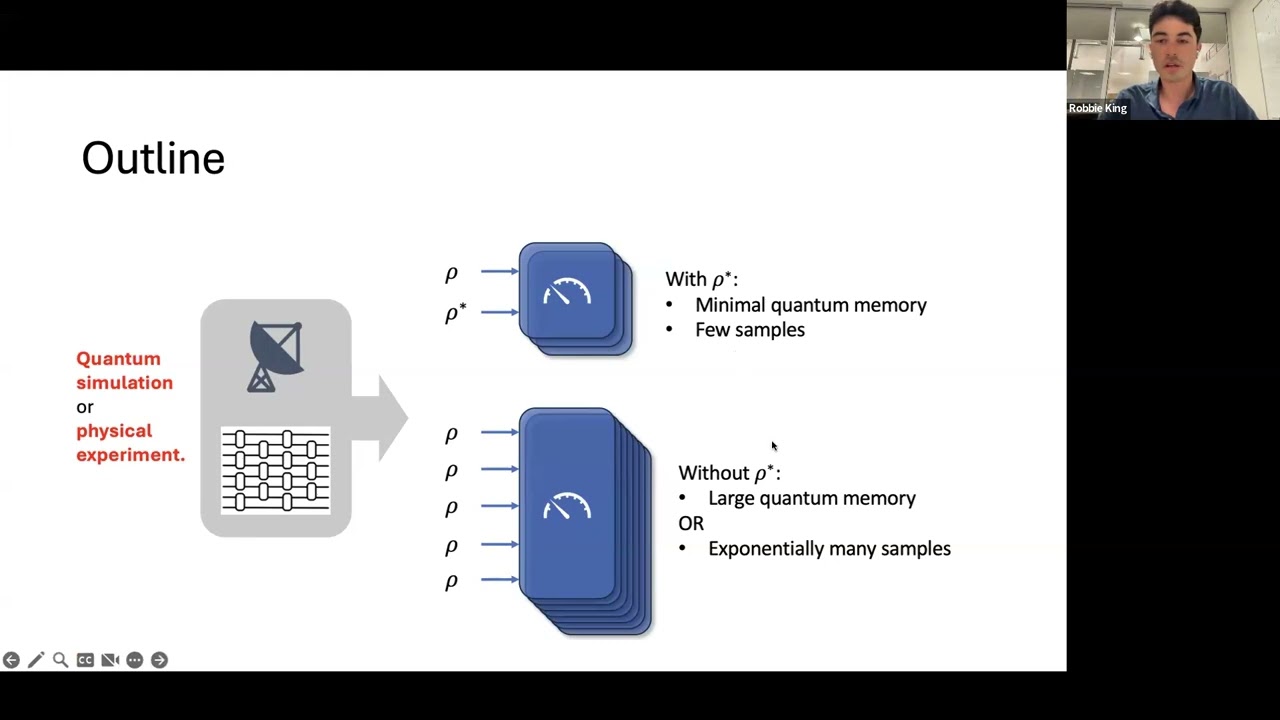
Exponential learning advantages with conjugate states and minimal quantum memory
Keywords
Summary
141 words
Critical Evaluation
Value of the Information & Strength of the Argument
The talk provides substantial value by introducing a new quantum resource (the complex conjugate state) that yields exponential improvements in shadow tomography. The argumentation is strong: the speaker starts with the known results, explains the difficulty with non-commuting observables, and then shows how the conjugate state resolves the commutation issue. The reasoning is clear and supported by mathematical derivations. The presentation is well-structured, and the speaker effectively communicates complex ideas to a specialized audience.
Scientific Rigor, Source Quality, Title Accuracy
The content is derived from a research paper by the speaker, and the talk includes references to previous work (e.g., Scott Aaronson’s shadow tomography). The arXiv link provided in the description is the primary source. The title precisely reflects the content: exponential learning advantages with conjugate states and minimal quantum memory. The talk is rigorous in its mathematical treatment, and the speaker acknowledges limitations and open questions. The presentation is honest about the assumptions and the implications.
166 words
Title / Content Match
The title accurately reflects the content: the talk presents exponential learning advantages when using conjugate states with minimal quantum memory.
Quality & Reliability
8/10
High technical accuracy, based on a peer-reviewed research paper presented by the author, with clear logical progression.
Key Moments
Markers derived by PSI from the transcript: the creator did not define chapters.
- Introduction to quantum learning tasks and motivation.
- Background on shadow tomography and sample complexity.
- Previous results on commuting observables and entangled measurements.
- Main theorems: single-copy and multiple-copy lower bounds.
- The advantage of using conjugate states and the generalized Bell basis.
- Application to bosonic physics and displacement operators.
- Proof ideas and reduction to distinguishing tasks.
Cited Sources
- Exponential learning advantages with conjugate states and minimal quantum memory — Primary research paper presented in the talk.
Contribution & Novelties
The main novelty is the identification of the complex conjugate state as a new quantum resource that provides exponential advantages in shadow tomography with minimal quantum memory. This expands the class of tasks where such advantages are provable. The paper also provides a precise analysis of classical shadows under generalized Clifford ensembles and gives a class of efficiently learnable quantities. The approach has potential applications in quantum simulation, sensing, and discovering new physical phenomena.
Pour aller plus loin :
- Shadow Tomography of Quantum States — Foundational paper by Scott Aaronson defining shadow tomography.
- Weyl algebra — Mathematical structure underlying Heisenberg-Weyl operators used in the talk.
- Boson — Particle type relevant to bosonic systems discussed in the context of displacement operators.
120 words
Radar Profile
The profile shows high technical level and reliability, with moderate information quantity but excellent quality content, resulting in a strong overall assessment.