Exponentially Improved Efficient Machine Leaning for Quantum Many body States
Keywords
Summary
159 words
Critical Evaluation
Value of the Information & Strength of the Argument
The information is of high value as it provides a substantial theoretical improvement in sample complexity for learning quantum states, addressing a critical limitation of existing approaches. The argumentation is logical and rigorous, building from the background and prior work to the formulation of the problem, the introduction of positive good kernels, and the derivation of polynomial bounds. The use of mathematical proofs and the connection to PAC learning theory strengthen the credibility of the claims.
Scientific Rigor, Source Quality, Title Accuracy
The scientific rigor is high: the talk is based on a preprint on arXiv, and the speaker refers to a published Science paper and other related works. The sources are reputable, and the presentation includes mathematical derivations and numerical verification. The title is accurate and descriptive of the content, though it contains a minor typo. The talk’s structure is clear and well-organized, though the network issues during the live presentation slightly affect the delivery but not the content.
169 words
Title / Content Match
The title accurately reflects the content, focusing on an exponentially improved machine learning method for quantum many-body states with provable guarantees.
Quality & Reliability
9/10
The talk is based on a rigorous theoretical result with mathematical proofs, published on arXiv, and presented by an expert researcher. The content is highly reliable and represents a significant contribution to the field.
Key Moments
Markers derived by PSI from the transcript: the creator did not define chapters.
- Introduction and motivation for learning quantum many-body states with machine learning.
- Background on computational complexity of many-body problems and introduction to machine learning approaches.
- Review of previous work by Huang et al. and its limitations regarding sample complexity.
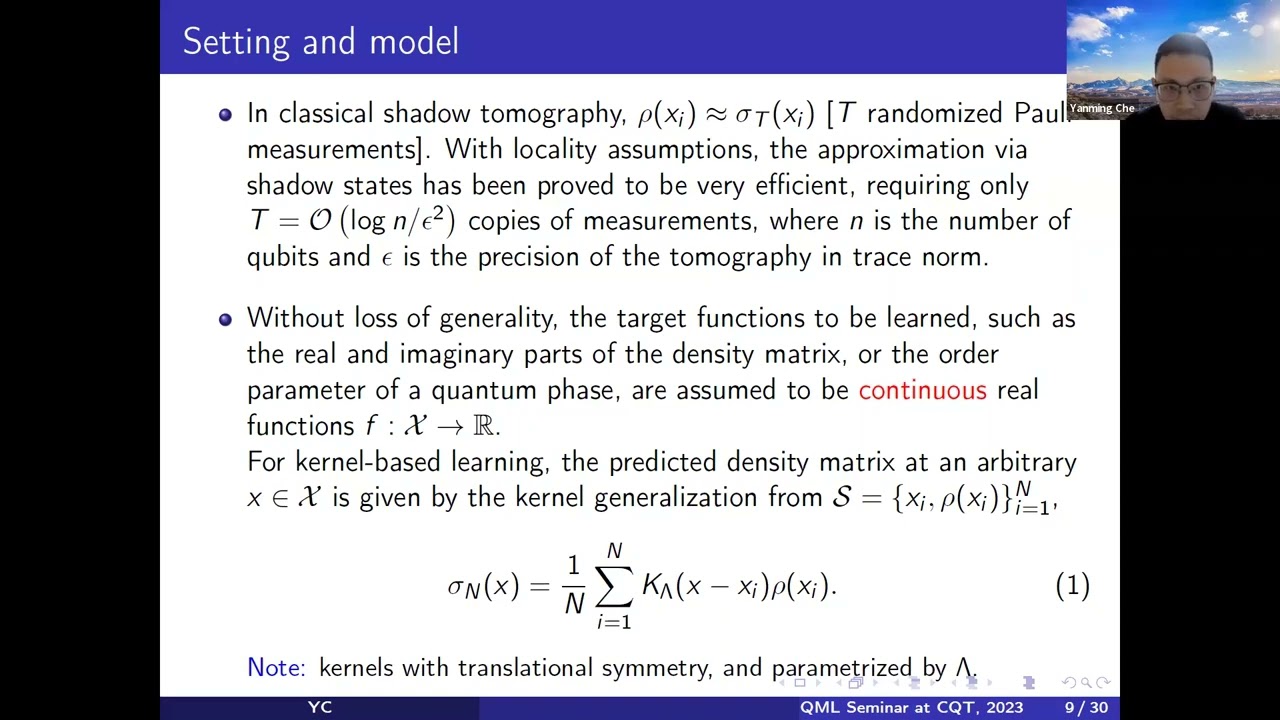
- Introduction of the main contribution: using positive good kernels to preserve density matrix properties and achieve polynomial sample complexity.
- Statement of the main theorems on sample complexity for full state learning and property learning.
- Proof ideas: approximation and generalization errors, triangular inequality, and connections to reproducing kernel Hilbert space.
- Numerical demonstration on the one-dimensional transverse-field Ising model, showing polynomial scaling.
- Conclusion, comparison with existing results, and discussion of related works.
Cited Sources
- Exponentially Improved Efficient Machine Learning for Quantum Many-body States with Provable Guarantees — The paper presenting the main results discussed in the talk.
- Huang et al., Science 377, eabk3333 (2022) — Prior work cited as the baseline with exponential sample complexity.
Concurring Sources
- Huang et al., Science 377, eabk3333 (2022) — The prior work on learning quantum many-body states, which the present study extends and improves upon.
Contribution & Novelties
The talk presents a significant theoretical advancement by demonstrating that the sample complexity for learning quantum many-body states can be dramatically improved from exponential to polynomial when using positive good kernels in a kernel regression framework. This is achieved by preserving the physical properties of the density matrix and leveraging the continuity of the target functions. The work also provides an extension to learning ground-state properties with further reductions under locality assumptions. This contributes to making machine learning-based predictions for quantum systems more practical and opens new directions for future research.
Pour aller plus loin :
- Probably approximately correct learning (PAC learning) — The theoretical framework underpinning the sample complexity bounds.
- Kernel regression — The core method used in the approach for prediction.
- Reproducing kernel Hilbert space (RKHS) — A key concept used in the proof and analysis of the generalization error.
142 words
Radar Profile
The radar profile is highly uniform, with all four dimensions scoring between 8 and 9, indicating a video that is rich in content, technically deep, and highly reliable. The strength lies in the quality and rigor of the information presented, though the quantity is slightly lower due to the focused nature of the talk.