Scalable quantum dynamics compilation via quantum machine learning
Keywords
Summary
187 words
Critical Evaluation
Value of the Information & Strength of the Argument
The presentation offers high informational value by clearly articulating a novel methodological framework that bridges quantum machine learning and quantum circuit compilation. The argumentation is structured and logically progressive: it starts from the motivation of quantum simulation, identifies the limitations of Trotterization and previous VQC approaches (system size and topology constraints), and then introduces the out-of-distribution generalization theorem as a solution to the cost function evaluation bottleneck. The speaker provides concrete numerical evidence, including training and test loss curves for 80-qubit systems, and compares against optimized Trotterization schemes from recent literature. The argument is strengthened by addressing sample complexity, showing that the number of samples scales linearly with circuit volume, and by discussing the practical feasibility of classical simulation (e.g., training on a laptop in 1-2 hours for certain cases). The interactive Q&A further reinforces the argument by clarifying subtle points such as the difference between local and global Haar distributions and the quasi-1D treatment for 2D systems. The main limitation acknowledged is that the 2D extension is not a full 2D treatment but a quasi-1D strip, and the method’s performance on true 2D systems remains an open question.
Scientific Rigor, Source Quality, Title Accuracy
The scientific rigor is high: the work is based on a formal theorem (out-of-distribution generalization) and provides explicit bounds and scaling arguments. The methodology is transparent, with clear descriptions of the cost function, the use of MPS compression, and the optimization procedure (Adam with global updates). The speaker references prior work on Trotterization optimization and acknowledges the non-optimality of standard Trotterization. The source cited is the arXiv preprint (2409.16346), which is the primary reference for this work. The title accurately reflects the content, as the talk focuses on scalable quantum dynamics compilation via quantum machine learning, covering both 1D and quasi-1D 2D systems. The presentation does not overstate claims; it clearly delineates the scope (quasi-1D) and the theoretical guarantees. The absence of peer review is a minor caveat, but the preprint is publicly available for scrutiny.
340 words
Title / Content Match
The title accurately reflects the content: the talk is precisely about scalable quantum dynamics compilation using quantum machine learning, covering 1D and quasi-1D 2D systems.
Quality & Reliability
8/10
The talk presents a peer-reviewed-style research result (arXiv preprint) with explicit theoretical grounding (out-of-distribution generalization bounds), numerical benchmarks against optimized Trotterization, and transparent discussion of limitations (quasi-1D treatment, classical simulation constraints). The speaker is the first author and answers audience questions directly. The main weakness is the absence of peer-review confirmation and the reliance on a single preprint.
Key Moments
Markers derived by PSI from the transcript: the creator did not define chapters.
- Introduction of the speaker and the topic: scalable quantum dynamics compilation via quantum machine learning.
- Motivation: Feynman's quote and the goal of quantum simulation; challenges of quantum supremacy and noisy intermediate-scale quantum devices.
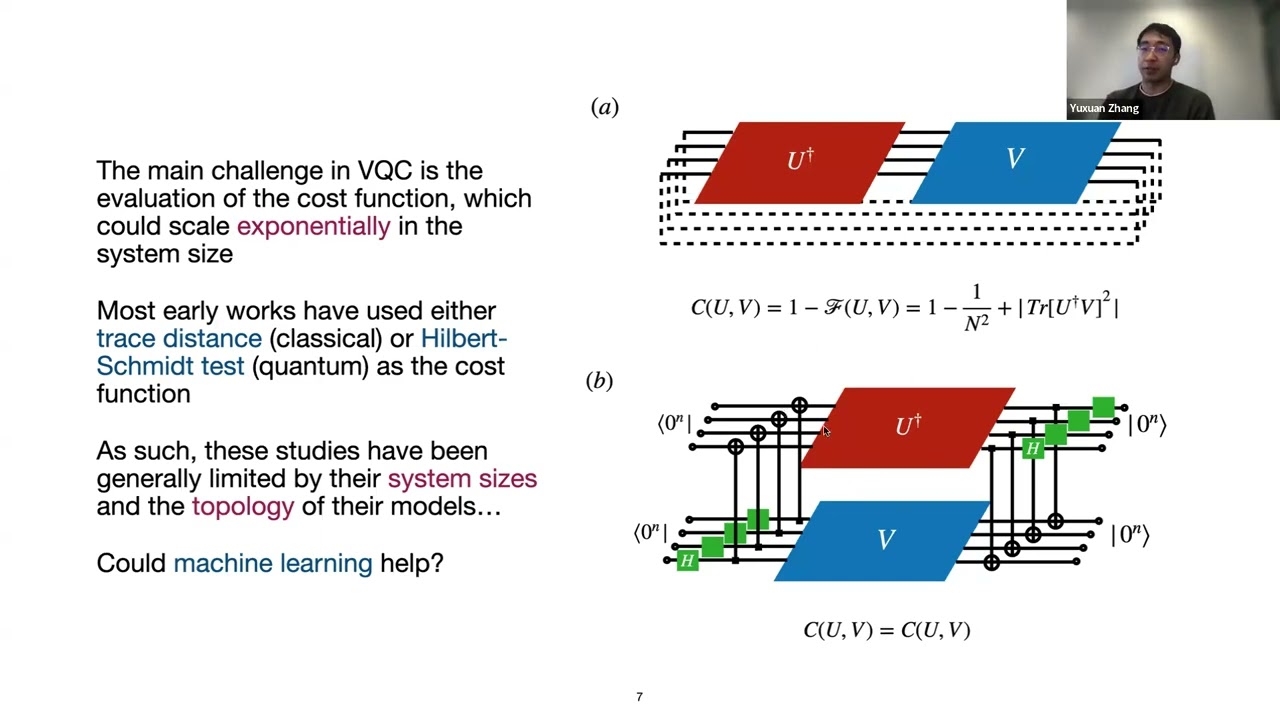
- Explanation of quantum circuit compilation and the variational quantum compilation (VQC) approach.
- Introduction of the out-of-distribution generalization theorem and its application to reduce the cost function to training on product states.
- Discussion of sample complexity: number of samples scales linearly with circuit volume.
- Numerical results for 1D systems: 80 qubits, evolution time 3.5, training with 16 samples.
- Introduction of MPS compression and TDVP for efficient data generation.
- Extension to 2D strips via quasi-1D treatment and comparison with Trotterization.
- Results: orders of magnitude improvement in error for same CNOT count compared to optimized Trotterization.
Cited Sources
- Scalable quantum dynamics compilation via quantum machine learning — The primary arXiv preprint by Yuxuan Zhang et al., which is the subject of this talk.
Contribution & Novelties
The key novelty of this work is the application of out-of-distribution generalization from quantum machine learning to the problem of quantum dynamics compilation. By training on a small dataset of product states, the method achieves a unitary circuit that generalizes to highly entangled Haar-random states, overcoming the prohibitive cost of evaluating the global Haar-random cost function. This allows the use of tensor network methods (MPS compression) to efficiently generate training data, enabling scaling to 80 qubits in 1D and, for the first time, to 2D strips via a quasi-1D treatment. The approach demonstrates orders of magnitude improvement in accuracy over optimized Trotterization for the same CNOT count, highlighting its potential for near-term quantum processors.
Pour aller plus loin :
- Variational quantum eigensolver — Background on variational quantum algorithms, closely related to VQC.
- Matrix product state — Explanation of the tensor network method used for data compression.
- Trotterization — Context on the standard method for quantum dynamics simulation that this work improves upon.
- Out-of-distribution generalization in quantum machine learning — The theoretical foundation for the generalization guarantees used in this work (reference to Caro et al.).
185 words
Radar Profile
The radar profile shows a strong emphasis on technical depth and information quality, with high scores in quantity and quality of information, and an exceptionally high technical level. Reliability is also high, reflecting the rigorous theoretical and numerical grounding. The only slight dip is in global reliability due to the preprint status, but overall the profile indicates a highly specialized and credible research presentation.