Noise induced shallow circuits and absence of barren plateaus
Keywords
Summary
234 words
Critical Evaluation
Value of the Information & Strength of the Argument
The informational value of this talk is high for anyone working on near-term quantum algorithms, because it attacks a modelling assumption that is almost universally adopted in the literature — that noise is depolarizing — and shows that relaxing it reverses a headline conclusion. The argument is built as a clean logical chain: depolarizing noise drives states to the maximally mixed state, hence exponential concentration of Pauli expectation values, hence barren plateaus and classical simulability; non-unital noise breaks the first step, and therefore the two consequences. The speaker is careful to state the scope of each claim: the absence of barren plateaus is proven for local cost functions and for any non-unital noise, while global cost functions still concentrate exponentially. He also quantifies the locality of trainability, showing that the variance of the partial derivative decays exponentially with the distance from the end of the circuit and with the Pauli weight, so only the last logarithmic layers carry trainable parameters. A particularly strong element of the argumentation is the treatment of mixed noise: the speaker states that there is no threshold, and that an arbitrarily small non-unital component dominates a unital one, with the caveat that if the non-unital parameter is exponentially small in the number of qubits the results no longer apply. The classical simulation algorithm is presented as a constructive consequence of effective shallowness rather than as an isolated claim, which strengthens the overall coherence. The main limitation acknowledged by the speaker is that the indistinguishability statement holds on average over the circuit ensemble, not in the worst case, and he explicitly cites counterexamples where engineered non-unital noise enables long computations. This honesty about the average-case nature of the result is what makes the argument credible rather than overreaching.
Scientific Rigor, Source Quality, Title Accuracy
The scientific rigour is high. The speaker distinguishes systematically between theorems, corollaries and open questions, states the assumptions of each result (locality of the noise, non-unitality, Pauli weight of the observable, dimensionality of the architecture), and gives the scaling of every bound. He also positions the work against prior literature: the depolarizing-noise results on barren plateaus and on the classical simulability of random circuit sampling, the work on quantum refrigerators showing that the nature of the noise matters for error correction, and the recent results showing that both the easiness and the hardness proofs for random circuit sampling fail under non-unital noise. He explicitly notes that the complexity of sampling from noisy random circuits remains open. The source base is essentially the arXiv preprint cited in the description, which is the primary reference for the talk, plus the surrounding literature named orally. The title is fully adequate to the content: the two announced contributions, noise-induced shallow circuits and absence of barren plateaus, are precisely the two main theorems developed. No comments were provided for analysis.
481 words
Title / Content Match
The title matches the content precisely: the talk is devoted to noise-induced effective shallowness of quantum circuits and to the absence of barren plateaus under non-unital noise.
Quality & Reliability
9/10
Seminar presentation of a peer-oriented theoretical result by the paper's first author, with explicit statements of assumptions, theorems and corollaries, and a direct arXiv reference. The reasoning is transparent, the speaker distinguishes clearly between what is proven, what is conjectured and what remains open, and answers audience objections on the spot. No sensationalism, no unsupported claims.
Key Moments
Markers derived by PSI from the transcript: the creator did not define chapters.
- Spoiler of the main results: only the last log n layers matter for Pauli expectation values, absence of barren plateaus for local cost functions, and classical estimation of Pauli expectation values.
- Review of depolarizing noise: convergence to the maximally mixed state at depth beyond logarithmic, trivial classical simulation, and exponential decay of Pauli expectation values.
- Definition of unital versus non-unital noise channels, with amplitude damping and T1 errors as hardware-relevant non-unital examples.
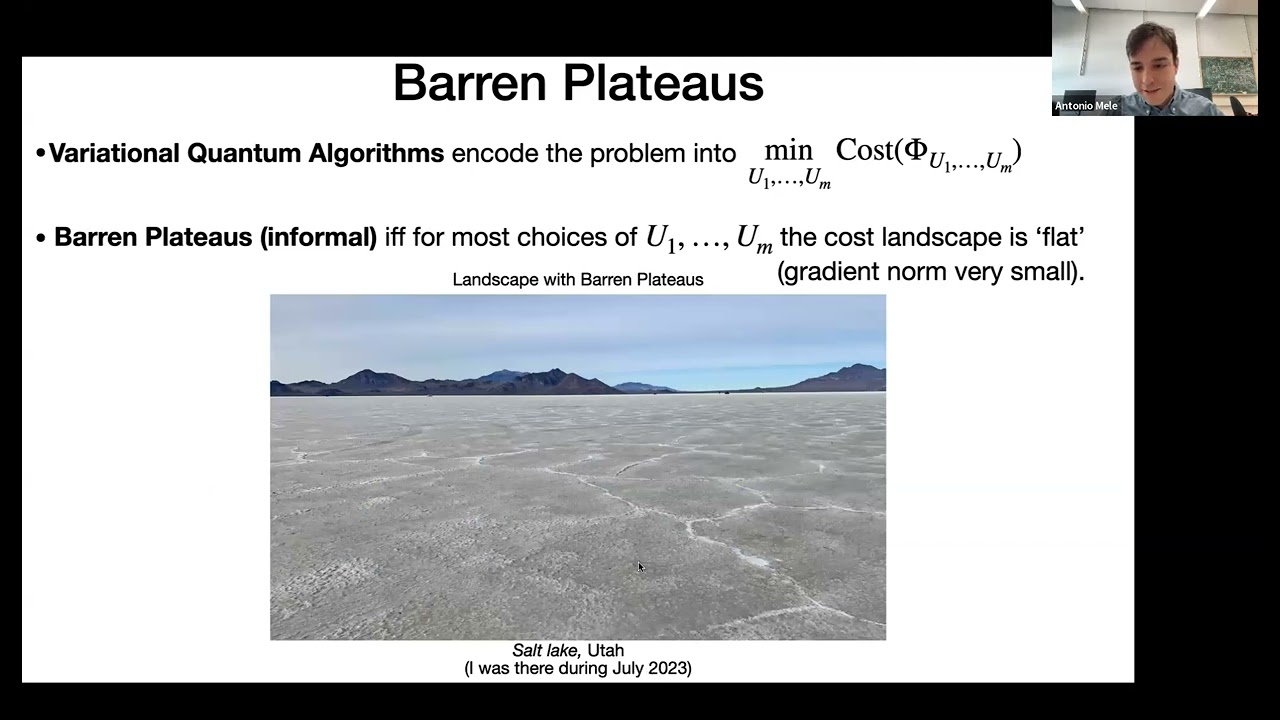
- Introduction to variational quantum algorithms and the barren plateau phenomenon, including the variance-of-gradient criterion for trainability.
- Audience question on the relevance of random circuit ensembles to variational algorithms; the speaker clarifies that the results concern random initialization in the absence of a clever initialization strategy.
- Main result: absence of barren plateaus for local cost functions under any non-unital noise, with variance of the cost bounded below by a constant.
- Partial derivative bounds: exponential suppression with distance from the end of the circuit and with Pauli weight, with matching lower bound for local observables in the last logarithmic layers.
- Audience question on mixed unital and non-unital noise; answer that there is no threshold and that any non-zero non-unital parameter gives the result, unless it is exponentially small in the number of qubits.
- Effective shallow circuits: truncating the circuit to its last K layers suffices for an exponentially accurate estimate of any Pauli expectation value.
- Average-case indistinguishability of the outputs of two different input states at linear depth, and discussion of engineered non-unital noise enabling long computations.
Cited Sources
- Noise-induced shallow circuits and absence of barren plateaus (arXiv:2403.13927) — Primary preprint presented in the talk, by Antonio Anna Mele, Armando Angrisani, Soumik Ghosh, Sumeet Khatri, Jens Eisert, Daniel Stilck França and Yihui Quek.
Concurring Sources
- Noise-induced shallow circuits and absence of barren plateaus (arXiv:2403.13927) — The preprint itself, whose abstract matches the results presented in the talk.
Contribution & Novelties
The talk’s original contribution is to move the analysis of noise in quantum circuits beyond the depolarizing assumption that dominates the literature, and to show that this move reverses a central negative result. Under depolarizing noise, exponential concentration of Pauli expectation values and barren plateaus are unavoidable at depth beyond logarithmic. The authors prove that under any non-unital noise, local cost functions retain a constant variance and the gradient norm squared has constant expectation, so the last logarithmic layers remain trainable. Simultaneously, they prove that any non-unitary noise truncates most circuits to effectively logarithmic depth for Pauli expectation value estimation, and they exploit this to build a classical algorithm whose runtime is independent of circuit depth, polynomial in the number of qubits in one dimension and quasi-polynomial in higher dimensions. The combination is notable: the same noise that removes barren plateaus also makes the circuit classically simulable for this task, which weakens the case for noisy variational quantum machine learning proposals that output Pauli expectation value estimates. The work also frames the open question of the complexity of sampling from non-unital noisy random circuits.
Pour aller plus loin :
- Barren plateaus — Wikipedia entry giving the general context and the variance-of-gradient criterion used throughout the talk.
- Quantum depolarizing channel — Reference for the unital noise model that the talk contrasts with non-unital noise.
- Amplitude damping — Canonical non-unital channel, cited by the speaker as the hardware-relevant example of T1 noise.
- Quantum circuit sampling — Background on the random circuit sampling experiments whose easiness and hardness proofs are discussed as open under non-unital noise.
263 words
Radar Profile
The profile is that of a specialised theory seminar: maximum technical level, high information density and high reliability, with a slightly lower quantity score because the talk is a single coherent result rather than a broad survey. The low view count is typical of advanced quantum information content and does not reflect the quality of the material.