Exponential concentration in quantum kernel methods
Keywords
Summary
222 words
Critical Evaluation
Value of the Information & Strength of the Argument
The informational value of this talk lies in the transfer of a well-established result from variational quantum algorithms to the quantum kernel setting, and in the precise identification of where the analogy holds and where it breaks. The argument is built in two clearly separated parts: first a pedagogical reconstruction of barren plateaus, then the transposition to kernels. The central conceptual move is to replace the parameter vector by the pair of input data points, which allows the same curse-of-dimensionality reasoning to apply to the Gram matrix entries rather than to a loss landscape. This is a genuine analytical contribution rather than a restatement: the speaker derives concentration bounds for each of the four sources and shows that the concentration point itself can vanish exponentially for global fidelity kernels. The most valuable part of the argument is the consequence analysis. The speaker does not merely claim that concentrated kernels are hard to estimate; he shows, via a hypothesis-testing framework, that shot-estimated kernel values become statistically indistinguishable from samples of a fixed distribution, hence independent of the input data. This converts a numerical-precision concern into a statement about the model’s information content, which is a stronger and more useful claim. The argument is further strengthened by the ridge-regression example, where the model achieves perfect training accuracy by memorizing labels while failing to generalize, and by the observation that adding training data does not help once shot noise is included. The reasoning is internally consistent and the speaker is careful to distinguish what is proven analytically from what is verified by simulation. Weaknesses are mostly presentational: the derivations are sketched rather than shown, several steps are deferred to the paper, and the informal delivery occasionally obscures the logical chain. The claim that exponential concentration is ’everywhere’ is asserted with reference to companion work rather than demonstrated within the talk itself.
Scientific Rigor, Source Quality, Title Accuracy
The scientific rigor is high. The work is published in a peer-reviewed journal, the concentration bounds are derived analytically rather than inferred from numerics alone, and the numerical simulations serve as verification rather than as the primary evidence. The speaker explicitly separates the four sources of concentration and assigns a bound to each, which is the kind of structured claim that can be independently checked. He also acknowledges the limits of the result, noting that exponential concentration is not the only obstacle in QML and that other issues such as local minima and the design of good learning problems remain open. The source base is narrow but appropriate: the talk is a presentation of a single study, and the only external reference explicitly offered to the audience is a review article on barren plateaus, mentioned without a full citation in the spoken text. The description provides exactly one link, the Nature Communications paper, which is the primary source and is consistent with the content of the talk. No competing or dissenting literature is discussed, which is a limitation for a seminar but not a flaw of the underlying study. Regarding title-content adequacy, the title matches the content closely: the talk is indeed about exponential concentration in quantum kernel methods, with the first part serving as necessary background on barren plateaus. The title is neither broader nor narrower than what is delivered. No viewer comments were provided for analysis.
561 words
Quality & Reliability
8/10
The talk presents a peer-reviewed study published in Nature Communications, with analytically derived concentration bounds for four identified sources (data-embedding expressivity, global measurements, entanglement, noise), verified through numerical simulations. The reasoning is rigorous and the limitations are stated explicitly. Minor deductions for the informal seminar format, the absence of detailed quantitative results in the spoken presentation, and the reliance on the audience consulting the paper for full derivations.
Key Moments
Markers derived by PSI from the transcript: the creator did not define chapters.
- Introduction of the speaker and his background at Chulalongkorn University in Bangkok.
- Definition of a machine learning model as a parameterized function, with linear regression and deep networks as examples.
- Motivation for quantum machine learning: hoping for quantum advantage with less training data and higher accuracy.
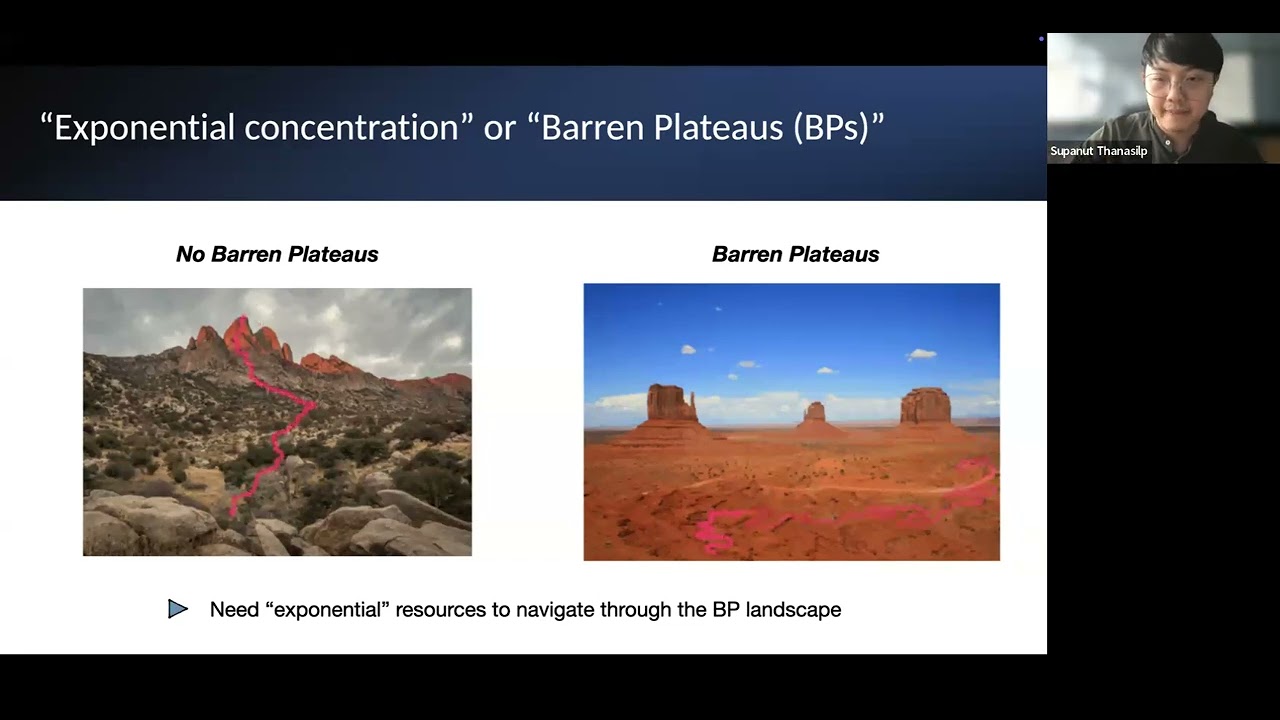
- Introduction of barren plateaus in variational quantum algorithms and the flat loss landscape picture.
- Formal definition of barren plateaus via exponentially vanishing variance of the loss function.
- Explanation of the curse of dimensionality: loss functions as inner products of exponentially large objects.
- Transition to quantum kernels and the question of how barren plateau results generalize.
- Introduction to kernel methods, feature maps, and the quantum kernel as a similarity measure between data-encoded states.
- Convexity of kernel training and the fact that quantum hardware is only needed to estimate the Gram matrix.
- Transposition of exponential concentration from parameter space to input data space at the embedding step.
- Swap test analysis showing that concentrated kernels yield measurement outcomes indistinguishable from uniform noise.
- Hypothesis-testing argument: estimated kernel values become statistically independent of the input data.
- Ridge regression example showing perfect training accuracy through label memorization and poor generalization.
- Conclusion, follow-up work on extreme learning machines and quantum reservoir computing, and acknowledgements.
Cited Sources
- Exponential concentration in quantum kernel methods (Nature Communications) — The primary paper underlying the talk, listed in the video description. It contains the analytical concentration bounds for the four identified sources and the numerical simulations referenced throughout the presentation.
Concurring Sources
- Barren plateaus in quantum neural network training landscapes (Nature Communications) — Foundational result establishing exponentially vanishing gradients in variational quantum circuits, which the talk presents as the direct antecedent of the kernel concentration phenomenon.
- Effect of data encoding on the expressive power of variational quantum machine learning models (Physical Review A) — Study of how data-embedding strategies determine the expressive power of quantum models, consistent with the talk's identification of embedding expressivity as a source of concentration.
Contribution & Novelties
The original contribution is the demonstration that the exponential concentration phenomenon, previously characterized mainly for variational quantum algorithms, reappears in quantum kernel methods but manifests over the input data space rather than over the parameter space. The authors identify four distinct sources of concentration — expressivity of the data embedding, global measurements, entanglement, and noise — and derive an analytical concentration bound for each. The most novel element is the consequence analysis: using a hypothesis-testing framework, they show that when concentration occurs, shot-estimated kernel values become statistically indistinguishable from samples of a fixed distribution, making the trained model provably data-insensitive. This reframes concentration from a numerical-precision problem into an information-theoretic limitation. The ridge-regression construction further shows that a model can achieve perfect training accuracy by memorizing labels while failing to generalize, and that adding training data does not remedy the problem once shot noise is accounted for. The work also extends the analysis to parametrized data embeddings trained with kernel alignment, showing susceptibility to the same exponential concentration.
Pour aller plus loin :
- Barren plateaus — Wikipedia entry providing the background on the variational-algorithm phenomenon that this work transposes to kernels.
- Kernel method — General introduction to kernel methods, feature maps, and the Gram matrix, which are the mathematical objects at the center of the talk.
- Quantum machine learning — Overview of the field, useful for situating quantum kernels among other QML models such as variational circuits and quantum reservoir computing.
- Curse of dimensionality — The underlying geometric intuition invoked by the speaker to explain why inner products of exponentially large objects vanish; no URL given as the exact target page was not certain.
- Kernel alignment — The classical method for training data embeddings mentioned as also susceptible to exponential concentration; cited by name only.
295 words
Radar Profile
The profile is strongly skewed toward technical depth and information quality, reflecting a research-level seminar built on a peer-reviewed analytical result. Information quantity is solid but not maximal, since the talk is a single-study presentation with derivations deferred to the paper. Reliability is high, tempered only by the informal format and the absence of dissenting literature.