Quantum Regularized Least Squares
Keywords
Summary
201 words
Critical Evaluation
Value of the Information & Strength of the Argument
The talk provides a high-value contribution by presenting new quantum algorithms that significantly improve on prior work in quantum least squares. The argumentation is solid, as it builds on well-established frameworks such as block-encoding and QSVT, and the speaker clearly explains each step, from the input model to the final algorithms. The novelty lies in the combination of robust QSVT with variable-time amplitude amplification, leading to better complexity bounds and reduced qubit requirements. The talk also demonstrates the generality of the block-encoding framework, which allows the results to apply to various input models. The speaker’s reasoning for the regularization is well-motivated, addressing both overfitting and ill-posedness. The use of a variable-time algorithm is justified by the varying difficulty in inverting singular values, and the logarithmic overhead in amplitude amplification is a key improvement.
Scientific Rigor, Source Quality, Title Accuracy
The content is based on a peer-reviewed paper published in Quantum Journal, which ensures scientific rigor. The speaker cites the paper explicitly and references prior work on QSVT and variable-time amplitude amplification without providing external URLs, but the presentation is internally consistent. The title ‘Quantum Regularized Least Squares’ exactly matches the topic, and the talk stays focused on this subject throughout. No public comments are available to analyze.
216 words
Title / Content Match
The title accurately reflects the content, which focuses on quantum algorithms for regularized least squares problems.
Quality & Reliability
8/10
The talk presents original research from a peer-reviewed paper published in Quantum Journal, with detailed algorithmic descriptions and a rigorous technical exposition.
Key Moments
Markers derived by PSI from the transcript: the creator did not define chapters.
- Introduction to linear regression, overfitting, and ill-posed problems, leading to the need for regularization.
- Definition of block-encoding as the input model, explaining the unitary encoding and precision parameters.
- Explanation of Quantum Singular Value Transformation (QSVT), its polynomial approximations, and its application to matrix inversion.
- Introduction of variable-time amplitude amplification and how it is combined with QSVT to improve efficiency and reduce ancilla qubits.
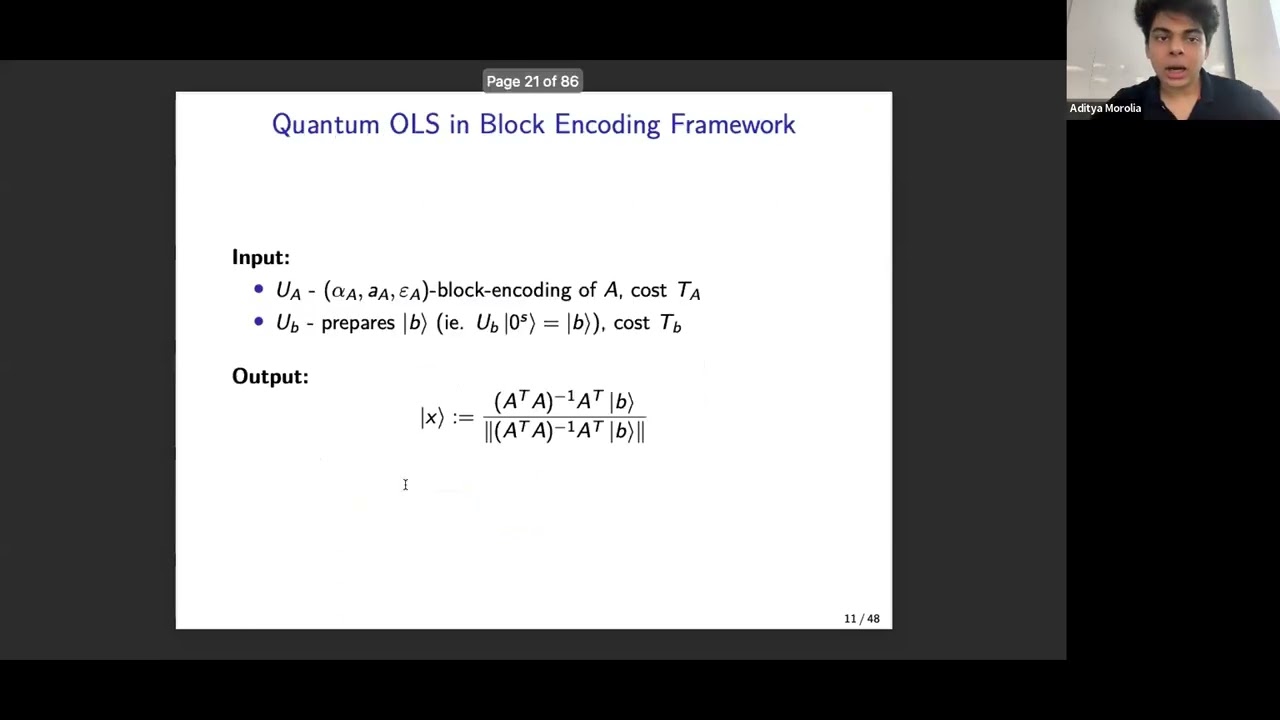
- Construction of the regularized matrix using block-encodings of A and L, and application of matrix inversion to solve the regularized least squares problem.
Cited Sources
- Quantum regularized least squares (paper) — The primary paper this talk is based on, providing the algorithms and complexity results.
Contribution & Novelties
The talk introduces novel quantum algorithms for regularized least squares, improving upon prior quantum ridge regression methods. The key innovations include a robust quantum singular value discrimination subroutine and a variable-time matrix inversion algorithm using QSVT that reduces ancilla qubit requirements to a logarithmic factor. These results are made possible by the block-encoding framework, which generalizes the input model and enables extensions to weighted and generalized least squares.
Pour aller plus loin :
- Quantum singular value transformation and beyond: exponential improvements for quantum matrix arithmetics — The foundational paper on QSVT, which is central to the talk’s techniques.
- Quantum algorithm for linear systems of equations (HHL) — The seminal HHL algorithm for quantum linear systems, which the talk builds upon.
- Variable time amplitude amplification and faster algorithms — The concept of variable-time amplitude amplification, which is used in the talk to improve efficiency.
143 words
Radar Profile
The radar profile shows a balanced high performance across all dimensions, with particularly strong scores in technical level and quantity of information, reflecting a dense, algorithm-focused talk.